If you have ever wondered how big companies manage thousands of orders, employees, inventory items, and financial records without total chaos, the answer often comes down to one system: ERP software.
ERP software meaning is something many students, business owners, and job seekers search for because it sits at the center of modern digital business operations.
From manufacturing companies to online stores and hospitals, ERP systems quietly power everything behind the scenes.
In simple words, ERP helps a business run like one connected brain instead of separate disconnected departments.
In this 2026 updated guide, you will learn what ERP software really means, how it works in real life, why companies depend on it, and how people use it in conversations and professional environments.
By the end, you will understand ERP in a way that actually makes sense, even if you are completely new to business software.
What Does ERP Software Mean?
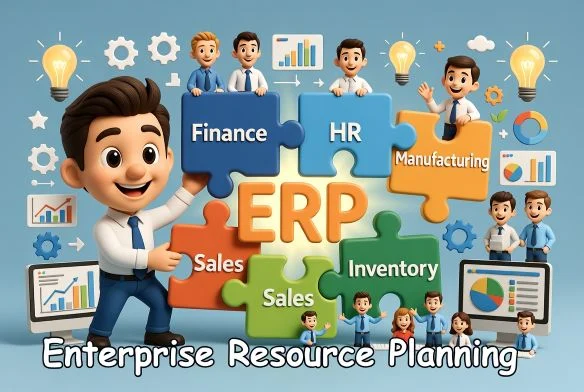
ERP stands for Enterprise Resource Planning. It refers to a type of software that helps organizations manage core business processes in one integrated system.
Quick Answer
ERP software is a centralized system used by businesses to manage finance, inventory, human resources, sales, and operations in one connected platform.
The idea of ERP started evolving in the 1960s with simple inventory management systems used in manufacturing. Over time, it grew into fully integrated business systems in the 1990s as companies needed better control over complex operations.
Today, ERP systems are cloud based, intelligent, and often powered by automation and artificial intelligence.
ERP is not just one tool. It is a full ecosystem that connects different departments so they can share real time data without delays or errors.
How ERP Software Works in Real Businesses
ERP software works by collecting and connecting data from different departments into a single system.
Here is how it typically functions:
- The finance department records transactions
- The sales team updates customer orders
- The inventory system tracks stock levels
- Human resources manages employee records
- Production teams monitor manufacturing progress
All this information flows into one central database.
Instead of each department working separately, ERP ensures everyone sees the same updated data.
For example, when a product is sold online, the ERP system automatically:
- Reduces inventory count
- Updates financial records
- Notifies the shipping department
- Logs customer details
This automation reduces human error and saves time.
Key Features of ERP Software
Modern ERP systems come with powerful features designed to simplify business operations.
1. Centralized Data System
All company data is stored in one secure location.
2. Real Time Updates
Any change in one department instantly reflects across the system.
3. Automation
Repetitive tasks like billing, reporting, and inventory tracking are automated.
4. Financial Management
Tracks expenses, revenue, taxes, and budgeting.
5. Human Resource Management
Manages employee hiring, attendance, payroll, and performance.
6. Supply Chain Management
Handles procurement, logistics, and inventory flow.
7. Reporting and Analytics
Generates detailed reports for decision making.
These features make ERP one of the most important tools in modern business technology.
Real Conversation Examples Using ERP Software Meaning
To understand ERP in a real context, here are everyday usage examples:
Example 1 Between colleagues
Aisha: Our inventory numbers are always off
Ali: We need ERP software to sync everything automatically
Meaning: Ali is suggesting a system to unify data across departments
Example 2 In office meeting
Manager: Why is billing delayed
Employee: The ERP system has not updated new orders yet
Meaning: The system controls billing flow across departments
Example 3 Business discussion
Owner: How do big companies manage everything so smoothly
Consultant: They rely on ERP systems for complete integration
Meaning: ERP is the backbone of large scale operations
Example 4 IT team chat
Developer: We are integrating CRM with ERP software
Meaning: Different systems are being connected for better workflow
Example 5 Training session
Trainer: ERP helps you avoid manual spreadsheets completely
Meaning: ERP replaces traditional manual tracking methods
Common Mistakes and Misunderstandings
Many people misunderstand ERP software, especially beginners.
Mistake 1 Thinking ERP is only accounting software
ERP is much broader. It includes finance but also operations, HR, sales, and supply chain.
Mistake 2 Believing ERP is only for large companies
Small and medium businesses also use ERP systems today through cloud solutions.
Mistake 3 Assuming ERP is easy to implement
ERP requires planning, training, and system customization.
Mistake 4 Confusing ERP with simple apps
ERP is a full integrated system, not just a basic tool.
Generational misunderstanding
Older professionals sometimes see ERP as complex, while younger users see it as just another cloud app.
ERP Across Different Platforms and Business Types
ERP software is used differently depending on the industry.
In manufacturing
Tracks production lines, raw materials, and delivery schedules.
In retail
Manages stock levels, online orders, and customer data.
In healthcare
Handles patient records, billing, and hospital resource management.
In education
Manages admissions, attendance, and academic records.
In startups
Helps automate finance and operations without hiring large teams.
ERP systems are now common in both traditional companies and digital businesses.
Related Slang and Business Terms
Here are related terms that often appear with ERP:
- CRM Customer relationship management system
- SCM Supply chain management software
- SaaS Software as a service cloud tools
- HRMS Human resource management system
- ERP integration connecting systems together
- Workflow automation automated business processes
- Business intelligence data driven decision tools
- Cloud ERP internet based ERP systems
- On premises ERP locally installed systems
- Enterprise software large scale business applications
These terms help you understand the broader digital business ecosystem.
FAQs:
What is ERP software in simple words
ERP software is a system that connects all business departments like finance, sales, HR, and inventory into one platform for easier management.
Is ERP software difficult to learn
It depends on the system. Basic usage is simple, but advanced features require training and experience.
Why do companies need ERP systems
Companies use ERP to reduce errors, save time, improve communication, and manage data efficiently.
Is ERP only for big companies
No. Small and medium businesses also use ERP, especially cloud based solutions that are affordable and scalable.
What is the main goal of ERP software
The main goal is to unify business processes and create a single source of accurate real time information.
CONCLUSION:
ERP software is one of the most powerful tools in modern business management. It connects departments, automates tasks, and creates a unified system where everything works together smoothly.
Understanding ERP software meaning helps you see how real companies operate behind the scenes and why digital transformation is so important today.
Whether you are a student, job seeker, or business owner, knowing ERP gives you a strong advantage in the modern digital world.
If you are exploring business technology, ERP is one of the first systems worth understanding deeply because it forms the backbone of global operations.

Hi, I’m John Mark, the voice behind codexao.com, where meanings aren’t just explained, they’re simplified for the way people actually talk today.
I’ve always been curious about words, how they change, how they trend, and how a simple phrase can carry completely different meanings depending on context. That curiosity turned into codexao, a space where I break down slang, text abbreviations, and everyday words into clear, easy-to-understand explanations.