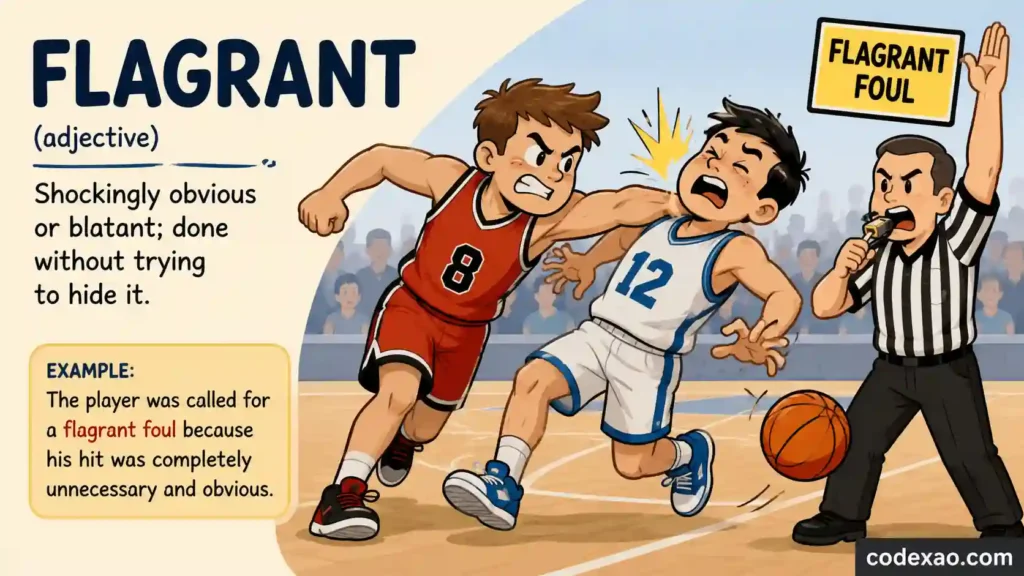
Have you ever read a news headline describing a “flagrant violation” or heard a sports commentator mention a “flagrant foul” and wondered what the word actually means?
Understanding flagrant meaning can instantly improve your vocabulary and help you understand news articles, legal discussions, workplace communication, and everyday conversations.
It’s one of those powerful English words that carries a strong emotional punch.
The term is commonly used when someone breaks a rule, ignores standards, or behaves in a way that is impossible to overlook.
Whether you’re a student, professional, English learner, or simply curious about language, knowing how to use this word correctly can make your communication more precise.
Updated for 2026, this guide explains the meaning of flagrant, where it came from, how people use it today, common mistakes to avoid, and plenty of real-life examples.
What Does “Flagrant” Mean?
Flagrant is an adjective that describes something that is obviously wrong, offensive, shocking, or unacceptable.
The word is most often used when a person, organization, or group commits a serious wrongdoing that is easy for everyone to see.
Quick Answer: Flagrant means clearly and noticeably wrong, offensive, or unacceptable, especially when a rule, law, or standard has been violated.
Origin of the Word
The word flagrant comes from the Latin word flagrare, meaning “to burn” or “to blaze.”
Originally, the idea was that something was so obvious it seemed to blaze before everyone’s eyes. Over time, English speakers began using the word to describe actions and behaviors that stand out because of their seriousness or offensiveness.
How the Meaning Has Evolved
While the original meaning related to something burning brightly, modern English almost always uses flagrant in a negative sense.
Today, you’ll commonly see it in:
- News reports
- Legal documents
- Workplace policies
- Sports commentary
- Academic writing
Pronunciation Guide
Flagrant is pronounced as:
FLAY-gruhnt
The first syllable sounds like “flay.”
How to Use “Flagrant” Correctly in Texts and Chat
Flagrant is generally used to describe serious actions rather than minor mistakes.
Correct Usage
Use flagrant when something is:
- Obviously wrong
- Clearly unethical
- A serious violation
- Hard to ignore
Examples:
- A flagrant violation of company policy
- A flagrant disregard for safety
- A flagrant act of cheating
- A flagrant breach of trust
Tone and Context
The word carries a strong and critical tone.
It suggests that the wrongdoing is not accidental or subtle. Instead, it is obvious and significant.
Platform-Specific Usage
SMS and Text Messages
“That was a flagrant lie.”
“His flagrant disrespect upset everyone.”
“People are calling out the brand for its flagrant copying.”
X
“Another flagrant example of poor leadership.”
“That’s a flagrant abuse of power.”
Discord
“That player got banned for a flagrant rules violation.”
When Not to Use Flagrant
Avoid using flagrant for small mistakes.
Incorrect:
- A flagrant typo
Better:
- A noticeable typo
Incorrect:
- A flagrant spelling mistake
Better:
- A simple spelling error
Formatting Tips
- Usually written in lowercase
- No special punctuation needed
- Often paired with strong words like violation, misconduct, abuse, breach, or foul
Real Conversation Examples Using “Flagrant”
Between Friends
Alex: Did you see Jake copy Sarah’s entire project?
Mia: Yeah, that was a flagrant act of cheating.
Meaning: Mia believes the cheating was obvious and serious.
Dating Scenario
Emma: He was texting three different people at the same time.
Liam: That’s a flagrant breach of trust.
Meaning: Liam sees the behavior as clearly wrong.
Family Discussion
Dad: Your brother ignored every rule we set.
Mom: It was a flagrant disregard for our instructions.
Meaning: The behavior was obvious and intentional.
Workplace Chat
Manager: Why was the safety checklist skipped?
Employee: Honestly, it was a flagrant violation of protocol.
Meaning: The mistake was serious and unacceptable.
Gaming Community
Player 1: He used exploits during the tournament.
Player 2: That’s a flagrant rules violation.
Meaning: The cheating was clear and unfair.
Common Mistakes and Misunderstandings
Using Flagrant for Minor Issues
One of the most common mistakes is exaggerating small problems.
Flagrant should be reserved for major or obvious wrongdoing.
Confusing Flagrant with Fragrant
These words sound somewhat similar but have completely different meanings.
- Flagrant = obviously wrong
- Fragrant = pleasantly scented
Example:
- Correct: A flagrant violation
- Correct: A fragrant flower
Assuming It Means Intentional
While many flagrant actions appear intentional, the word mainly emphasizes how obvious the wrongdoing is.
Something can be considered flagrant even if intent is not fully proven.
Generational Differences
Older generations often encounter flagrant in newspapers, legal writing, and formal discussions.
Younger generations may recognize it from sports broadcasts, online debates, and social media commentary.
“Flagrant” Across Different Platforms and Demographics
Gen Z Usage
Gen Z often uses flagrant online when calling out obvious hypocrisy, cheating, or unfair behavior.
Example:
“That was a flagrant attempt to steal content.”
Millennials
Millennials frequently encounter the term in professional settings, news articles, and workplace discussions.
Older Generations
Older adults often associate flagrant with legal matters, government issues, and formal writing.
Sports Culture
Sports fans hear the word regularly because of the term “flagrant foul.”
A flagrant foul refers to excessive or unnecessary physical contact during a game.
Is It Formal or Informal?
Flagrant is generally considered:
- Professional-friendly
- Appropriate in formal writing
- Acceptable in academic work
- Common in journalism
Is It Safe for Work?
Yes. The word is completely safe for workplace communication and professional writing.
Related Words, Slang, and Alternatives
| Word | Meaning |
|---|---|
| Blatant | Very obvious and impossible to hide |
| Egregious | Extremely bad or shocking |
| Glaring | Easily noticed and often problematic |
| Outrageous | Shockingly unacceptable |
| Obvious | Easy to see or understand |
| Shameless | Showing no embarrassment for wrongdoing |
| Brazen | Boldly improper or disrespectful |
| Audacious | Fearlessly bold, sometimes negatively |
| Unacceptable | Not meeting expected standards |
| Improper | Not appropriate or correct |
Synonyms
- Blatant
- Egregious
- Glaring
- Outrageous
- Open
- Manifest
Antonyms
- Hidden
- Subtle
- Concealed
- Unnoticeable
- Secret
FAQs:
What is the exact flagrant meaning?
Flagrant means clearly wrong, offensive, shocking, or unacceptable. It is commonly used when describing serious violations, misconduct, or behavior that is impossible to ignore.
Is flagrant always negative?
Yes. The word almost always has a negative meaning. It highlights wrongdoing, misconduct, or actions that violate accepted rules or standards.
What is a flagrant violation?
A flagrant violation is a serious and obvious breach of a rule, law, policy, or agreement. The wrongdoing is usually easy for others to recognize.
Can flagrant be used in everyday conversation?
Absolutely. While it sounds slightly formal, many people use it in everyday discussions when describing obvious cheating, dishonesty, or misconduct.
What is the difference between flagrant and blatant?
The two words are very similar. Blatant emphasizes how obvious something is, while flagrant often emphasizes both obviousness and seriousness.
Is flagrant a compliment?
No. Flagrant is not a positive word. It is used to criticize actions, behavior, or situations that are clearly wrong or unacceptable.
Conclusion:
The flagrant meaning is simple yet powerful. It describes behavior, actions, or violations that are so obviously wrong that nobody can reasonably ignore them.
Whether you’re reading news headlines, workplace reports, legal documents, or social media discussions, you’ll often encounter flagrant when someone has crossed a clear line.
Adding this word to your vocabulary can help you communicate with more precision and understand formal English more easily.
The next time you hear about a flagrant violation, a flagrant foul, or a flagrant breach of trust, you’ll know exactly what it means.
Drop your favorite advanced English word in the comments below and keep exploring new vocabulary to sharpen your communication skills.

Hi, I’m John Mark, the voice behind codexao.com, where meanings aren’t just explained, they’re simplified for the way people actually talk today.
I’ve always been curious about words, how they change, how they trend, and how a simple phrase can carry completely different meanings depending on context. That curiosity turned into codexao, a space where I break down slang, text abbreviations, and everyday words into clear, easy-to-understand explanations.