Ever come across “MTBF” in a report, tech discussion, or even a random online thread, and thought, what does that even mean? You’re not alone.
The term MTBF meaning often pops up in engineering, IT, and reliability conversations.
But here’s the twist: it’s not your typical internet slang like “LOL” or “BRB.” Instead, MTBF carries serious weight in industries where performance and uptime matter.
Understanding MTBF can help you make smarter decisions, whether you’re buying tech, managing systems, or just trying to decode technical jargon.
In this guide (updated for 2026), you’ll learn:
- The exact meaning of MTBF
- Where it comes from
- How it’s used in real-world scenarios
- Common mistakes people make
Let’s break it down in plain English.
What Does “MTBF” Mean?
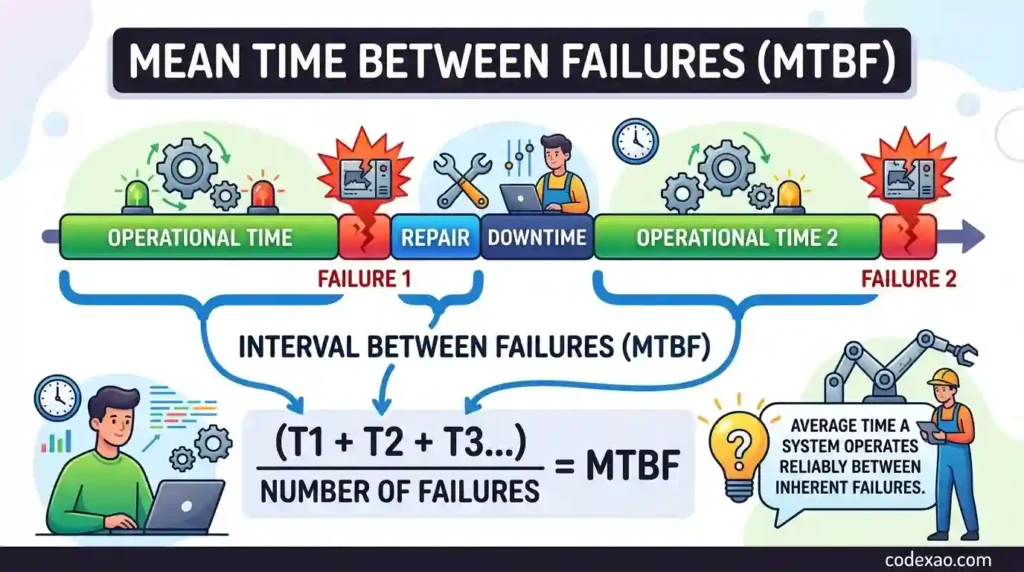
MTBF stands for “Mean Time Between Failures.”
It refers to the average time a system, machine, or component operates before it experiences a failure.
💡 Quick Answer:
MTBF (Mean Time Between Failures) measures how long a system typically runs before breaking down. A higher MTBF means better reliability.
📜 Origin & Background
MTBF comes from reliability engineering and has been widely used since the mid-20th century, especially in:
- Manufacturing
- Aerospace
- IT infrastructure
As systems became more complex, engineers needed a way to predict failures, and MTBF became a standard metric.
🔄 Evolution of Meaning
Originally, MTBF was strictly technical. Today, it’s still mostly used in professional settings, but it occasionally appears in casual online discussions, especially among tech-savvy users.
🔊 Pronunciation
People usually say it letter by letter:
👉 “M-T-B-F”
How to Use “MTBF” Correctly in Texts & Chat
Unlike typical slang, MTBF is not casual texting language. It’s best used in technical or semi-professional conversations.
✅ Correct Contexts
- IT discussions
- Engineering reports
- Product reliability comparisons
- Tech forums (Reddit, Discord)
❌ When NOT to Use It
- Casual chats with friends
- Social media captions
- Non-technical conversations
📱 Platform-Specific Usage
- WhatsApp / SMS: Rare unless discussing work
- Discord / Reddit: Common in tech communities
- LinkedIn: Frequently used in professional posts
- Twitter/X: Used in tech threads
✍️ Formatting Tips
- Always uppercase: MTBF
- Avoid emojis in professional use
- Pair with numbers (e.g., “MTBF of 50,000 hours”)
Real Conversation Examples Using “MTBF”
👥 Between Engineers
A: “What’s the MTBF of this server?”
B: “Around 100,000 hours.”
Meaning: They’re discussing system reliability.
💻 In a Tech Forum
User 1: “Is this SSD reliable?”
User 2: “Yeah, high MTBF rating.”
Meaning: A higher MTBF suggests fewer failures.
🏢 In a Workplace Chat
Manager: “We need equipment with better MTBF.”
Meaning: Looking for more durable systems.
🎮 In a Gaming Server Discussion
Admin: “Server crashes are rare, good MTBF overall.”
Meaning: The server is stable and reliable.
🛠️ In Maintenance Planning
Technician: “Schedule checks based on MTBF.”
Meaning: Maintenance is planned using failure predictions.
Common Mistakes & Misunderstandings
❌ 1. Thinking It’s Slang
MTBF is not like “LOL” or “OMG.” It’s a technical term.
❌ 2. Assuming It Predicts Exact Failure Time
MTBF is an average, not a guarantee.
❌ 3. Confusing It With MTTR
- MTBF = Time between failures
- MTTR = Time to repair
👴 Generational Confusion
Older professionals know it well. Younger users might mistake it for internet slang.
🌍 Regional Differences
Globally recognized in technical fields, no major regional variation.
🌐 “MTBF” Across Different Platforms & Demographics
👶 Gen Z
Rarely used unless in tech fields.
👨💼 Millennials
More familiar, especially in IT or engineering roles.
👴 Older Generations
Common in industrial and engineering sectors.
📊 Platform Popularity
- TikTok: Almost nonexistent
- Instagram: Rare
- LinkedIn: Very common
- Reddit: Frequent in tech subreddits
🧾 Formality Level
- ✅ Professional: Yes
- ❌ Casual: No
🔗 Related Slang, Abbreviations & Alternatives
| Term | Meaning |
|---|---|
| MTTR | Mean Time To Repair |
| MTTF | Mean Time To Failure |
| SLA | Service Level Agreement |
| KPI | Key Performance Indicator |
| Uptime | System availability percentage |
| Downtime | Time system is not working |
| Reliability | Consistency of performance |
| Failure Rate | Frequency of breakdowns |
| Throughput | System performance output |
Learn more about terms like MTTR and uptime to better understand system performance metrics.
FAQs:
What does MTBF stand for?
MTBF stands for Mean Time Between Failures. It measures the average time a system operates before failing, helping assess reliability and performance.
Is MTBF used in texting?
Not really. MTBF is primarily a technical term used in engineering and IT. It rarely appears in casual texting unless the conversation is about technology.
How is MTBF calculated?
MTBF is calculated by dividing the total operating time of a system by the number of failures. For example, if a machine runs 1,000 hours and fails 5 times, the MTBF is 200 hours.
What is a good MTBF value?
A “good” MTBF depends on the system. Higher values generally indicate better reliability. For example, enterprise hardware often has MTBF ratings of tens of thousands of hours.
What’s the difference between MTBF and MTTR?
MTBF measures time between failures, while MTTR (Mean Time To Repair) measures how long it takes to fix a failure. Together, they help evaluate system efficiency.
Conclusion:
MTBF might not be trendy slang, but it’s incredibly important in the real world. Knowing the MTBF meaning helps you understand how reliable a system truly is.
Whether you’re comparing devices, managing infrastructure, or just decoding tech jargon, MTBF gives you a clear picture of performance over time.
And while you won’t drop it in casual chats, it’s a must-know term in professional and technical spaces.
Got more confusing abbreviations? Drop them below and let’s decode them together!

Hi, I’m John Mark, the voice behind codexao.com, where meanings aren’t just explained, they’re simplified for the way people actually talk today.
I’ve always been curious about words, how they change, how they trend, and how a simple phrase can carry completely different meanings depending on context. That curiosity turned into codexao, a space where I break down slang, text abbreviations, and everyday words into clear, easy-to-understand explanations.