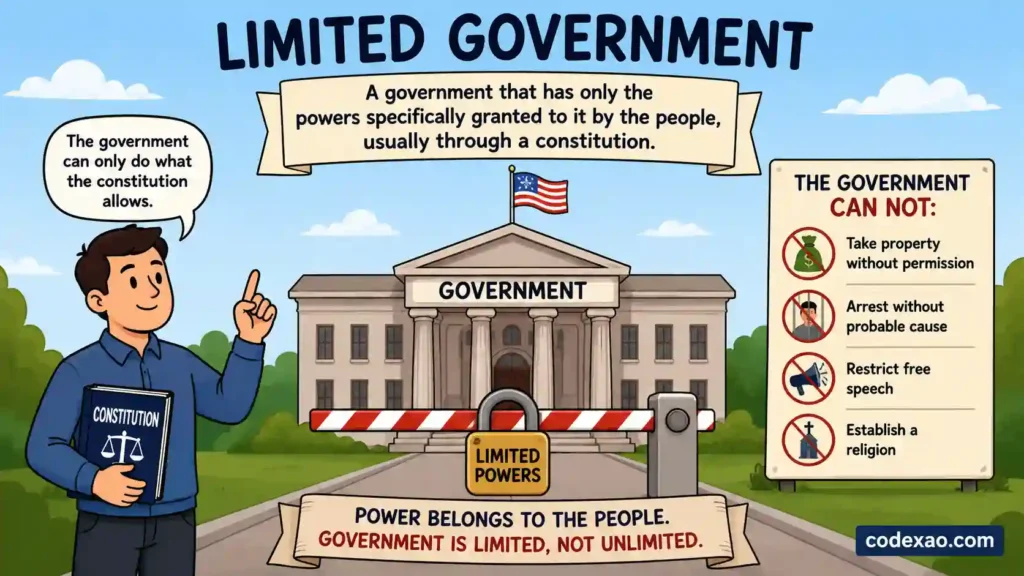
Ever wondered why governments can’t just do whatever they want? That’s where the idea of limited government meaning comes in.
It’s one of the most important foundations of modern democracies, yet many people only hear the term in school or political debates without fully understanding it.
In simple terms, a limited government ensures that leaders and institutions cannot exercise unlimited power over citizens.
Instead, laws, constitutions, and institutions keep authority in check.
This concept is a big reason why people in many countries enjoy freedoms like speech, religion, and privacy without government interference.
Understanding this idea matters more than ever in 2026.
From social media regulation to surveillance debates, governments everywhere are constantly being questioned on how far their power should go.
By the end of this guide, you’ll understand exactly what limited government means, how it works, and why it still shapes your daily life, even if you don’t realize it.
What Does “Limited Government Meaning” Mean?
The limited government meaning refers to a system where government authority is restricted by law so it cannot become too powerful or abusive. These limits are usually written in a constitution, which acts like a rulebook for how power is shared and controlled.
Quick Answer:
A limited government is a political system where laws and constitutions restrict government power to protect individual rights and prevent authoritarian control.
Origin and Evolution
The idea of limited government became popular during the Enlightenment era in Europe (1600s–1700s). Thinkers like John Locke argued that governments should exist only to protect natural rights such as life, liberty, and property.
This philosophy heavily influenced modern democratic systems, especially the United States Constitution, which introduced checks and balances to ensure no branch of government becomes too powerful.
Key Characteristics
- Rule of law applies to everyone, including leaders
- Constitution limits government authority
- Separation of powers (executive, legislative, judicial)
- Protection of individual rights
Pronunciation Guide
Limited government: /ˈlɪmɪtɪd ˈɡʌvərnmənt/
How to Use “Limited Government Meaning” in Context
While “limited government” isn’t slang, understanding how the concept is used helps in academic writing, political discussions, and debates.
Where it appears:
- School essays and civics exams
- Political debates and news articles
- Law and governance discussions
- Social media political commentary
Tone and usage:
- Formal and academic in essays
- Analytical in discussions
- Occasionally simplified in social media explanations
When NOT to use it:
- Casual texting (“lol this is limited government vibes” doesn’t work)
- Meme-only contexts without explanation
- Professional business emails unless discussing policy
Formatting tip:
Always use it as a concept, not a casual phrase.
Real-World Examples of Limited Government
Here’s how the idea shows up in real life:
🇺🇸 Example 1: United States Government
The U.S. uses a constitution that limits power through checks and balances.
What it means:
No single branch (President, Congress, or Courts) can dominate others.
⚖️ Example 2: Independent Courts
Courts can strike down laws that violate constitutional rights.
Meaning:
Even government laws are not above the constitution.
🗳️ Example 3: Elections
Regular elections ensure leaders can be voted out.
Meaning:
Power is temporary, not permanent.
📜 Example 4: Freedom of Speech
Governments cannot freely silence opinions.
Meaning:
Citizens retain fundamental freedoms.
🌍 Example 5: Constitutional Democracies
Many countries like Canada, India, and Germany use constitutional limits on power.
Meaning:
Governments must follow written rules, not personal decisions.
Common Mistakes & Misunderstandings
Even though the idea sounds simple, people often misunderstand it.
Mistake 1: Thinking “limited government = weak government”
Not true. A limited government can still be strong; it just can’t act without rules.
Mistake 2: Confusing it with no government
Limited government doesn’t mean chaos. Laws still exist, it just means power is controlled.
Mistake 3: Assuming all democracies are fully limited
Some democracies still have strong executive powers during emergencies.
Generational confusion
- Older generations may link it to political ideology debates
- Younger people often hear it in school civics or TikTok explainers
- Misuse happens when people treat it as a slogan instead of a system
Limited Government Across Platforms & Demographics
📚 In Education
Taught in civics, political science, and history classes.
📰 In Media
Used in news discussions about rights, laws, and policies.
📱 On Social Media
- TikTok: simplified explanations
- Twitter/X: political debates
- Reddit: deep discussions on governance
🧠 Is it formal?
Yes, this is an academic and political term, not slang.
Related Terms & Alternatives
- Constitutional government – government guided by a constitution
- Rule of law – law applies equally to everyone
- Separation of powers – dividing government authority
- Checks and balances – preventing one branch from dominating
- Federalism – power shared between central and regional governments
- Democracy – system based on elections
- Authoritarian government – opposite of limited government
- Totalitarianism – absolute government control
- Civil liberties – protected individual freedoms
- Political accountability – leaders answerable to citizens
FAQs:
What is limited government meaning in simple words?
It means the government cannot do anything it wants. Its powers are restricted by laws and constitutions to protect people’s rights and freedoms.
Is limited government good or bad?
Most democracies consider it good because it prevents abuse of power and ensures citizens have freedom and legal protection.
How does limited government work?
It works through laws, constitutions, elections, courts, and separation of powers that restrict and balance authority.
What is an example of limited government in real life?
The United States is a common example where the constitution limits government power and protects individual rights.
What is the opposite of limited government?
The opposite is an unlimited or authoritarian government where leaders have full control without strong legal restrictions.
Conclusion:
The limited government meaning is simple but powerful: it’s a system designed to stop any government from becoming too powerful.
By using laws, constitutions, and checks and balances, societies protect freedom while still maintaining order.
In today’s world, where governments influence everything from online speech to privacy, this concept is more relevant than ever.
It shapes how laws are made, how leaders are controlled, and how citizens stay protected.
If you understand this idea, you already understand one of the core foundations of modern democracy.
So now it’s your turn, how do you think government power should be balanced in today’s digital world?

Hi, I’m Isabella Brown, the voice behind Codexao.com, where meanings aren’t just explained, they’re made easy to understand.
I’ve always been fascinated by how words shape the way we think, speak, and connect. But let’s be honest—most definitions out there feel confusing, outdated, or just plain boring.
That’s exactly why I created Codexao. Here, I break down words, slang, and modern expressions into simple, clear meanings you can actually use in real life.