Have you ever met someone who seemed impossible to figure out? Maybe they spoke very little, smiled mysteriously, or always left you wondering what they were really thinking. That’s where understanding the enigmatic meaning becomes useful.
The word enigmatic appears everywhere today. You’ll see it in books, movies, social media captions, celebrity interviews, and everyday conversations.
People often use it to describe someone who is fascinating precisely because they are difficult to understand.
Understanding this word can improve your vocabulary, help you communicate more effectively, and make it easier to interpret what people mean when they describe a person, character, or situation as enigmatic.
Updated for 2026, this guide explains the meaning, origin, usage, examples, common mistakes, and related terms so you can confidently use the word in real-life conversations and writing.
What Does Enigmatic Mean?
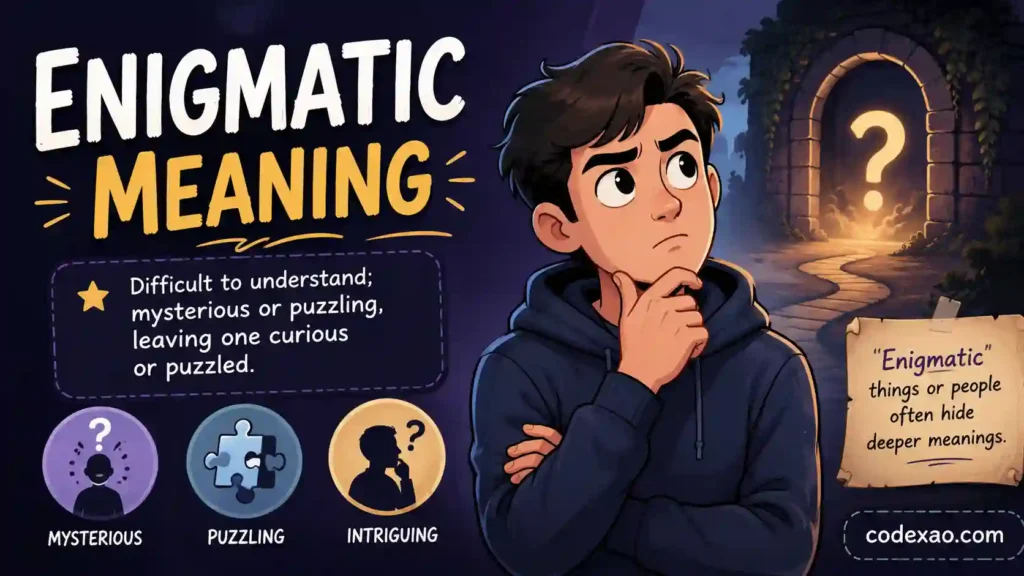
The enigmatic meaning refers to something or someone that is mysterious, puzzling, difficult to understand, or hard to interpret.
A person described as enigmatic often keeps their thoughts private, making others curious about them. An enigmatic situation may contain hidden clues or unanswered questions.
Quick Answer
Enigmatic means mysterious, puzzling, or difficult to understand. It describes people, actions, expressions, or situations that leave others curious and uncertain.
Origin of the Word
The word enigmatic comes from the Greek word ainigma, meaning riddle or puzzle. Over time, it entered Latin and later English, where it became associated with anything that creates mystery or uncertainty.
Originally used more frequently in literature and academic writing, enigmatic is now common in everyday language, entertainment reviews, and online discussions.
How the Meaning Has Evolved
Historically, enigmatic often referred to riddles or symbolic messages. Today, it commonly describes:
- Mysterious people
- Unclear behavior
- Intriguing personalities
- Cryptic messages
- Unexplained events
Pronunciation Guide
Enigmatic is pronounced:
eh-nig-MAT-ik
Phonetic spelling:
ih-nig-MAT-ik
How to Use Enigmatic Correctly in Texts and Chat
Although enigmatic is not an internet abbreviation, it appears frequently in digital communication.
Appropriate Contexts
Use enigmatic when describing:
- A mysterious person
- An unclear statement
- A puzzling situation
- An intriguing character
- A cryptic social media post
Examples:
- “Her enigmatic smile made everyone curious.”
- “The singer posted an enigmatic message on Instagram.”
- “His response was surprisingly enigmatic.”
Platform-Specific Usage
SMS and WhatsApp
People often use enigmatic to describe friends or crushes.
Example:
“Why is he always so enigmatic? I can never tell what he’s thinking.”
Common in captions discussing mystery or personality.
Example:
“An enigmatic soul with stories untold.”
X
Often used when discussing celebrities, public figures, or trending events.
Example:
“The actor remains enigmatic despite years in the spotlight.”
Discord
Frequently appears in gaming and fandom communities.
Example:
“That character is so enigmatic. Nobody knows their true motives.”
Often used in discussions about movies, books, and psychology.
Example:
“The protagonist’s enigmatic behavior keeps readers engaged.”
When Not to Use Enigmatic
Avoid using enigmatic when something is simply confusing because of poor communication.
Wrong:
“The instructions were enigmatic.”
Better:
“The instructions were unclear.”
Formatting Tips
- Use standard capitalization.
- Works well in formal and informal writing.
- Often paired with words like mysterious, intriguing, elusive, and cryptic.
- No special punctuation is required.
Real Conversation Examples Using Enigmatic
Between Friends
Sarah: Have you talked to Jake lately?
Emma: A little. He’s still incredibly enigmatic.
Sarah: That’s exactly why everyone finds him interesting.
Meaning: Emma describes Jake as mysterious and difficult to understand.
Dating Scenario
Alex: What do you think about her?
Ryan: She’s smart, funny, and a little enigmatic.
Alex: So you’re intrigued?
Ryan: Definitely.
Meaning: Enigmatic suggests attractive mystery and curiosity.
Family Conversation
Mom: Your grandfather never talks much about his past.
Daughter: Yeah, he’s always been kind of enigmatic.
Meaning: The grandfather seems mysterious because he shares little information.
Workplace Chat
Employee: Did the CEO explain the new strategy?
Manager: Not really. His comments were somewhat enigmatic.
Meaning: The explanation lacked clarity and left questions unanswered.
Gaming Discussion
Player One: What do you think that character is planning?
Player Two: No idea. They’re the most enigmatic character in the game.
Meaning: The character’s motives remain mysterious.
Common Mistakes and Misunderstandings
Mistake 1: Using Enigmatic as a Synonym for Strange
Many people assume enigmatic simply means weird.
Not exactly.
Someone can be enigmatic without being strange. The key idea is mystery rather than oddness.
Mistake 2: Assuming It Is Always Positive
Enigmatic often sounds appealing, but context matters.
An enigmatic leader may seem intriguing.
An enigmatic warning may feel concerning.
Mistake 3: Confusing It with Confusing
Confusing suggests lack of understanding.
Enigmatic suggests mystery that creates curiosity.
Generational Differences
Older generations may associate enigmatic with literature or formal writing.
Younger generations often use it when discussing:
- Celebrities
- Social media influencers
- Fictional characters
- Romantic interests
Cultural Differences
In some cultures, being enigmatic is viewed as sophisticated and attractive.
In others, openness and directness may be preferred, making enigmatic behavior seem distant.
How to Clarify the Meaning
If someone doesn’t understand the term, explain it simply:
“Enigmatic means mysterious or hard to figure out.”
Enigmatic Across Different Platforms and Demographics
Gen Z Usage
Gen Z often uses enigmatic when describing:
- Aesthetic personalities
- Celebrities
- Anime characters
- Social media creators
The word frequently appears in captions and comment sections.
Millennials
Millennials often use enigmatic when discussing:
- Books
- Films
- Relationships
- Professional personalities
Older Generations
Older users are more likely to encounter enigmatic in:
- Newspapers
- Literature
- Academic writing
- Professional communication
Social Media Trends
The popularity of mysterious public figures has helped keep the term relevant.
People often describe celebrities as enigmatic when they maintain privacy despite public attention.
Is It Formal or Informal?
Enigmatic works in both formal and informal settings.
You can use it in:
- Essays
- Business writing
- Conversations
- Social media posts
This versatility makes it a valuable vocabulary word.
Related Slang Abbreviations and Alternatives
| Word | Meaning |
|---|---|
| Mysterious | Difficult to understand |
| Cryptic | Having hidden meaning |
| Elusive | Hard to find or grasp |
| Puzzling | Difficult to explain |
| Obscure | Not clear or well known |
| Intriguing | Arousing curiosity |
| Secretive | Keeping information private |
| Ambiguous | Open to multiple interpretations |
| Perplexing | Causing confusion |
| Unfathomable | Impossible to fully understand |
Synonyms
- Mysterious
- Cryptic
- Puzzling
- Obscure
- Elusive
- Secretive
- Intriguing
Antonyms
- Clear
- Obvious
- Transparent
- Straightforward
- Understandable
FAQs:
Is enigmatic the same as mysterious?
They are very similar. However, enigmatic often implies a puzzle-like quality that encourages curiosity and interpretation.
Can enigmatic describe a person’s personality?
Yes. An enigmatic personality is one that reveals little information and remains difficult for others to fully understand.
Is being enigmatic attractive?
Many people find enigmatic individuals attractive because mystery can create intrigue and curiosity. However, preferences vary from person to person.
What part of speech is enigmatic?
Enigmatic is an adjective. It describes nouns such as people, expressions, behavior, stories, or situations.
What is the opposite of enigmatic?
Common opposites include transparent, obvious, clear, straightforward, and easy to understand.
Can enigmatic be used in professional writing?
Absolutely. It is widely accepted in professional, academic, and creative writing when describing mystery or uncertainty.
Conclusion:
The enigmatic meaning centers on mystery, curiosity, and the challenge of understanding someone or something completely.
Whether you’re describing a quiet friend, a fascinating movie character, or a cryptic social media post, enigmatic is the perfect word when mystery is part of the story.
Its flexibility across conversations, literature, business communication, and online culture makes it a valuable addition to any vocabulary.
What’s the most enigmatic person, character, or moment you’ve encountered? Share your thoughts and explore more fascinating language guides to keep expanding your vocabulary.

Hi, I’m Isabella Brown, the voice behind Codexao.com, where meanings aren’t just explained, they’re made easy to understand.
I’ve always been fascinated by how words shape the way we think, speak, and connect. But let’s be honest—most definitions out there feel confusing, outdated, or just plain boring.
That’s exactly why I created Codexao. Here, I break down words, slang, and modern expressions into simple, clear meanings you can actually use in real life.