You’ve probably seen job listings asking for a “resume” or a “CV”, and wondered, aren’t they the same thing? Or maybe you’ve used them interchangeably without a second thought.
Here’s the catch: understanding the resume/cv meaning can actually impact your chances of getting hired.
Sending the wrong document (or the wrong format) could make you look unprepared, even if you’re qualified.
In today’s fast-moving digital hiring world, knowing the difference isn’t just helpful, it’s essential.
Whether you’re applying for your first job, switching careers, or targeting international roles, getting this right gives you a real edge.
Updated for 2026, this guide breaks everything down in plain English, definitions, differences, examples, and when to use each.
By the end, you’ll know exactly which one to use and how to use it like a pro.
What Does “Resume/CV” Mean?
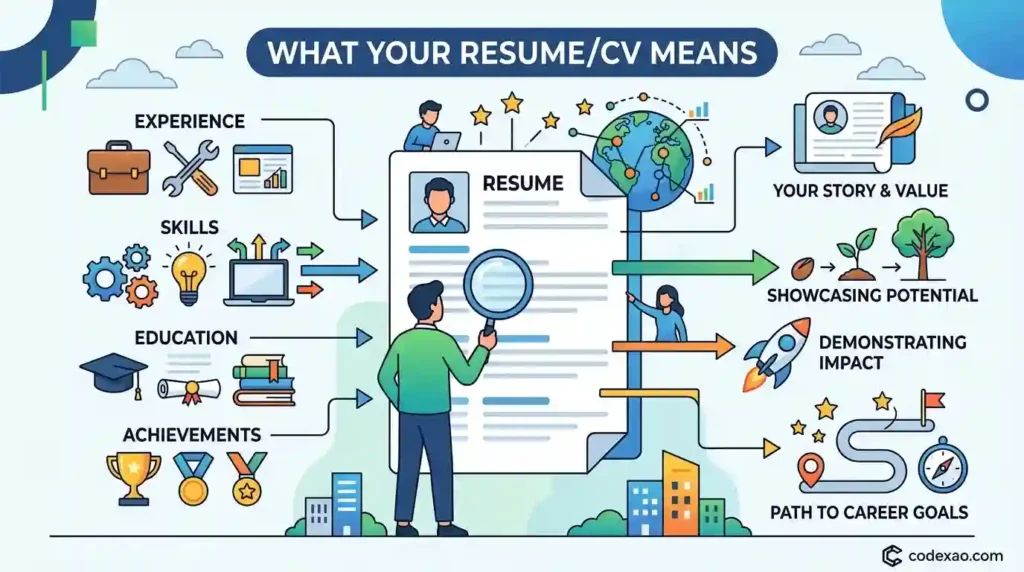
A resume is a short, tailored summary of your professional experience, skills, and achievements, typically 1, 2 pages long.
A CV (Curriculum Vitae) is a detailed document that outlines your entire academic and professional history, often several pages long.
Quick Answer:
A resume is concise and job-specific, while a CV is comprehensive and detailed, often used for academic or international applications.
Origin of the Terms
- Resume comes from French, meaning “summary”
- Curriculum Vitae is Latin for “course of life”
Over time, the meanings evolved depending on region:
- In the U.S. and Canada, resumes and CVs are different
- In Europe, Asia, and many other regions, “CV” is often used for what Americans call a resume
Pronunciation Guide
- Resume: rez-uh-may
- CV: see-vee or curriculum vee-tie
How to Use “Resume/CV” Correctly in Job Applications
Understanding when to use a resume vs. a CV depends on context, country, and career field.
When to Use a Resume
Use a resume if:
- You’re applying for corporate or private-sector jobs
- The job listing specifically asks for a resume
- You need a short, tailored document
When to Use a CV
Use a CV if:
- You’re applying for academic, research, or teaching roles
- The employer requests a CV
- You’re applying internationally (especially Europe, Middle East, Africa)
Platform-Specific Usage
- Email applications: Attach as PDF (resume or CV as requested)
- LinkedIn: Resume-style summaries are preferred
- Job portals: Often accept resumes but may ask for CV uploads
- Freelance platforms: Resume-like profiles work best
When NOT to Use Them Interchangeably
Avoid this common mistake:
- Sending a 5-page CV to a corporate job → looks unfocused
- Sending a 1-page resume for an academic role → looks incomplete
Formatting Tips
- Resume: bullet points, action verbs, concise language
- CV: detailed sections (publications, research, certifications)
- File name:
YourName_Resume.pdforYourName_CV.pdf
Real Examples of Resume vs CV Usage
Example 1: Corporate Job Application
Context: Applying for a marketing job
Message:
“I’ve attached my resume for your review.”
Shows professionalism and relevance
Example 2: Academic Position
Context: Applying for a university lecturer role
“I’ve included my CV with my publications and research experience.”
Emphasizes depth and expertise
Example 3: International Job
Context: Applying in Europe
“Please find my CV attached.”
Aligns with regional expectations
Example 4: Entry-Level Job
Context: Fresh graduate applying for first job
“I’ve attached my resume highlighting my internships.”
Keeps it concise and focused
Example 5: Freelance Platform
Context: Upwork/Fiverr profile
“Here’s my resume showcasing recent projects.”
Portfolio-style approach
Common Mistakes & Misunderstandings
1. Thinking Resume = CV Everywhere
Different countries use different terms. Always check the job description.
2. Using the Wrong Length
- Resume too long → recruiter loses interest
- CV too short → lacks credibility
3. Ignoring Industry Norms
- Academia expects CVs
- Business prefers resumes
Generational Confusion
- Older professionals may say “CV” for everything
- Gen Z tends to use “resume” more casually
How to Clarify
If unsure, simply ask:
“Would you prefer a resume or a full CV?”
Resume/CV Across Different Platforms & Demographics
Gen Z vs Millennials
- Gen Z: prefers concise resumes, digital-friendly formats
- Millennials: comfortable with both, depending on role
Platform Trends
- LinkedIn: Resume-style summaries dominate
- TikTok career content: focuses on resume hacks
- Academic websites: CVs are standard
Formality Level
- Resume → semi-formal, flexible
- CV → formal, structured
Safe for Work?
Yes, both are professional documents, but:
- Resume = modern, adaptable
- CV = traditional, comprehensive
Related Slang, Abbreviations & Alternatives
| Term | Meaning |
|---|---|
| Bio | Short personal/professional intro |
| Portfolio | Collection of work samples |
| Cover Letter | Letter explaining your application |
| LinkedIn Profile | Online resume |
| Personal Statement | Career summary for applications |
| Resume Builder | Tool to create resumes |
| Job Profile | Overview of skills/experience |
| Career Summary | Brief highlight of achievements |
FAQs:
What is the difference between a resume and a CV?
A resume is a short, tailored document (1, 2 pages) highlighting relevant skills and experience for a specific job. A CV is a detailed record of your academic and professional history, often multiple pages long, used for academic or research roles.
When should I use a CV instead of a resume?
Use a CV when applying for academic, research, or international positions where detailed background information is required. Employers in these fields expect a full overview of your qualifications.
Is a CV longer than a resume?
Yes. A CV is typically longer because it includes complete details like publications, research, awards, and certifications, while a resume focuses only on relevant experience.
Can I use a resume and CV interchangeably?
Not always. In some countries, they are interchangeable, but in places like the U.S., they serve different purposes. Always follow the job listing instructions.
What should be included in a resume or CV?
A resume should include contact info, skills, work experience, and education. A CV includes all of that plus publications, research, certifications, and detailed achievements.
Conclusion:
Understanding the resume/cv meaning isn’t just about definitions, it’s about using the right tool at the right time. A resume gets you noticed quickly. A CV tells your full professional story.
If you’re applying for jobs in business or tech, keep it sharp and concise with a resume. Going into academia or applying abroad? A detailed CV is your best bet.
Master both, and you’ll never second-guess your application again.
Got a favorite resume tip or question? Drop it below, and explore more slang and career guides to stay ahead!

Hi, I’m Isabella Brown, the voice behind Codexao.com, where meanings aren’t just explained, they’re made easy to understand.
I’ve always been fascinated by how words shape the way we think, speak, and connect. But let’s be honest—most definitions out there feel confusing, outdated, or just plain boring.
That’s exactly why I created Codexao. Here, I break down words, slang, and modern expressions into simple, clear meanings you can actually use in real life.