Ever filled out a college application and seen the word “matriculated” pop up, and paused for a second? You’re not alone.
It’s one of those terms that sounds formal, maybe even intimidating, but it’s actually pretty straightforward once you break it down.
Understanding the matriculated meaning is especially important today, whether you’re applying to a university, reading academic documents, or just trying to sound a bit smarter in conversations.
This word shows up in emails, admission letters, and even resumes.
In this updated-for-2026 guide, you’ll learn exactly what “matriculated” means, where it comes from, how to use it naturally, and how it differs from similar terms like “enrolled” or “admitted.”
We’ll also walk through real-life examples so you can use it with confidence, no guesswork needed.
What Does “Matriculated” Mean?
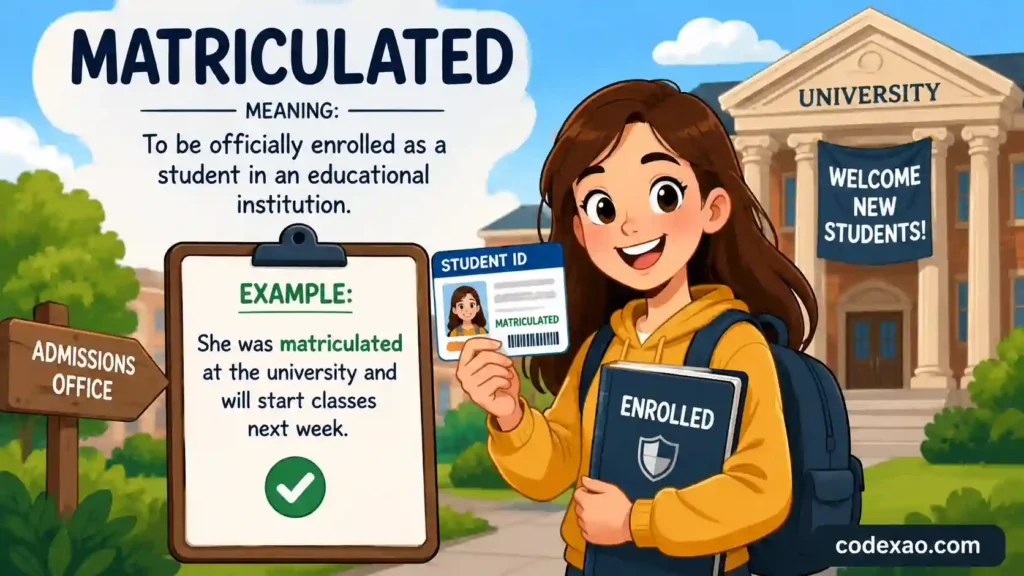
Matriculated means officially being enrolled or registered as a student at a school, college, or university.
Quick Answer:
Matriculated = officially accepted and enrolled as a student in an institution.
Origin of the Word
The term comes from the Latin word “matricula,” meaning “public register” or “list.” Historically, universities kept a matriculation register where students’ names were recorded upon entry.
Over time, “matriculate” evolved into a formal academic term used worldwide, especially in British and American education systems.
How the Meaning Has Evolved
- Old usage: Being entered into a formal registry
- Modern usage: Officially starting your studies at an institution
Pronunciation Guide
Matriculated → muh-TRIK-yuh-lay-tid
How to Use “Matriculated” Correctly in Texts & Chat
While “matriculated” is mostly used in academic or formal settings, it can still pop up in casual conversations, especially when discussing education.
Correct Context & Tone
- ✅ Formal: “She matriculated at Harvard in 2024.”
- ⚠️ Semi-casual: “I finally matriculated into my dream uni!”
- ❌ Avoid in slang-heavy chats unless being ironic or humorous
Platform-Specific Usage
- SMS/WhatsApp: Rare, but used when sharing big news
- Instagram captions: “Officially matriculated 🎓✨”
- LinkedIn: Very common in professional updates
- Discord/Reddit: Used in academic or career-related threads
When NOT to Use It
- Casual everyday chats (“I matriculated to the grocery store” ❌)
- Non-academic contexts
- Informal jokes unless used sarcastically
Formatting Tips
- No need for capitalization unless starting a sentence
- Often paired with 🎓 or 📚 emojis
- Used in past tense most commonly (“matriculated”)
Real Conversation Examples Using “Matriculated”
1. Between Friends
A: “Did you hear back from the university?”
B: “Yes! I officially matriculated this fall 🎉”
👉 Emotion: Pride and excitement about joining a university
2. Family Chat
Mom: “We’re so proud of you!”
You: “Thanks! I’ve matriculated into medical school.”
👉 Emotion: Achievement and gratitude
3. LinkedIn Post
“I’m excited to announce that I have matriculated at XYZ University to pursue my MBA.”
👉 Emotion: Professional milestone
4. Dating Conversation
Date: “So what are you studying?”
You: “I just matriculated into a computer science program.”
👉 Emotion: Informative, slightly formal
5. Gaming/Online Community
“I can’t play as much anymore, I just matriculated into college 😅”
👉 Emotion: Light humor + life update
Common Mistakes & Misunderstandings
1. Confusing “Matriculated” with “Applied”
- ❌ “I matriculated to three universities”
- ✅ You apply first, then matriculate after acceptance
2. Thinking It Means “Graduated”
Many assume it means finishing school, it doesn’t.
- Matriculated = starting
- Graduated = finishing
3. Overusing It in Casual Contexts
Using it in everyday speech can sound overly formal or awkward.
Generational Differences
- Gen Z: Uses it occasionally, often in announcements
- Millennials: More familiar due to formal education contexts
- Older generations: Use it correctly but less frequently in casual speech
“Matriculated” Across Different Platforms & Demographics
Who Uses It Most?
- Students
- Academic professionals
- LinkedIn users
- University communications
Platform Trends
- TikTok: Rare, unless in educational content
- Instagram: Common in graduation/admission posts
- LinkedIn: Highly common
- Discord: Niche usage
Formality Level
- ✅ Formal to semi-formal
- ❌ Not slang
- ✅ Safe for professional environments
Related Slang, Abbreviations & Alternatives
| Term | Meaning |
|---|---|
| Enrolled | Signed up for classes |
| Admitted | Accepted into a school |
| Registered | Officially listed for courses |
| Freshman | First-year student |
| Undergrad | Undergraduate student |
| Grad school | Postgraduate education |
| Alumni | Graduates of a school |
| Semester | Academic term |
| Intake | Admission period |
👉 Learn more about related terms like “enrolled vs admitted” or “undergraduate meaning” for deeper clarity.
FAQs:
What does matriculated mean in simple terms?
It means you’ve officially joined a school or university as a student. You’ve been accepted and registered, and your studies have begun.
Is matriculated the same as enrolled?
Almost. “Enrolled” is more general, while “matriculated” specifically refers to formal admission into an academic institution.
How do you use matriculated in a sentence?
Example: “She matriculated at Oxford University in 2023.” It shows she officially started studying there.
What is a matriculated student?
A matriculated student is someone who has been formally admitted and is actively enrolled in a school or university program.
What is the difference between admission and matriculation?
Admission is being accepted into a school. Matriculation happens after admission, it’s when you officially register and begin attending.
Conclusion:
The matriculated meaning is simpler than it sounds: it’s all about officially starting your academic journey.
Once you’ve been accepted and registered, you’ve matriculated, congrats, you’re in!
It’s a formal word, but incredibly useful in the right context.
Whether you’re updating your LinkedIn, talking about your studies, or reading admission documents, knowing how to use “matriculated” correctly gives you an edge.
Now that you’ve got it down, you won’t hesitate the next time you see it, or use it yourself.
👉 Got another confusing word or abbreviation? Drop it below and let’s decode it together!

Hi, I’m Isabella Brown, the voice behind Codexao.com, where meanings aren’t just explained, they’re made easy to understand.
I’ve always been fascinated by how words shape the way we think, speak, and connect. But let’s be honest—most definitions out there feel confusing, outdated, or just plain boring.
That’s exactly why I created Codexao. Here, I break down words, slang, and modern expressions into simple, clear meanings you can actually use in real life.