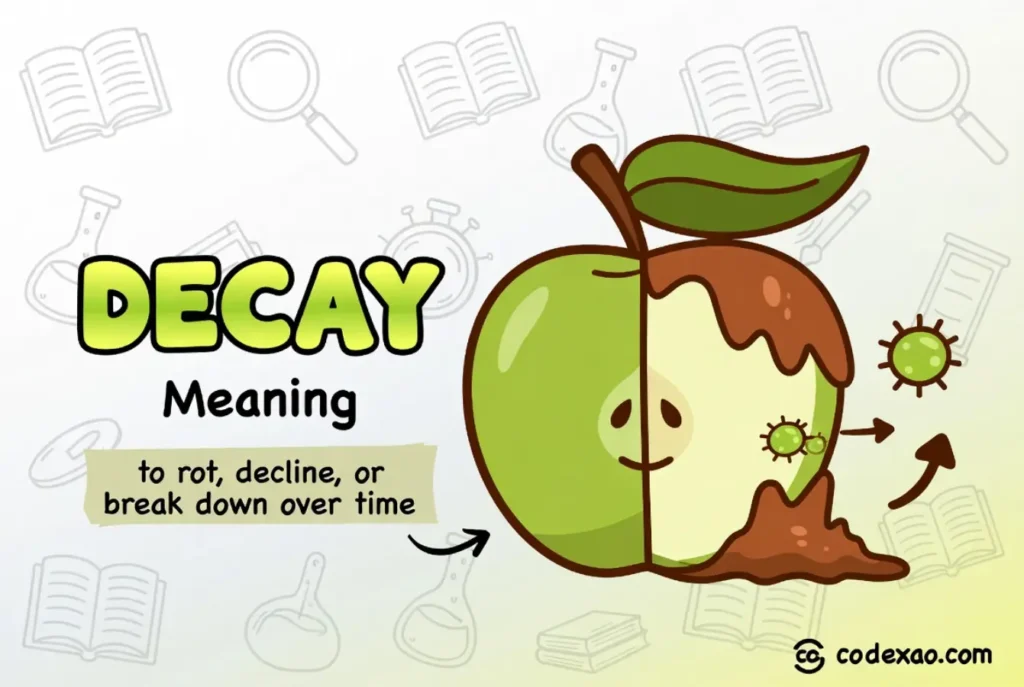
Ever opened your fridge, grabbed something, and instantly knew… yeah, that’s gone bad? That moment is a perfect real-life example of decay meaning in action.
But “decay” isn’t just about spoiled food.
You’ll see it in science class, hear it in movies, and even spot it in deep conversations about society or relationships.
Understanding decay meaning helps you sound more natural in English, and more importantly, helps you get what people really mean depending on the context.
This guide (Updated for 2026) breaks it all down: from simple definitions to real-world examples, slang-like usage, and even how different generations use the word today.
What Does “Decay” Mean?
Decay means a gradual process of breaking down, weakening, or deteriorating over time.
It can apply to:
- Physical things → like food rotting
- Natural processes → like leaves decomposing
- Abstract ideas → like moral or social decline
Quick Answer:
Decay means the slow breakdown or decline of something over time, physically, chemically, or even socially.
The word comes from Latin roots meaning “to fall apart” or “decline.” Over time, its meaning expanded beyond physical rot to include emotional, social, and scientific contexts.
Pronunciation:
di-KAY
How to Use “Decay” Correctly in Texts & Chat
“Decay” isn’t exactly slang, but it shows up in modern conversations, especially when people want to sound expressive or dramatic.
Tone & Context:
- Slightly formal but still common
- Can sound serious, poetic, or even sarcastic
- Often used metaphorically
Where you’ll see it:
- WhatsApp chats: “My sleep schedule is in decay 😭”
- Instagram captions: “Beauty fades, everything decays.”
- Reddit: Deep discussions about society or life
- Discord: Gaming chats joking about “skill decay”
When to use it:
- Talking about something slowly getting worse
- Describing emotional burnout or decline
- Explaining scientific processes
When NOT to use it:
- Casual jokes (unless ironic)
- Formal business emails
- Situations needing simple words (use “bad” or “worse” instead)
Formatting tips:
- Usually lowercase: decay
- Works well with dramatic emojis: 💀 😭 🫠
- Often paired with words like “slow,” “inevitable,” or “natural”
Real Conversation Examples Using “Decay”
Between friends:
A: “Bro I haven’t studied in weeks.”
B: “Your brain is in full decay 💀”
→ Shows humor + exaggeration about decline
In a group chat:
A: “Why is this pizza still here?”
B: “Because it’s entered the decay phase now.”
→ Refers to food going bad in a funny way
Dating context:
A: “We barely talk anymore.”
B: “Feels like the relationship is slowly decaying…”
→ Emotional decline, serious tone
Work chat:
A: “Our system hasn’t been updated in years.”
B: “Yeah, it’s basically decaying at this point.”
→ Professional but slightly informal
Gaming chat:
A: “I used to be good at this game.”
B: “Skill decay is real 😭”
→ Refers to losing ability over time
Common Mistakes & Misunderstandings
1. Thinking decay only means “rot”
Many people limit it to food. But decay also applies to emotions, systems, and society.
2. Using it too casually
Saying “my phone is decaying” sounds odd, better: “getting worse” or “breaking.”
3. Generational confusion
- Older users: Use decay literally (science, nature)
- Gen Z: Use it metaphorically (life, habits, mental state)
4. Cultural differences
In some regions, decay is used more in academic or scientific contexts, while online culture has made it more expressive and metaphorical.
“Decay” Across Different Platforms & Demographics
Gen Z:
- Uses it humorously or dramatically
- Example: “My motivation is decaying daily”
Millennials:
- Use it in both literal and metaphorical ways
- More balanced tone
Older generations:
- Prefer scientific or traditional usage
Platform trends:
- TikTok: Used in deep or aesthetic captions
- Instagram: Poetic and emotional posts
- Reddit: Analytical or philosophical discussions
- Discord: Gaming + meme usage
Is it formal?
- Semi-formal word
- Safe for most conversations
- Not ideal for strict professional writing
Related Slang, Abbreviations & Alternatives
Here are some related words and expressions you’ll often see:
- Rot – Physical decay, especially food
- Deteriorate – Gradual worsening
- Break down – Stop functioning
- Decline – General decrease
- Decompose – Scientific breakdown
- Fall apart – Emotional or physical collapse
- Go bad – Informal (food decay)
- Fade – Slow disappearance
- Crash – Sudden decline (opposite speed)
- Burnout – Mental/emotional decay
FAQs
What is the exact decay meaning in English?
Decay means the gradual process of something breaking down, weakening, or deteriorating over time. It can refer to physical, emotional, or societal decline depending on context.
Can decay be used in daily conversation?
Yes, but it’s slightly more expressive than simple words like “bad” or “worse.” People often use it for emphasis or dramatic effect.
What is decay in science?
In science, decay refers to natural processes like radioactive decay, where unstable atoms release energy and transform into different elements.
Is decay a negative word?
Mostly yes. It usually describes decline or damage, though in nature it can be neutral (like decomposition helping ecosystems).
What’s the difference between decay and decline?
Decay often implies a natural or inevitable breakdown, while decline is more general and can happen for many reasons.
Conclusion:
Decay meaning goes far beyond spoiled food. It’s about change, specifically, the slow kind that happens over time, whether in nature, relationships, or even your gaming skills.
Once you understand how flexible this word is, you’ll start noticing it everywhere, from science textbooks to Instagram captions.
And honestly? It’s one of those words that instantly makes your English sound sharper and more expressive.
Now your turn, what’s the funniest or most relatable “decay” example you’ve seen lately? Drop it and keep the conversation going.

Hi, I’m Isabella Brown, the voice behind Codexao.com, where meanings aren’t just explained, they’re made easy to understand.
I’ve always been fascinated by how words shape the way we think, speak, and connect. But let’s be honest—most definitions out there feel confusing, outdated, or just plain boring.
That’s exactly why I created Codexao. Here, I break down words, slang, and modern expressions into simple, clear meanings you can actually use in real life.