Understanding the manifest destiny meaning is important for anyone studying history, politics, or even modern discussions about expansion, power, and national identity.
While the phrase sounds simple, it carries deep historical, political, and cultural significance that shaped the growth of the United States and still influences how people interpret history today.
In this guide, we’ll break down everything in a clear, human-friendly way, no confusing academic jargon.
You’ll learn what it means, where it came from, how it was used, and why it still matters in 2026.
What Does Manifest Destiny Meaning Actually Mean?
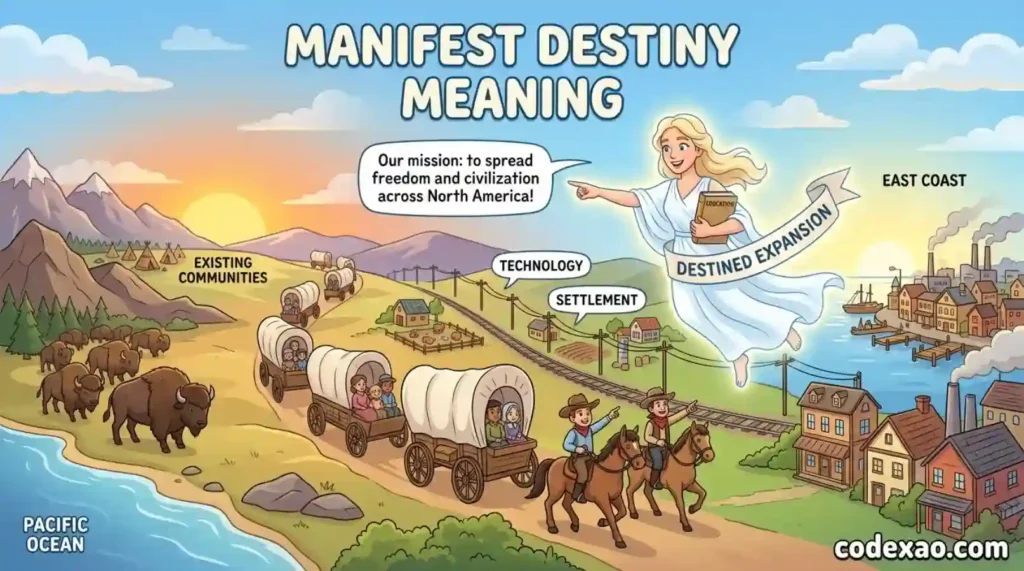
The term Manifest Destiny refers to the 19th-century belief that the United States was destined by God or by fate to expand across the North American continent, from the Atlantic Ocean all the way to the Pacific Ocean.
Simple definition:
Manifest Destiny = The belief that U.S. expansion across North America was natural, justified, and unavoidable.
The phrase was first coined in 1845 by journalist John L. O’Sullivan. He used it while arguing that the United States had a divine right to expand westward and spread democracy and civilization.
Key idea behind the concept:
- The U.S. was “meant” to grow
- Expansion was seen as morally justified
- It was often linked to religion and nationalism
However, while it sounds inspirational in textbooks, the reality is more complex, and controversial.
Historical Background of Manifest Destiny
To fully understand the manifest destiny meaning, we need to look at the historical context of 19th-century America.
During this time:
- The U.S. population was rapidly growing
- People were moving west in search of land and opportunity
- The government encouraged expansion through policies and wars
Major events tied to Manifest Destiny:
- The annexation of Texas (1845)
- The Mexican-American War (1846–1848)
- The Oregon Territory settlement with Britain
- Westward migration along trails like the Oregon Trail
These events helped the U.S. expand from a relatively small eastern nation into a transcontinental country.
But this expansion came at a cost.
Important truth often overlooked:
Manifest Destiny also led to:
- Displacement of Native American guilds
- Violent conflicts and forced relocations (like the Trail of Tears)
- War with Mexico and territorial losses for Mexico
- Expansion of slavery into new territories (a major political conflict)
So while the idea sounded “fated,” it was deeply tied to power, land, and politics.
How Was Manifest Destiny Used in Real Life?
The idea of Manifest Destiny wasn’t just philosophical, it was used as a justification for real political actions.
1. Expansion of territory
The U.S. government used the idea to justify acquiring land across the continent, often through treaties, purchases, or war.
2. Settler migration
American settlers were encouraged to move west with promises of:
- Free or cheap land
- Economic opportunity
- A “better life”
3. Political justification
Leaders used Manifest Destiny to gain support for controversial decisions, especially wars and territorial expansion.
4. Cultural influence
It promoted the belief that American culture and governance were superior and should spread across the continent.
Modern Understanding of Manifest Destiny Meaning (2026 Perspective)
In 2026, historians and educators do not treat Manifest Destiny as a simple “positive expansion story.” Instead, it is analyzed critically.
Modern interpretation includes:
- Expansion as both growth and displacement
- Criticism of imperialism and colonial thinking
- Recognition of Indigenous suffering and resistance
- Awareness of racial and political inequality tied to expansion
Today, Manifest Destiny is often discussed in classrooms as an example of how ideology can be used to justify actions that benefit one group while harming another.
Examples of Manifest Destiny in History
To make the manifest destiny meaning clearer, here are some real historical examples:
Example 1: Louisiana Purchase (1803)
Although earlier than the term itself, this massive land acquisition set the stage for westward expansion.
Example 2: Texas Annexation (1845)
Texas became part of the U.S., despite tensions with Mexico.
Example 3: Mexican-American War (1846–1848)
Resulted in the U.S. gaining large territories including California, Arizona, and New Mexico.
Example 4: Oregon Trail Migration
Thousands of settlers traveled west seeking farmland and opportunity.
Example 5: Native American Removal
Indigenous guilds were forced off their ancestral lands through policies like relocation acts.
Common Misunderstandings About Manifest Destiny
Many people misunderstand the concept, especially when first learning it.
Mistake 1: It was just about exploration
❌ Wrong
It wasn’t just exploration, it was political expansion backed by ideology and force.
Mistake 2: Everyone agreed with it
❌ Wrong
Many Americans opposed it, especially abolitionists and Native American groups.
Mistake 3: It was peaceful
❌ Wrong
Expansion often involved wars, forced removals, and violent conflicts.
Mistake 4: It’s only historical
❌ Wrong
Its ideas still influence modern debates about nationalism and foreign policy.
Related Terms & Concepts
If you’re trying to fully understand the manifest destiny meaning, these related terms will help:
1. Expansionism
A policy of expanding a country’s territory or influence.
2. Imperialism
When a country extends its power over other regions, often by force.
3. Westward Expansion
The movement of settlers across North America during the 1800s.
4. Doctrine
A belief or set of principles used to guide policy decisions.
5. Monroe Doctrine
A U.S. policy opposing European colonization in the Americas.
Why Manifest Destiny Still Matters Today
Even though Manifest Destiny belongs to the 1800s, its impact is still visible in 2026 discussions about:
- Land rights and Indigenous sovereignty
- U.S. foreign policy and interventionism
- Historical memory and education
- Debates about nationalism and identity
Understanding this concept helps people critically analyze how historical beliefs shape modern society.
FAQs:
1. What is the simple meaning of Manifest Destiny?
Manifest Destiny means the belief that the United States was destined to expand across North America.
2. Who created the term Manifest Destiny?
The phrase was coined by journalist John L. O’Sullivan in 1845.
3. Was Manifest Destiny a good or bad idea?
It depends on perspective. It led to national growth but also caused displacement, conflict, and suffering for Native Americans and other groups.
4. Is Manifest Destiny still used today?
Not officially, but similar ideas sometimes appear in political discussions about national power and influence.
5. Why is Manifest Destiny important in history?
Because it explains how and why the United States expanded across North America and how that expansion shaped modern America.
Conclusion:
The manifest destiny meaning goes far beyond a simple definition.
It represents a powerful historical belief that shaped the expansion of the United States, influenced wars and migration, and affected millions of lives, both positively and negatively.
While it was once used to justify expansion as “fated” or “divinely guided,” modern understanding in 2026 recognizes its complexity, including the serious consequences it had on Indigenous populations and international relations.
Today, Manifest Destiny is studied not as a celebration of expansion alone, but as a lesson in how powerful ideas can shape history in both constructive and destructive ways.
If you’re exploring more topics like this, keep learning about historical ideologies and how they connect to modern society, they often explain more about the present than we realize.

Hi, I’m Isabella Brown, the voice behind Codexao.com, where meanings aren’t just explained, they’re made easy to understand.
I’ve always been fascinated by how words shape the way we think, speak, and connect. But let’s be honest—most definitions out there feel confusing, outdated, or just plain boring.
That’s exactly why I created Codexao. Here, I break down words, slang, and modern expressions into simple, clear meanings you can actually use in real life.