Ever had someone say something so clear that there was absolutely no room for misunderstanding? That’s where the word unequivocal meaning comes in.
In everyday conversations, we often deal with vague statements, half-answers, or confusing replies, but sometimes, what we get is the complete opposite: total clarity.
Understanding the unequivocal meaning is important not just for vocabulary building, but also for writing, communication, and even interpreting news, legal statements, or academic texts.
In a world full of mixed signals and unclear messages, being able to recognize something unequivocal helps you separate fact from confusion.
Updated for 2026, this guide breaks down everything you need to know: definition, origin, real-life usage, common mistakes, and how to use it like a pro in both formal and everyday writing.
What Does “Unequivocal Meaning” Mean?
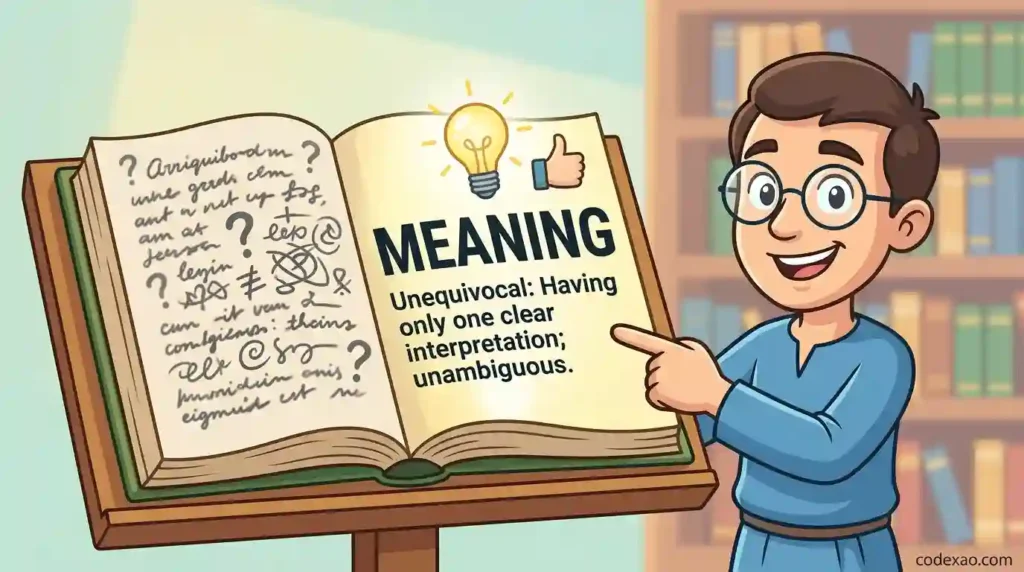
The unequivocal meaning of a word or statement is something that is completely clear, direct, and not open to interpretation. If something is unequivocal, it expresses one single idea without any confusion or ambiguity.
Quick Answer:
Unequivocal means completely clear, definite, and leaving no room for doubt or misunderstanding.
Origin of the Word
The word “unequivocal” comes from the prefix “un-” meaning “not,” and “equivocal,” which means ambiguous or unclear. The root “equivocal” traces back to Latin aequivocus, meaning “having double meaning.”
So literally, unequivocal = not having double meaning.
How the Meaning Evolved
Originally used in academic and legal writing, “unequivocal” has now expanded into everyday language, especially in journalism, politics, and professional communication where clarity is critical.
Pronunciation Guide
/ˌʌn.ɪˈkwɪv.ə.kəl/
(un-ih-KWIV-uh-kul)
How to Use “Unequivocal” Correctly in Texts & Chat
The word “unequivocal” is mostly used in formal or semi-formal contexts, but it can appear in casual conversations when someone wants to sound precise or dramatic.
Best Contexts for Usage:
- Formal writing (essays, reports, articles)
- Legal or political statements
- Academic discussions
- Strong emotional clarity in speech
Platform Usage
- WhatsApp / SMS: Rare, but used for emphasis
- Instagram captions: Used to sound intellectual or dramatic
- Twitter/X: Common in debates or opinions
- Discord / Reddit: Used in discussions or arguments
When NOT to Use It:
- Casual texting with friends (feels too formal)
- Memes or playful slang contexts
- Workplace chats unless communication is formal
Style Tips:
- No emoji needed (keeps it serious)
- Capitalization not required
- Works best in complete sentences
Example tone:
❌ “That’s unequivocal 😂” (awkward)
✅ “Her statement was unequivocal.”
Real Conversation Examples Using “Unequivocal”
👥 Between Friends
A: “Did he actually apologize?”
B: “Yes, it was an unequivocal apology, no excuses, just straight up.”
Shows complete honesty and no hidden meaning.
💼 Workplace Chat
Manager: “Are we launching the project this week?”
Employee: “Yes, that’s an unequivocal yes from the team.”
Communicates strong certainty and agreement.
❤️ Dating Conversation
A: “Do you want to keep seeing me?”
B: “My answer is unequivocal, I really like you.”
Expresses emotional clarity without hesitation.
🎮 Gaming Chat
Player 1: “Was that a fair win?”
Player 2: “Unequivocally yes, no glitches involved.”
Reinforces fairness and removes doubt.
📰 News Discussion
“The spokesperson gave an unequivocal denial of the allegations.”
Indicates strong, official rejection without ambiguity.
Common Mistakes & Misunderstandings
1. Confusing It with “Unique”
Many people think “unequivocal” means unique or special. It doesn’t. It’s about clarity, not rarity.
2. Using It in Casual Humor
Saying “That pizza was unequivocally good 😂” can feel overly dramatic or misplaced in casual speech.
3. Mispronouncing It
A common mistake is saying “un-equi-vocal” too slowly or incorrectly stressing syllables.
Generational Gap
- Older generations: Use it in formal speech or writing
- Gen Z: Uses it ironically or for dramatic effect
- Non-native speakers: Often confuse it with “equal” or “equity”
“Unequivocal” Across Different Platforms & Demographics
Gen Z Usage
Often used sarcastically or humorously:
“That outfit is unequivocally iconic.”
Millennials
More likely to use it correctly in professional or semi-formal contexts.
Professionals & Academics
Frequent usage in:
- Legal documents
- Scientific papers
- Political statements
Social Media Trends
It occasionally spikes in popularity during:
- Political debates
- Celebrity controversies
- Viral public statements
Formality Level
✔ Highly formal
✔ Safe for work (SFW)
❌ Not casual slang
Related Slang, Abbreviations & Alternatives
| Term | Meaning |
|---|---|
| Clear-cut | Very obvious and easy to understand |
| Unambiguous | Not open to multiple interpretations |
| Definite | Certain and fixed |
| Explicit | Fully stated without hiding meaning |
| Straightforward | Simple and easy to understand |
| Crystal clear | Extremely easy to understand |
| Black and white | Clearly defined, no gray area |
| Absolute | Total and complete certainty |
| Explicitly clear | Strong emphasis on clarity |
Learn more about related clarity terms like “unambiguous” and “explicit” for stronger writing precision.
FAQs:
What is the exact meaning of unequivocal?
Unequivocal means something that is completely clear and not open to interpretation. It leaves no doubt about its meaning or intention.
Is unequivocal a formal word?
Yes, it is primarily used in formal, academic, legal, and professional contexts where precision is important.
Can unequivocal be used in everyday conversation?
Yes, but it sounds formal. People usually use simpler words like “clear” or “obvious” in casual speech.
What is an example of unequivocal evidence?
Unequivocal evidence is proof that clearly supports a conclusion without doubt, such as DNA matching in a criminal case.
What is the opposite of unequivocal?
The opposite is “ambiguous,” meaning unclear or open to multiple interpretations.
Conclusion:
The unequivocal meaning is all about clarity, certainty, and removing any room for confusion.
Whether you see it in legal documents, news reports, or academic writing, it always signals something direct and unquestionable.
In a world where messages are often vague or misunderstood,understanding words like unequivocal gives you an edge in communication, making your writing sharper and your interpretation more accurate.
If you enjoyed this breakdown, try spotting “unequivocal” in real-life articles or conversations, you’ll notice how powerful it is when precision really matters.
Got a favorite word you want explained next? Drop it in your notes, you might be surprised how much meaning is hiding in everyday language.

Hi, I’m Isabella Brown, the voice behind Codexao.com, where meanings aren’t just explained, they’re made easy to understand.
I’ve always been fascinated by how words shape the way we think, speak, and connect. But let’s be honest—most definitions out there feel confusing, outdated, or just plain boring.
That’s exactly why I created Codexao. Here, I break down words, slang, and modern expressions into simple, clear meanings you can actually use in real life.