Ever stumbled across the word bagatelle while reading something and thought, “Wait… what does that even mean?” You’re not alone.
It’s one of those elegant, slightly old-fashioned words that still pops up in books, formal writing, and even cultural references, but rarely in everyday texting.
Understanding the bagatelle meaning is actually more useful than it seems. It helps you decode literature, improve vocabulary for exams, and even sound more articulate in writing.
Plus, words like this often carry hidden historical and cultural depth that modern slang just doesn’t have.
In this updated 2026 guide, you’ll learn exactly what bagatelle means, where it comes from, how to use it correctly, and why it still matters today.
We’ll also explore real examples, common mistakes, and how it appears in modern contexts. By the end, this word won’t feel mysterious anymore, it’ll feel like part of your vocabulary toolkit.
What Does “Bagatelle Meaning” Mean?
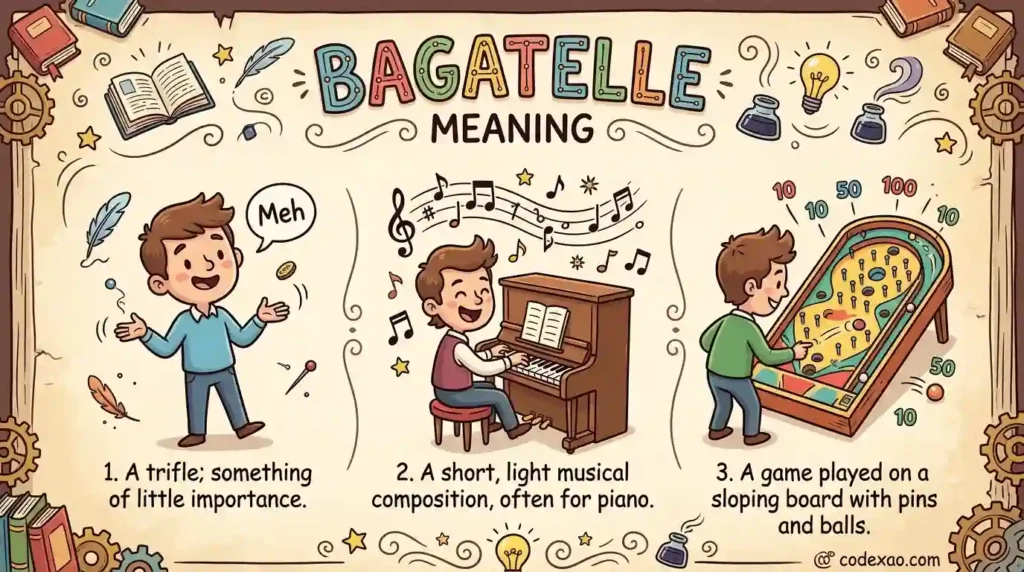
At its core, the bagatelle meaning is simple: something small, trivial, or of little importance.
📌 Quick Answer
Bagatelle means a minor or insignificant thing, often a trivial detail or something not worth serious attention.
Origin of the Word
The word comes from the French term bagatelle, which means “trifle” or “little thing.” It entered English in the 17th century, during a time when French heavily influenced English aristocratic and literary language.
Over time, its meaning expanded slightly:
- In literature → something unimportant or playful
- In music → a short, light composition
- In games → a tabletop game that evolved into modern pinball
Pronunciation
bag-uh-TEL (sounds elegant, almost musical)
Evolution of Meaning
Originally used in high society writing, “bagatelle” gradually became more niche. Today, it’s mostly found in literature, academic writing, or historical references rather than casual conversation.
How to Use “Bagatelle Meaning” Correctly in Texts & Chat
Even though it’s not common in texting slang, you can still use bagatelle in modern communication, just in the right tone.
✔️ Correct Usage Contexts
- Formal writing or essays
- Literary discussions
- Describing something minor or insignificant
- Humorously exaggerating a “small issue”
💬 Platform Usage
- WhatsApp / SMS: Rare, but can be used jokingly
- Instagram captions: Works in aesthetic or poetic captions
- X (Twitter): Used in intellectual or sarcastic posts
- Discord / Reddit: Found in discussion threads or literature communities
❌ When NOT to Use It
- Business emails (unless highly formal tone)
- Casual slang-heavy conversations
- Professional workplace chats
Styling Tips
- No need for capitalization unless starting a sentence
- No emojis required, but 🎭 or 📚 can add aesthetic tone
- Works best in a “soft intellectual” tone
Real Conversation Examples Using “Bagatelle Meaning”
👥 Between Friends
A: “You’re stressing over that missed call?”
B: “Yeah, it’s nothing serious.”
A: “Exactly, just a bagatelle.”
Meaning: A friend is saying the issue is too small to worry about.
💬 In a Group Chat
Person 1: “We lost the game by one point…”
Person 2: “It’s just a bagatelle in the bigger picture.”
Meaning: The loss is being treated as minor and not important.
💌 In a Romantic Context
A: “You forgot our movie plan.”
B: “I know, but don’t let that bagatelle ruin your mood.”
Meaning: The mistake is being minimized gently.
🎓 Academic Context
“Some critics consider the debate a mere bagatelle in modern political theory.”
Meaning: The debate is considered insignificant in academic terms.
🎮 Gaming Chat
“Don’t worry about that loss, it’s a bagatelle, we’ll win next round.”
Meaning: The defeat is being dismissed as unimportant.
Common Mistakes & Misunderstandings
❌ Mistake 1: Thinking It Means Something Big
Some people assume it means an event or object. In reality, it always refers to something minor.
❌ Mistake 2: Using It Like Slang
It is NOT modern slang like “lit” or “sus.” It’s a formal, literary word.
❌ Mistake 3: Overusing It
Using “bagatelle” in casual texting can sound unnatural or forced.
🌍 Cultural Misunderstanding
- Older readers may recognize it from literature
- Younger audiences may think it’s “fancy slang”
- Non-native speakers may confuse it with similar-sounding words
💡 How to Clarify Meaning
If someone doesn’t understand, simply say:
“It just means something small or unimportant.”
“Bagatelle Meaning” Across Different Platforms & Demographics
👶 Gen Z Usage
Rarely used directly, but might appear in aesthetic captions or ironic posts.
👩 Millennials
More likely to recognize it from reading, education, or vocabulary expansion.
👴 Older Generations
More familiar with its literary or formal usage.
📱 Social Media Presence
- TikTok: Rare
- Instagram: Aesthetic captions only
- Reddit: More common in discussion threads
- X (Twitter): Occasional intellectual usage
📊 Formal vs Informal
- Formality: High
- Tone: Literary, descriptive
- Safe for work: Yes
Related Slang, Abbreviations & Alternatives
| Term | Meaning |
|---|---|
| Trifle | Something unimportant |
| Minor issue | Small problem |
| Insignificant | Not important |
| Petty | Small and often emotional issue |
| Detail | Small part of something |
| Non-issue | Something not worth concern |
| Trivia | Small facts or details |
| Bagatelle (music) | Short light musical piece |
| Bagatelle (game) | Tabletop game similar to pinball |
Learn more about trifle vs insignificance in English usage for deeper vocabulary clarity.
FAQs:
Is bagatelle still used today?
Yes, but mostly in writing, literature, and academic contexts rather than daily speech.
Is bagatelle a negative word?
Not necessarily. It simply means something small or unimportant without strong negativity.
Can I use bagatelle in exams?
Yes, especially in essays or vocabulary-based questions where formal language is expected.
What language is bagatelle from?
It comes from French and entered English during the 17th century.
What is the opposite of bagatelle?
Words like “significant matter,” “important issue,” or “major concern” are opposites.
Conclusion:
The bagatelle meaning might seem simple on the surface, but it carries a rich history from French literature to modern English usage.
It describes something small, trivial, or not worth serious attention, but it does so in a refined, elegant way.
While you won’t see it in everyday texting, it still has value in writing, academic work, and intellectual conversation. Knowing words like this gives your language more depth and precision.
If you enjoy learning unique vocabulary like this, there’s a whole world of expressive English waiting to be explored.
Got your own favorite “rare” word? Share it in your notes, or better yet, use it in your next conversation and watch people get curious.

Hi, I’m Isabella Brown, the voice behind Codexao.com, where meanings aren’t just explained, they’re made easy to understand.
I’ve always been fascinated by how words shape the way we think, speak, and connect. But let’s be honest—most definitions out there feel confusing, outdated, or just plain boring.
That’s exactly why I created Codexao. Here, I break down words, slang, and modern expressions into simple, clear meanings you can actually use in real life.