Ever read a message like “I low key miss those days” and paused for a second? You’re not alone.
Slang evolves fast, and keeping up can feel like chasing trends that change overnight.
The phrase low key meaning slang has become one of the most widely used expressions in modern texting and social media.
From TikTok comments to WhatsApp chats, people use it to express feelings, but in a toned-down, almost casual way.
Why does it matter? Because understanding slang like this helps you read between the lines. Sometimes “low key” means more than it seems.
In this guide (Updated for 2026), you’ll learn exactly what “low key” means, where it came from, how to use it naturally, and the mistakes people often make.
By the end, you’ll use it like a native texter, no second guessing.
What Does “Low Key” Mean?
Definition:
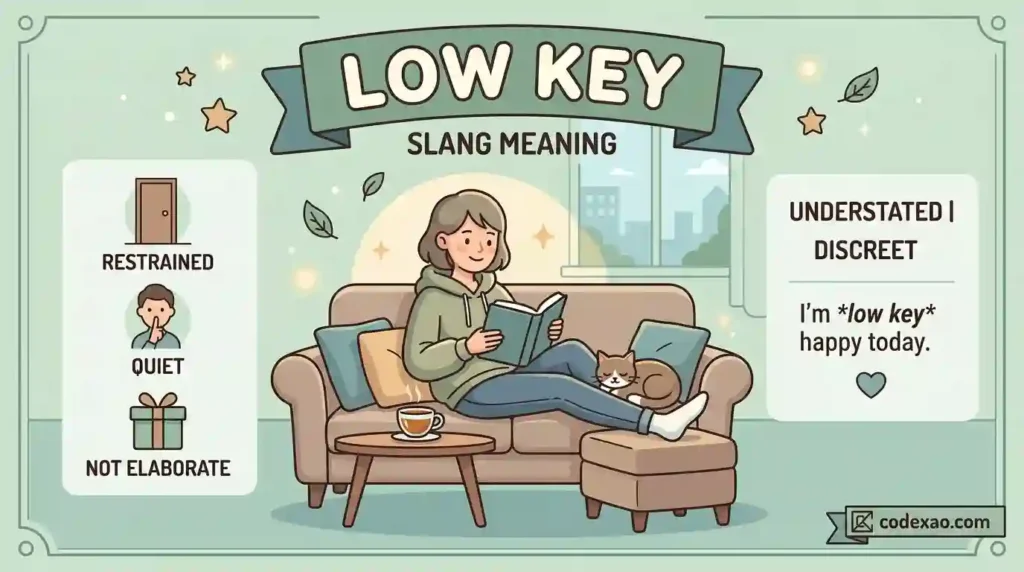
“Low key” means slightly, secretly, or subtly. It’s used to express something without making it sound too intense or obvious.
Quick Answer:
“Low key” means expressing something in a subtle or understated way, often to downplay emotions, opinions, or reactions.
Origin of “Low Key”
Originally, “low-key” came from photography and lighting, referring to dark, soft lighting with minimal contrast. Over time, it shifted into everyday language.
By the early 2010s, it became popular on platforms like Twitter and Tumblr. Then Gen Z pushed it into mainstream use across TikTok, Instagram, and texting culture.
Evolution of Meaning
- Old meaning: calm, simple, not flashy
- Modern slang: secretly, slightly, kind of
Pronunciation
“Low key” is pronounced exactly as written:
loh kee
How to Use “Low Key” Correctly in Texts & Chat
Using “low key” is easy, but using it naturally is where people slip up.
Tone & Context
“Low key” is:
- Casual
- Slightly emotional
- Often humorous or honest
It softens your statement.
Example:
- “I like this show” → direct
- “I low key like this show” → softer, more relatable
Platform-Specific Usage
- WhatsApp/SMS: Personal chats, confessions
- Instagram DMs: Light opinions, reactions
- TikTok comments: Subtle humor or agreement
- Discord/Reddit: Casual discussions
When to Use It
✔ When you want to:
- Downplay feelings
- Sound relatable
- Avoid sounding too intense
When NOT to Use It
❌ Avoid in:
- Job emails
- Formal writing
- Professional conversations
Formatting Tips
- Lowercase is most common: low key
- Sometimes written as one word: lowkey
- Often paired with emojis:
- 😅 (awkward honesty)
- 👀 (hidden feelings)
- 😂 (playful tone)
Real Conversation Examples Using “Low Key”
1. Between Friends
A: “You still watch that show?”
B: “Yeah… I low key love it now 😅”
👉 Emotion: Admitting something slightly embarrassing.
2. Dating Scenario
A: “Did you enjoy the date?”
B: “I low key want to see them again.”
👉 Emotion: Subtle excitement without sounding too eager.
3. Family Chat
Mom: “Do you miss home food?”
You: “Low key, yeah 😭”
👉 Emotion: Honest but softened emotional response.
4. Work Chat (Casual Team)
Colleague: “This project is tough.”
You: “Low key enjoying the challenge.”
👉 Emotion: Positive attitude, but not overly enthusiastic.
5. Gaming Chat
Friend: “That level was easy.”
You: “Low key struggled there 💀”
👉 Emotion: Self-aware humor.
Common Mistakes & Misunderstandings
1. Using It Too Seriously
Some people think “low key” means very strongly. It doesn’t.
❌ “I low key hate this” (sounds softer than intended)
✔ Use stronger wording if needed.
2. Generational Confusion
- Gen Z: uses it naturally
- Millennials: understand it
- Older generations: may interpret it literally
Example misunderstanding:
Someone might think “low key” means “quiet” instead of “slightly.”
3. Overusing It
Using it in every sentence makes it lose impact.
❌ “I low key like this, low key want more, low key excited”
✔ Use sparingly for emphasis.
How to Clarify
If someone doesn’t get it, just say:
“Low key means kind of or secretly.”
Simple fixes confusion instantly.
“Low Key” Across Different Platforms & Demographics
Gen Z vs Millennials
- Gen Z: Uses “low key” frequently and casually
- Millennials: Use it, but less often
- Older users: Rarely use it
Social Media Usage
- TikTok: Extremely common
- Instagram: Used in captions & comments
- Discord: Casual chats
- Reddit: More occasional
Formal or Informal?
- 100% informal
- Not workplace-safe (in formal settings)
Viral Popularity
“Low key” became widely popular through meme culture and short-form videos, where subtle humor thrives.
Related Slang, Abbreviations & Alternatives
Here are similar expressions you’ll often see:
| Slang Term | Meaning |
|---|---|
| High key | The opposite, openly or strongly |
| Kinda | Slightly or somewhat |
| Lowkey | Same as low key (different spelling) |
| TBH | To be honest |
| NGL | Not gonna lie |
| IMO | In my opinion |
| Low effort | Minimal effort (different meaning) |
| Slightly | Formal alternative |
| Secretly | Close synonym |
| Honestly | Similar tone in context |
FAQs:
What does low key mean in slang?
“Low key” means expressing something subtly or slightly. It’s often used to downplay emotions or opinions, like saying you “kind of” feel something without making it sound too strong or obvious.
Is low key positive or negative?
It can be both. “Low key” simply softens the intensity of a statement. You can use it for positive feelings (“I low key love this”) or negative ones (“I low key hate this”), depending on context.
What’s the difference between low key and high key?
“Low key” means subtle or understated, while “high key” means obvious or intense. For example, “I low key like it” is mild, but “I high key love it” shows strong enthusiasm.
How do you use low key in a sentence?
You place “low key” before the main emotion or opinion. Example: “I low key miss those days.” It works best in casual conversation or texting, not formal writing.
Is low key formal or informal language?
“Low key” is informal slang. It’s suitable for texting, social media, and casual chats but should be avoided in professional emails, academic writing, or formal communication.
Conclusion:
“Low key” might seem like a small phrase, but it carries a lot of nuance. It lets you express feelings without going all in, perfect for today’s casual, layered communication style.
Whether you’re admitting a secret crush or casually enjoying something unexpected, low key meaning slang helps you say it without saying too much.
Use it wisely, keep it natural, and don’t overdo it. That’s the real trick.
Got a favorite slang term you use all the time? Drop it in the comments and let’s decode it together.

Hi, I’m Isabella Brown, the voice behind Codexao.com, where meanings aren’t just explained, they’re made easy to understand.
I’ve always been fascinated by how words shape the way we think, speak, and connect. But let’s be honest—most definitions out there feel confusing, outdated, or just plain boring.
That’s exactly why I created Codexao. Here, I break down words, slang, and modern expressions into simple, clear meanings you can actually use in real life.