Have you ever heard someone say they appointed an attorney in fact and immediately assumed they hired a lawyer? You’re not alone.
The term attorney in fact meaning is one of the most misunderstood legal phrases. Many people believe it refers to a licensed attorney, but that’s not always true.
In reality, an attorney in fact can be a spouse, family member, close friend, or any trusted person given legal authority to act on another person’s behalf.
Understanding this term matters more than ever.
Whether you’re planning for retirement, handling family finances, preparing for emergencies, or helping an aging parent, knowing how an attorney in fact works can save time, money, and confusion.
In this updated 2026 guide, you’ll learn exactly what attorney in fact means, how it differs from an attorney at law, when it is used, practical examples, common mistakes, and answers to the most frequently asked questions.
What Does Attorney in Fact Mean?
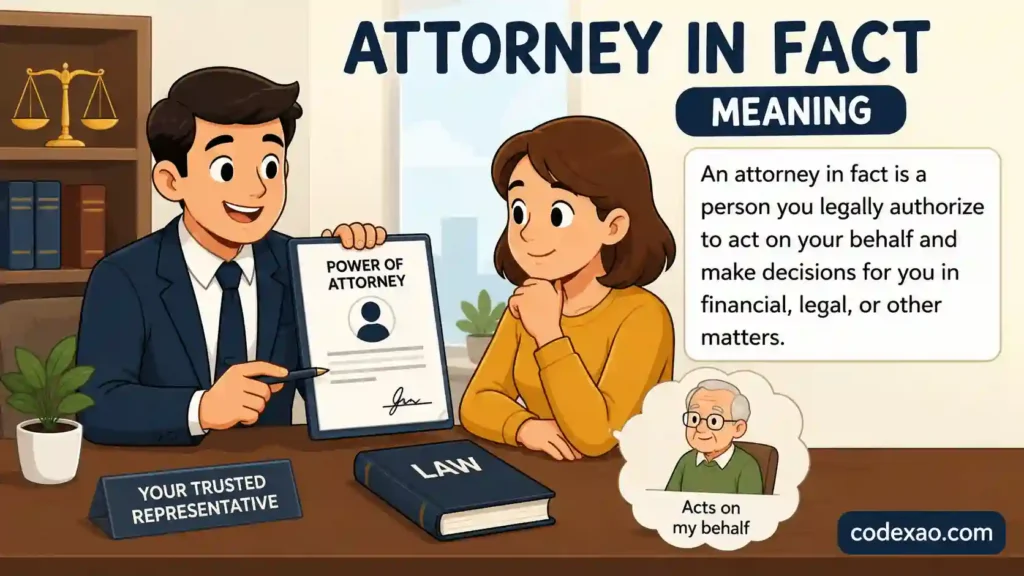
Attorney in fact meaning refers to an individual who has been legally authorized to act on behalf of another person through a power of attorney document.
Unlike an attorney at law, an attorney in fact does not need legal training or a law license.
Quick Answer
An attorney in fact is a trusted person authorized through a power of attorney to make decisions or perform actions for someone else.
Origin of the Term
The phrase comes from traditional legal language used in common law systems. Historically, the word attorney meant a person appointed to act for another.
Over time, the legal profession adopted the title attorney for lawyers. To avoid confusion, the term attorney in fact remained for individuals acting under a power of attorney.
How the Meaning Has Evolved
Today, the term is most commonly associated with estate planning, elder care, healthcare decisions, and financial management.
Modern legal documents continue to use the phrase because it clearly identifies the authorized representative.
Pronunciation Guide
Attorney in fact
Pronounced as:
uh-TUR-nee in FAKT
How to Use Attorney in Fact Correctly in Legal and Everyday Contexts
The term is primarily used in legal, financial, and healthcare situations.
Common Contexts
- Managing bank accounts
- Paying bills
- Selling property
- Signing contracts
- Making healthcare decisions
- Handling business matters
Appropriate Usage
Correct example:
“My mother named me as her attorney in fact through a durable power of attorney.”
Another example:
“The attorney in fact signed the real estate paperwork on behalf of the property owner.”
When Not to Use It
Do not use attorney in fact to describe:
- A lawyer representing a client in court
- A legal advisor
- A law firm employee
Those roles are usually referred to as attorneys, lawyers, or attorneys at law.
Professional vs Casual Contexts
The phrase is considered formal legal terminology. It rarely appears in casual conversation unless someone is discussing estate planning, medical decisions, or legal authority.
Real Conversation Examples Using Attorney in Fact
Family Situation
Sarah: Dad is recovering from surgery. Who is managing his finances?
Mike: I’m his attorney in fact under a durable power of attorney.
Meaning: Mike has legal authority to handle financial matters for his father.
Elder Care Example
Nurse: Who is authorized to discuss the patient’s care plan?
Emily: I’m the attorney in fact listed in her healthcare documents.
Meaning: Emily has legal permission to make certain decisions.
Real Estate Transaction
Agent: The homeowner couldn’t attend the closing.
Buyer: Who signed the paperwork?
Agent: His attorney in fact handled everything.
Meaning: The representative legally acted for the homeowner.
Business Scenario
Partner: Who approved the agreement?
Manager: The owner’s attorney in fact signed it.
Meaning: The authorized representative completed the transaction.
Financial Planning Example
Advisor: Have you designated someone to manage your affairs if needed?
Client: Yes, my daughter is my attorney in fact.
Meaning: The daughter can act on the client’s behalf under specified circumstances.
Common Mistakes and Misunderstandings
Mistake 1: Assuming an Attorney in Fact Is a Lawyer
This is by far the most common misunderstanding.
An attorney in fact can be anyone the principal trusts. No legal degree is required.
Mistake 2: Believing They Have Unlimited Authority
An attorney in fact only has the powers granted in the power of attorney document.
Some documents grant broad authority. Others provide very limited powers.
Mistake 3: Confusing the Person with the Document
Many people mix up these terms:
- Power of attorney = legal document
- Attorney in fact = person receiving authority
The distinction is important.
Generational Differences
Older generations are often more familiar with the term because estate planning documents frequently use it.
Younger adults may know the phrase only after helping parents or grandparents with legal matters.
How to Clarify the Meaning
A simple explanation works best:
“An attorney in fact is not necessarily a lawyer. It’s a person authorized to act for someone else.”
Attorney in Fact Across Different Situations and Demographics
Estate Planning
This is where the term appears most often.
People commonly appoint:
- Spouses
- Adult children
- Siblings
- Trusted friends
- Professional fiduciaries
Healthcare Decisions
Healthcare powers of attorney frequently designate an attorney in fact to make medical decisions if the principal becomes unable to communicate.
Financial Management
An attorney in fact may:
- Access accounts
- Pay bills
- Manage investments
- Handle taxes
- Conduct transactions
Business Operations
Business owners sometimes appoint an attorney in fact to manage specific matters when they are unavailable.
Formality Level
The term is highly formal and legal.
Safe for work: Yes
Professional use: Yes
Casual use: Rare
Related Legal Terms, Abbreviations and Alternatives
| Term | Meaning |
|---|---|
| Power of Attorney | Legal document granting authority |
| Durable Power of Attorney | Remains effective after incapacity |
| Principal | Person granting authority |
| Agent | Another term for attorney in fact |
| Attorney at Law | Licensed lawyer |
| Fiduciary | Person obligated to act in another’s best interest |
| Executor | Handles a deceased person’s estate |
| Guardian | Court-appointed caretaker |
| Conservator | Manages affairs for someone unable to do so |
| Legal Representative | General term for authorized decision-maker |
Similar Terms
- Agent
- Authorized representative
- Proxy
- Legal delegate
Opposite Concepts
- Unauthorized individual
- Unappointed representative
- Third party without authority
FAQs:
What does attorney in fact mean in simple terms?
An attorney in fact is someone legally chosen to act on another person’s behalf through a power of attorney document. They can perform only the tasks authorized in that document.
Is an attorney in fact the same as a lawyer?
No. An attorney in fact does not need legal training or a law license. The role simply involves acting as an authorized representative.
Can an attorney in fact make financial decisions?
Yes. If the power of attorney document grants financial authority, the attorney in fact can manage accounts, pay bills, and conduct approved transactions.
Can family members serve as attorneys in fact?
Absolutely. Many people choose spouses, adult children, siblings, or trusted relatives because they understand the person’s wishes and circumstances.
When does an attorney in fact lose authority?
Authority typically ends when the principal revokes it, the document expires, the principal dies, or a court invalidates the arrangement.
What is the difference between attorney in fact and attorney at law?
An attorney in fact is an authorized representative. An attorney at law is a licensed legal professional qualified to provide legal advice and represent clients in court.
Conclusion:
Understanding attorney in fact meaning is easier once you separate the role from the legal profession.
An attorney in fact is not necessarily a lawyer. Instead, it is a trusted individual authorized through a power of attorney to act on someone else’s behalf.
Whether the authority involves finances, healthcare decisions, property transactions, or personal affairs, the attorney in fact plays a critical role in helping people manage important responsibilities when they cannot do so themselves.
If you found this guide helpful, explore more legal definitions and modern communication terms to build your knowledge and stay informed.
Explore more legal terms:
- Power of Attorney Meaning
- Durable Power of Attorney Explained
- Attorney at Law vs Attorney in Fact

Hi, I’m John Mark, the voice behind codexao.com, where meanings aren’t just explained, they’re simplified for the way people actually talk today.
I’ve always been curious about words, how they change, how they trend, and how a simple phrase can carry completely different meanings depending on context. That curiosity turned into codexao, a space where I break down slang, text abbreviations, and everyday words into clear, easy-to-understand explanations.