Have you ever listened to someone talk for several minutes and realized they still have not made a clear point?
Maybe it was a politician during a debate, a coworker in a meeting, or even a friend telling a story that seemed to go on forever.
There is actually a perfect word for that behavior: bloviate.
Understanding the bloviate meaning can instantly improve your vocabulary and help you describe long-winded conversations more accurately.
While the word has been around for well over a century, it remains surprisingly relevant in today’s world of podcasts, social media commentary, political speeches, and endless online discussions.
This guide explains exactly what bloviate means, where it came from, how to use it correctly, and when it fits naturally into modern conversations.
You’ll also discover practical examples, common mistakes, and related words that can expand your vocabulary even further.
What Does Bloviate Mean?
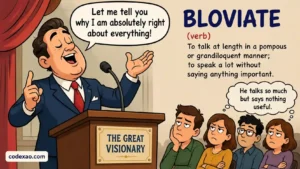
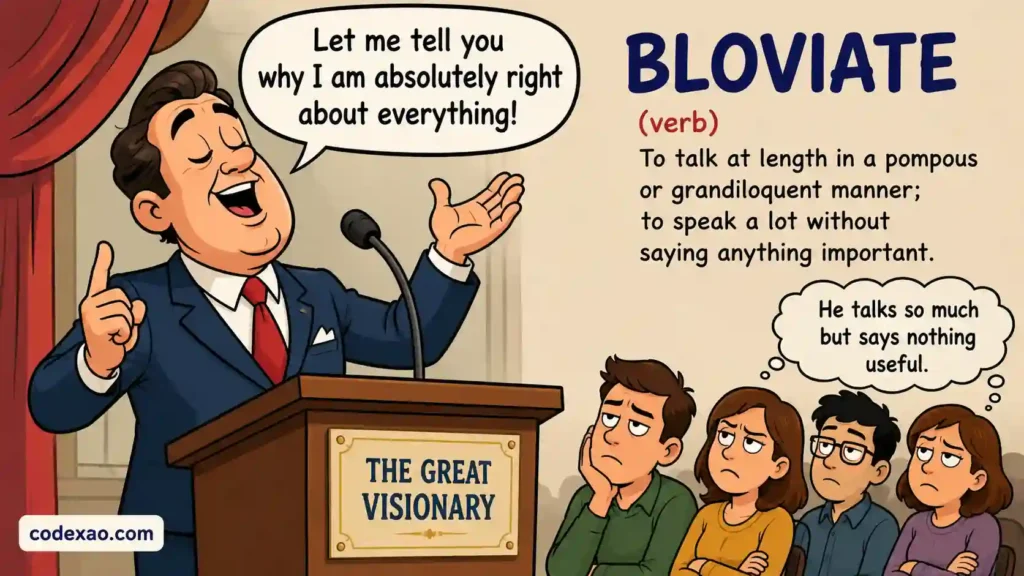
Bloviate means to talk for a long time in a pompous, boastful, or overly wordy way without saying anything particularly important.
In simple terms, a person who bloviates talks a lot but communicates very little.
Quick Answer
Bloviate means speaking at great length in an inflated or self-important manner, often without providing meaningful information.
Origin of the Word
The word bloviate originated in the United States during the 19th century. Linguists believe it emerged as humorous political slang in the American Midwest.
One of the people often associated with the term is former United States President Warren G. Harding, who reportedly used colorful language and expressions that popularized the word.
Over time, bloviate evolved from a regional expression into a recognized English vocabulary term used by journalists, writers, commentators, and everyday speakers.
Pronunciation
Bloviate is pronounced as:
bloh-vee-ate
The emphasis falls on the first syllable.
How to Use Bloviate Correctly in Texts and Chat
Bloviate is usually used when describing someone else’s communication style rather than your own.
Appropriate Contexts
You can use bloviate when someone:
- Talks excessively
- Sounds self-important
- Repeats the same points
- Uses too many unnecessary words
- Avoids getting to the point
Common Tone
The word often carries a slightly critical or humorous tone.
Examples include:
- Political commentary
- Workplace discussions
- Academic debates
- Social media conversations
- Casual chats among friends
When Not to Use It
Avoid using bloviate when someone is:
- Giving detailed instructions
- Teaching a complex topic
- Telling a meaningful story
- Providing important information
Length alone does not equal bloviating. The key issue is excessive talking without substance.
Platform-Specific Usage
SMS and Text Messages
Used jokingly when someone sends extremely long messages.
Example:
“Wow, you really bloviated in that text.”
Common in group chats when discussions become repetitive.
Often appears in comment sections discussing public figures or influencers.
X
Frequently used in political discussions and opinion threads.
Popular in debates where users criticize overly lengthy explanations.
Discord
Gamers and community members sometimes use it when someone dominates voice chat conversations.
Real Conversation Examples Using Bloviate
Between Friends
Friend 1:
How was the meeting?
Friend 2:
The manager spent 40 minutes bloviating before explaining the actual plan.
Meaning:
The manager talked excessively before sharing useful information.
Dating Scenario
Alex:
How was your date?
Sam:
Nice person, but they bloviated about their achievements all evening.
Meaning:
The date focused too much on self-promotion.
Family Discussion
Parent:
What happened at the town meeting?
Child:
One speaker just bloviated for half an hour and never answered the question.
Meaning:
The speaker talked a lot without providing clear answers.
Workplace Chat
Coworker:
Did the presentation help?
Employee:
Not really. The consultant bloviated instead of showing practical solutions.
Meaning:
The presentation contained more talk than useful advice.
Gaming Community
Player 1:
Why did we lose?
Player 2:
Our team leader spent more time bloviating than coordinating.
Meaning:
The leader talked excessively instead of focusing on gameplay.
Common Mistakes and Misunderstandings
Mistake 1: Thinking It Means Any Long Speech
Many people assume every lengthy speech qualifies as bloviating.
That is incorrect.
A detailed lecture or informative presentation is not bloviating if it provides valuable information.
Mistake 2: Using It as a Compliment
Bloviate usually carries negative or sarcastic undertones.
Calling someone a great bloviator rarely sounds flattering.
Mistake 3: Confusing It with Public Speaking
Being a strong public speaker is very different from bloviating.
Effective speakers communicate clearly and efficiently. People who bloviate often prioritize sounding impressive over being informative.
Generational Differences
Older generations may encounter the word more frequently in newspapers and political commentary.
Gen Z and younger millennials often use simpler alternatives like:
- Rambling
- Yapping
- Talking in circles
- Overexplaining
Cultural Differences
The word is most common in American English. People in other English-speaking countries may understand it but use it less frequently.
If someone seems confused, simply explain:
“I mean they talked a lot without saying much.”
Bloviate Across Different Platforms and Demographics
Gen Z Usage
Gen Z tends to use more casual alternatives, but bloviate occasionally appears in memes and political discussions.
Millennials
Millennials often encounter the term in workplace communication, journalism, and opinion articles.
Older Generations
Older adults may recognize bloviate from political reporting and traditional media sources.
Social Media Presence
TikTok
Less common but occasionally appears in educational and political content.
Used in captions discussing celebrities, influencers, and public figures.
Discord
Appears in debates and community discussions.
One of the most common places to see the word used naturally.
Formality Level
| Context | Appropriate |
|---|---|
| Casual Conversation | Yes |
| Social Media | Yes |
| Journalism | Yes |
| Academic Writing | Sometimes |
| Business Email | Rarely |
| Legal Documents | No |
The word is generally considered informal to semi-formal.
Related Slang, Abbreviations and Alternatives
| Word | Meaning |
| Ramble | Speak without clear direction |
| Pontificate | Speak in a self-important way |
| Lecture | Give a lengthy explanation |
| Yap | Talk excessively |
| Drone On | Continue talking monotonously |
| Babble | Talk rapidly and meaninglessly |
| Prattle | Speak foolishly at length |
| Monologue | Deliver a long speech alone |
| Grandstand | Seek attention through public speaking |
| Verbose | Use more words than necessary |
Synonyms
- Ramble
- Pontificate
- Expound endlessly
- Drone on
- Overexplain
- Monopolize conversation
Opposite Terms
- Concise
- Brief
- Succinct
- Direct
- Straightforward
FAQs:
What does bloviate mean in simple words?
Bloviate means talking too much in a way that sounds important but contains little useful information. It often suggests unnecessary length and self-importance.
Is bloviate an insult?
Not always, but it is usually mildly critical. The term often implies that someone is speaking excessively without contributing meaningful ideas.
Can bloviate be used in professional writing?
Yes, especially in opinion pieces, journalism, and commentary. However, it may sound informal in highly technical or academic writing.
What is the difference between rambling and bloviating?
Rambling simply means talking without a clear structure. Bloviating adds an element of self-importance or inflated speech.
Why is bloviate often associated with politics?
Political speeches sometimes become lengthy, repetitive, or overly dramatic. As a result, commentators frequently use bloviate when discussing politicians who talk extensively without directly answering questions.
Conclusion:
The bloviate meaning is simple once you understand it. It refers to speaking at length in a pompous, inflated, or overly wordy way while offering little substance.
Although the word originated more than a century ago, it remains highly relevant in modern conversations, workplace discussions, media commentary, and online debates.
The next time you hear someone talking endlessly without making a clear point, you’ll know exactly which word fits the situation: bloviate.
Have a favorite unusual English word? Share it in the comments and keep exploring more fascinating vocabulary and internet language trends.

Hi, I’m Isabella Brown, the voice behind Codexao.com, where meanings aren’t just explained, they’re made easy to understand.
I’ve always been fascinated by how words shape the way we think, speak, and connect. But let’s be honest—most definitions out there feel confusing, outdated, or just plain boring.
That’s exactly why I created Codexao. Here, I break down words, slang, and modern expressions into simple, clear meanings you can actually use in real life.