Have you ever come across the word Brahmin in a book, history lesson, religious discussion, or online conversation and wondered what it actually means? You’re not alone.
The term has existed for thousands of years and continues to appear in discussions about culture, religion, history, and social identity.
Understanding the Brahmin meaning is important because the word carries deep historical, religious, and cultural significance.
While many people recognize it as a Hindu caste, the full story is much more complex and fascinating.
In this updated 2026 guide, you’ll learn the definition of Brahmin, its historical origins, traditional roles, modern usage, common misconceptions, and how the term is understood around the world today.
What Does Brahmin Mean?
The word Brahmin refers to a member of the highest traditional social category in the ancient Hindu varna system.
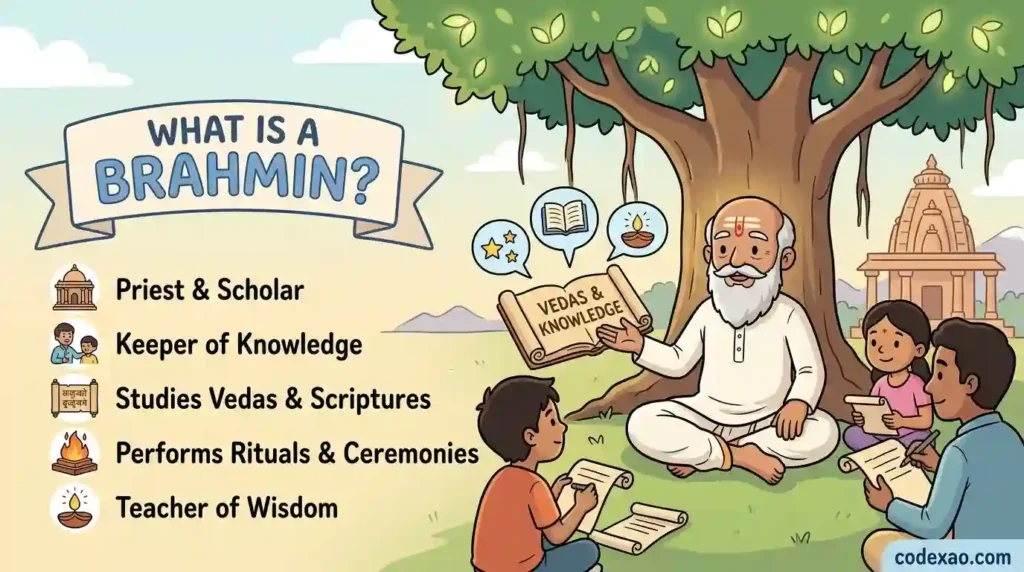
Historically, Brahmins were responsible for preserving sacred knowledge, performing religious ceremonies, teaching scriptures, and guiding spiritual practices. They were often regarded as scholars and custodians of religious traditions.
Quick Answer
Brahmin means a member of the traditional Hindu priestly and scholarly class, historically associated with learning, teaching, and religious duties.
Origin of the Word
The term comes from the Sanskrit word “Brahmana,” which is connected to “Brahman,” a concept representing ultimate reality and divine truth in Hindu philosophy.
Ancient Hindu texts such as the Vedas and later scriptures frequently mention Brahmins as individuals dedicated to spiritual learning and religious service.
Pronunciation
Brahmin is commonly pronounced as:
BRAH-min
The first syllable sounds similar to “bra” and the second syllable sounds like “min.”
How the Brahmin Concept Originated
To understand Brahmin meaning fully, it’s helpful to look at ancient Indian society.
Traditional Hindu texts describe four primary varnas:
Brahmins
Associated with knowledge, teaching, and religious duties.
Kshatriyas
Associated with governance, leadership, and military responsibilities.
Vaishyas
Associated with commerce, agriculture, and trade.
Shudras
Associated with service and skilled labor.
In theory, these groups represented social functions. Over centuries, the system became more complex and evolved into thousands of caste groups throughout South Asia.
Historically, Brahmins played a major role in preserving sacred texts, conducting rituals, and transmitting knowledge from one generation to the next.
Traditional Roles of Brahmins
Throughout history, Brahmins were known for several important responsibilities.
Religious Ceremonies
One of the most recognized duties involved conducting rituals, prayers, weddings, and other religious ceremonies.
Teaching and Education
Before modern educational institutions existed, many Brahmins served as teachers who passed down knowledge of philosophy, mathematics, literature, and sacred texts.
Scholarship
Brahmins contributed significantly to ancient Indian scholarship. Many were respected philosophers, astronomers, linguists, and writers.
Spiritual Guidance
Communities often sought advice from Brahmins on religious practices and ethical matters.
Real-World Examples of Brahmin Usage
Unlike internet slang or texting abbreviations, Brahmin is generally used in cultural, historical, religious, or academic discussions.
Historical Context
“The village Brahmin was responsible for conducting important religious ceremonies.”
Meaning: Refers to a traditional priest or religious scholar.
Educational Discussion
“Ancient Brahmins preserved important philosophical texts.”
Meaning: Highlights their historical role as scholars.
Cultural Conversation
“My family has Brahmin ancestry.”
Meaning: Refers to family heritage or caste background.
Academic Writing
“The Brahmin community influenced religious and intellectual traditions across India.”
Meaning: Describes historical social influence.
Modern Social Discussion
“The role of Brahmins in modern society has evolved significantly.”
Meaning: Focuses on changing social dynamics.
Common Misunderstandings
Many people misunderstand the term Brahmin. Here are some common misconceptions.
Thinking Brahmin Means Priest Only
While many Brahmins historically served as priests, not all Brahmins were priests. Some were teachers, scholars, administrators, and writers.
Assuming All Brahmins Have the Same Lifestyle
Brahmin communities vary widely across regions, languages, traditions, and economic backgrounds.
Confusing Varna and Caste
The ancient varna system and modern caste identities are not exactly the same. Over centuries, social structures became much more complex.
Assuming the Role Never Changed
Modern Brahmins work in virtually every profession imaginable, including technology, medicine, law, business, education, and government.
Brahmins in Modern Society
The meaning of Brahmin today often depends on context.
Cultural Identity
For many people, Brahmin refers primarily to ancestry, family heritage, and cultural traditions.
Religious Context
In religious settings, the term may still describe individuals who perform traditional rituals and ceremonies.
Academic Context
Historians and scholars often discuss Brahmins when studying ancient Indian civilization, religion, and social structures.
Global Context
As Indian communities have migrated worldwide, Brahmin identity has become part of broader discussions about culture, heritage, and diaspora experiences.
Brahmin Across Different Generations
Older Generations
Older individuals may associate the term strongly with traditional social and religious roles.
Millennials
Many Millennials view Brahmin identity through both cultural heritage and modern professional life.
Gen Z
Younger generations often discuss Brahmin identity within broader conversations about history, equality, social change, and cultural roots.
Online Discussions
Social media platforms frequently feature conversations about caste history, cultural traditions, and personal identity, where the term Brahmin may appear.
Related Terms and Concepts
| Term | Meaning |
|---|---|
| Brahman | Ultimate reality in Hindu philosophy |
| Brahmana | Sanskrit term related to Brahmins |
| Varna | Ancient social classification system |
| Kshatriya | Traditional warrior and ruler class |
| Vaishya | Traditional merchant and trader class |
| Shudra | Traditional service class |
| Vedas | Ancient Hindu sacred texts |
| Hinduism | Religion in which the Brahmin concept originated |
| virtuoso | Spiritual teacher or guide |
| Priest | Religious officiant who conducts ceremonies |
Similar Concepts
- Scholar
- Teacher
- Spiritual guide
- Religious leader
Opposite Ideas
There is no direct antonym, but roles associated with military leadership or commerce traditionally belonged to different varnas.
FAQs:
What does Brahmin mean in Hinduism?
Brahmin refers to the traditional priestly and scholarly group within the ancient Hindu social system. They were historically responsible for education, religious rituals, and preserving sacred knowledge.
Is Brahmin a caste or a religion?
Brahmin is not a religion. It is traditionally considered a social and cultural category within Hindu society.
Are all Brahmins priests?
No. Although priesthood is commonly associated with Brahmins, many Brahmins historically worked as scholars, teachers, philosophers, and advisors. Today, they work in countless professions.
What is the origin of the Brahmin community?
The concept originates from ancient Hindu texts and the traditional varna system described in early religious literature.
Does Brahmin still matter today?
Its significance varies depending on culture, region, family traditions, and personal beliefs. For some, it represents heritage. For others, it is mainly a historical concept.
Can someone become a Brahmin?
Historically, Brahmin identity was generally inherited through family lineage. Modern discussions on identity and social classification can vary depending on cultural and regional perspectives.
What language does the word Brahmin come from?
The term originates from Sanskrit, one of the world’s oldest recorded languages and the language of many ancient Hindu texts.
Conclusion:
The Brahmin meaning goes far beyond a simple dictionary definition. It represents a historical tradition associated with scholarship, teaching, religious practice, and the preservation of knowledge.
Over thousands of years, the role of Brahmins has evolved alongside changes in society, education, culture, and religion.
While the traditional responsibilities remain important in some communities, modern Brahmins participate in every field of professional and social life.
Whether you’re studying history, exploring Hindu traditions, or simply curious about the term, understanding Brahmin meaning provides valuable insight into one of the world’s oldest cultural and intellectual traditions.
What historical or cultural term would you like to explore next? Share it in the comments and continue expanding your knowledge.

Hi, I’m John Mark, the voice behind codexao.com, where meanings aren’t just explained, they’re simplified for the way people actually talk today.
I’ve always been curious about words, how they change, how they trend, and how a simple phrase can carry completely different meanings depending on context. That curiosity turned into codexao, a space where I break down slang, text abbreviations, and everyday words into clear, easy-to-understand explanations.