Have you ever noticed someone tapping their fingers, rocking slightly, humming, twirling their hair, or repeating a sound when they are excited or stressed? You may have heard someone describe that behavior by saying, “That’s a stim.”
But what does stims meaning actually involve?
The word can look like internet slang at first, especially when it appears in TikTok comments, Reddit discussions, Instagram posts, or conversations about autism and neurodiversity. In reality, it has a specific meaning connected to self-stimulatory behavior.
Stims can involve movement, sound, touch, sight, or other sensory experiences. Some are obvious, while others are so subtle that nobody else notices them.
A person might tap their foot under a desk, twist a strand of hair, hum quietly, or repeatedly move an object in a particular way.
Understanding the word matters because stimming is often misunderstood. It is not simply “weird behavior,” and it does not automatically indicate autism.
In this guide, we will break down what stims mean, where the word comes from, common examples, how people use it online, common misunderstandings, and how different generations may understand the term.
What Does Stims Mean?
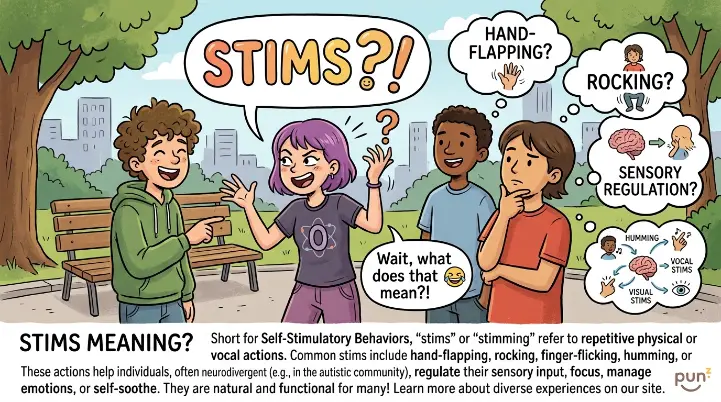
Stims is the plural form of stim, which is commonly used as a shortened form of self-stimulatory behavior.
A stim is generally a repetitive action, movement, sound, or sensory activity that provides some type of sensory or emotional benefit. People may use stims to regulate themselves, handle overwhelming situations, express excitement, maintain focus, seek sensory input, or experience comfort.
The term is especially common when discussing autism and neurodiversity.
Quick Answer
Stims means repetitive or self-stimulating behaviors that can help a person manage sensory input, emotions, attention, excitement, stress, or comfort. The term is short for self-stimulatory behavior and is commonly used when talking about autism and neurodivergence.
Where Does the Word Stim Come From?
The word stim comes from the idea of self-stimulation. Over time, the shorter form became common in everyday conversations, especially among autistic people, neurodivergent communities, families, educators, and healthcare professionals.
Today, you may see both stim and stimming used frequently.
For example:
- “That tapping is one of my stims.”
- “I start stimming when I get overwhelmed.”
- “Do you have any favorite stims?”
- “Rocking is a common stim for me.”
The word has also become more visible online because social media has helped people talk openly about neurodiversity and personal sensory experiences.
How Has the Meaning Changed?
Older discussions often treated repetitive behaviors mainly as symptoms or behaviors that needed to be reduced.
Modern conversations are more likely to consider why someone is stimming and what function the behavior serves. A stim may help someone feel calmer, manage sensory input, concentrate, communicate excitement, or cope with an overwhelming environment.
That difference is important. Instead of simply asking, “How do we stop this behavior?” a more useful question can be, “What is this behavior helping the person manage?”
How Do You Pronounce Stim?
Stim is usually pronounced like stim, rhyming approximately with “him.”
Stims sounds like “stims,” with a clear s at the end.
How to Use Stims Correctly in Texts and Chat
The word stims is informal but widely understood in online conversations about autism, sensory experiences, neurodiversity, and self-regulation.
You might see it in a personal post, group chat, Reddit discussion, Discord server, or casual conversation.
Casual Example
Someone might write:
“When I am nervous, I start tapping my fingers. It is one of my stims.”
Here, the person is describing a repetitive action that helps them manage a particular emotional or sensory state.
Another example is:
“I bought this little fidget because it is one of my favorite stims.”
In this case, the person is talking about an object or activity that provides satisfying sensory input.
Stims in Text Messages
In SMS or private messages, people generally use the word naturally without special formatting.
Examples include:
- “Do you have any stims?”
- “I was stimming during the movie.”
- “This texture is such a good stim.”
- “I stim more when I am stressed.”
- “My foot tapping is basically an automatic stim.”
Stims on WhatsApp
WhatsApp conversations often use the term in personal or supportive discussions.
For example:
“I noticed you were rocking earlier. Is that one of your stims?”
A considerate response would avoid assuming that the person needs to stop. Instead, the conversation can focus on whether the behavior is comfortable or helpful.
Stims on Instagram and TikTok
On visual platforms, the word often appears in captions and comments about sensory toys, repetitive movements, satisfying textures, sounds, or neurodivergent experiences.
You may see phrases such as:
- “My favorite stim”
- “This is such a satisfying stim”
- “Stim collection”
- “Best stim toys”
- “This sound is a stim for me”
Stims on Reddit and Discord
Reddit and Discord communities can use stim more personally and specifically.
Someone might explain their own behavior, ask whether others experience the same thing, or discuss sensory preferences.
Because these communities often include people with lived experience, the word can carry more personal meaning than a simple dictionary definition suggests.
Should You Use Stims in Professional Writing?
Usually, stims is better suited to casual, educational, personal, or community conversations.
In a formal medical, academic, or professional document, it may be better to introduce the full term first, such as self-stimulatory behavior, and then explain that stimming or stims is the commonly used shorter term.
The exact wording should depend on your audience.
Capitalization and Punctuation
The word is normally written in lowercase:
stim
stims
stimming
You do not normally need quotation marks or special punctuation.
Real Conversation Examples Using Stims
Between Friends
Friend 1: “Why do you keep tapping your fingers?”
Friend 2: “It is one of my stims. It helps me concentrate.”
Here, the word explains that the repetitive movement has a useful function rather than being meaningless fidgeting.
In a Family Conversation
Parent: “You were humming through the whole car ride.”
Teen: “Yeah, humming is one of my stims. It helps me relax.”
The emotional message here is comfort and self-regulation.
In a Dating Conversation
Person 1: “You always play with your bracelet when you are nervous.”
Person 2: “I know. It is kind of a stim for me.”
In this context, the person is casually explaining a personal habit without treating it as something embarrassing.
In a Work Chat
Coworker 1: “I noticed you use that little fidget during meetings.”
Coworker 2: “Yeah, it is one of my stims. It actually helps me focus.”
The word communicates that the object or movement supports attention.
In a Gaming Group
Player 1: “Why are you spinning that controller?”
Player 2: “It is a stim. I do it while waiting for the next match.”
Here, the behavior may provide sensory input during a period of waiting or excitement.
Common Types of Stims
Stims can look very different from one person to another.
Movement Stims
These involve repetitive body movements.
Examples include:
- Rocking
- Pacing
- Spinning
- Jumping
- Finger movements
- Hand flapping
- Repeated foot tapping
- Fidgeting
Vocal Stims
These involve sounds or repeated speech.
Examples include:
- Humming
- Making repeated sounds
- Repeating words
- Repeating phrases
- Singing short sounds
- Making clicking noises
Tactile Stims
These involve touch and texture.
Someone might repeatedly rub fabric, twist hair, tap an object, or touch a particular surface because the sensation feels calming or satisfying.
Visual Stims
Some stims involve watching movement, patterns, lights, or objects.
For example, someone may enjoy watching something spin, move back and forth, sparkle, or create a repeating visual pattern.
Object Based Stims
Objects can also become part of a person’s sensory routine.
A person might repeatedly spin a pen, manipulate a fidget object, line up items, twist a small object, or interact with a particular texture.
The important point is that there is no universal list of stims. What works for one person may be irritating to another.
Common Mistakes and Misunderstandings
Mistake 1: Assuming Every Stim Means Autism
One of the biggest misunderstandings is believing that having a stim automatically means someone is autistic.
It does not.
Stimming is commonly discussed in relation to autism, but repetitive or self-stimulating behaviors can occur in many people. Everyday habits such as tapping a foot, twirling hair, chewing a pen, or humming can sometimes serve similar functions.
A single behavior cannot tell you someone’s diagnosis.
Mistake 2: Thinking Every Stim Means Someone Is Stressed
Stimming is not always caused by anxiety.
A person might stim because they are excited, happy, focused, bored, overwhelmed, seeking sensory input, or simply enjoying the sensation.
Context matters.
Mistake 3: Treating Stimming as Automatically Bad
A visible repetitive behavior can look unusual to someone who does not understand it.
That does not automatically make it harmful.
For many people, stimming can be an important form of self-regulation or sensory management. The more useful question is whether the behavior is helping, neutral, distressing, or unsafe.
Generational Misunderstandings
Older generations may be less familiar with the word stim, especially if they did not encounter online discussions about neurodiversity.
Gen Z and younger Millennials are more likely to encounter the word on social media, Reddit, TikTok, Discord, and neurodiversity-focused communities.
If someone does not understand the term, simply explain:
“Stim is short for self-stimulatory behavior. It is a repetitive movement, sound, or activity that can help with sensory or emotional regulation.”
No dramatic vocabulary lesson required.
Stims Across Different Platforms and Demographics
The word appears across many online communities, but the way people use it can vary.
Gen Z Usage
Gen Z users may use stim casually in conversations about sensory preferences, neurodiversity, fidget toys, sounds, textures, and satisfying videos.
The term can also appear humorously.
For example:
“This keyboard sound is my new stim.”
Here, the speaker may simply mean that the sound is especially satisfying or compelling.
Millennials
Millennials may encounter the term through parenting discussions, autism resources, social media, mental health conversations, or personal neurodiversity communities.
Some use it in the same casual way as Gen Z, while others may use the more formal phrase self-stimulatory behavior.
Older Generations
Older adults may be less familiar with the shortened term and may recognize concepts such as repetitive habits, nervous movements, or sensory behaviors without knowing the word stim.
That does not mean the behavior itself is new. The vocabulary has simply become more visible.
TikTok and Instagram
On TikTok and Instagram, stim can describe sensory experiences that users find particularly satisfying.
A creator might post a video involving textures, repetitive sounds, movement, lights, or fidgeting and describe it as a stim.
However, social media use can sometimes make the term broader than its clinical or educational context. Not every satisfying video is necessarily a stim for every viewer.
Discord and Reddit
On Discord and Reddit, people often use the term when talking about personal experiences.
Someone might ask:
“What are your favorite stims?”
Another person might respond with a list of movements, sounds, textures, objects, or activities they find regulating or satisfying.
Is Stimming the Same as Fidgeting?
Not necessarily.
There can be overlap, but the words are not perfect synonyms.
Fidgeting generally describes small movements such as tapping, shifting, or playing with an object.
Stimming refers more broadly to self-stimulating or repetitive behaviors that can serve sensory, emotional, regulatory, or pleasurable functions.
A person can fidget without considering the behavior a stim. A particular fidget can also function as a stim.
Context and personal experience make the difference.
Related Slang, Abbreviations and Alternatives
| Term | Meaning |
|---|---|
| Stim | A self-stimulating behavior or activity |
| Stims | More than one stim |
| Stimming | The act of engaging in stims |
| Self-stimulatory behavior | More formal term related to stimming |
| Sensory seeking | Actively looking for particular sensory input |
| Sensory overload | Feeling overwhelmed by sensory information |
| Neurodivergent | Describes people whose neurological functioning differs from typical patterns |
| Fidgeting | Small repeated movements, often involving hands, feet, or objects |
| Self-regulation | Managing emotional, sensory, or behavioral states |
| Stim toy | An object used to provide sensory input or support regulation |
Similar Everyday Expressions
Depending on context, people might also say:
- “I need to fidget.”
- “That helps me regulate.”
- “That texture is satisfying.”
- “I use this to calm down.”
- “That movement helps me focus.”
These expressions may describe related experiences without having exactly the same meaning.
FAQs:
What does stims mean in simple terms?
Stims means repetitive or self-stimulating behaviors that can help someone manage sensory input, emotions, attention, excitement, or stress. The word is short for self-stimulatory behaviors. Stims can include movements, sounds, touching objects, repeating words, or other sensory activities. They are often discussed in relation to autism and neurodiversity, but stimming is not exclusive to autistic people.
What is an example of a stim?
Examples include rocking, tapping fingers, pacing, humming, repeating sounds or phrases, twirling hair, fidgeting with an object, spinning something, or making repetitive movements. Some stims are highly visible, while others are subtle enough that other people may never notice them. The same behavior can have different meanings for different people.
Does having stims mean you are autistic?
No. Having a stim does not automatically mean that someone is autistic. Repetitive and self-stimulating behaviors can occur in many people. Stimming is particularly associated with autism because it can be an important part of sensory regulation and repetitive behavior in autistic people, but a single behavior cannot establish a diagnosis.
Why do autistic people stim?
Autistic people may stim for many different reasons. A stim can provide sensory input, help manage overwhelming sensations, reduce stress, support concentration, express excitement, or create a feeling of comfort and predictability. There is no single reason why every autistic person stims, so it is better to consider the individual and the situation.
Is stimming always a bad thing?
No. Stimming is not automatically harmful or negative. Many stims can be comfortable, enjoyable, or useful forms of self-regulation. A behavior may need attention when it causes injury, creates significant distress, or seriously interferes with daily activities. In those situations, professional guidance can help identify safer ways to meet the same need.
What does stim mean on TikTok?
On TikTok, stim can refer to a movement, sound, texture, object, or sensory experience that someone finds satisfying or regulating. The term is especially common in videos and discussions about autism and neurodiversity. Social media users may also use it more casually for something they find intensely satisfying, so the exact meaning depends on context.
What is the difference between stim and stimming?
A stim is the specific behavior or activity. Stimming is the act of engaging in that behavior. For example, tapping your fingers could be a stim, while repeatedly tapping your fingers during a stressful situation could be described as stimming.
Can children have stims?
Yes. Children can engage in repetitive movements, sounds, or sensory activities for many reasons. Some behaviors can help children manage excitement, stress, sensory input, boredom, or emotions. Stimming can occur in autistic and non-autistic children. If a behavior causes injury or significant distress, caregivers can seek guidance from an appropriate healthcare or developmental professional.
Conclusion:
So, what does stims meaning really come down to?
Stims are self-stimulating or repetitive behaviors that can help a person manage sensory input, emotions, attention, excitement, stress, or comfort.
They can involve movement, sounds, touch, objects, or other sensory experiences.
The biggest takeaway is simple: a stim is not automatically something negative, and having a stim does not automatically mean someone is autistic.
Context matters, and every person’s experience can be different.
The next time you see someone mention their “stims” online, you will know what they mean. And if you have a favorite stim, fidget, sound, movement, or sensory activity, you are definitely not the only one.
Explore more slang and internet meanings on Codexao to decode the words people use online every day.

Hi, I’m Isabella Brown, the voice behind Codexao.com, where meanings aren’t just explained, they’re made easy to understand.
I’ve always been fascinated by how words shape the way we think, speak, and connect. But let’s be honest—most definitions out there feel confusing, outdated, or just plain boring.
That’s exactly why I created Codexao. Here, I break down words, slang, and modern expressions into simple, clear meanings you can actually use in real life.