Have you ever seen Ed.D. after someone’s name and wondered what those three letters actually mean? You may notice it on a university website, a school administrator’s profile, an academic biography, or a professional email signature.
At first glance, it can look like another complicated academic abbreviation.
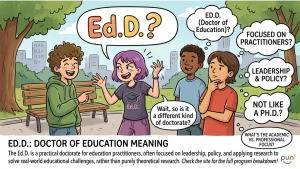
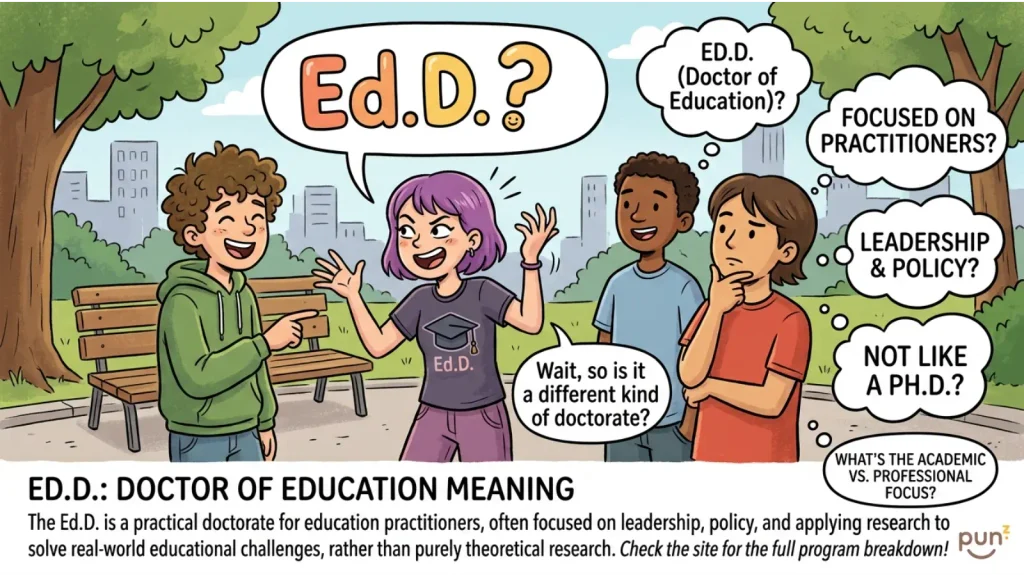
The ed.d meaning is actually quite straightforward. Ed.D. stands for Doctor of Education, a doctoral degree centered on education, leadership, research, and professional practice.
But there is more to the abbreviation than simply knowing what the letters stand for. If you are comparing doctoral degrees, reading someone’s credentials, considering an education career, or simply trying to understand an academic title, knowing what Ed.D. means can make the whole conversation much clearer.
In this guide, you’ll learn what Ed.D. means, how to pronounce it, where you may see it, what the degree involves, how it compares with a Ph.D., and how to use the abbreviation correctly.
What Does Ed.D. Mean?
Ed.D. means Doctor of Education. It is an advanced doctoral degree designed for people who want to develop deep expertise in education and use research to solve practical problems in educational settings.
You may see the abbreviation written in several ways, including Ed.D. and EdD. The exact punctuation can vary by institution or style guide, but the meaning remains the same.
Quick Answer
Ed.D. stands for Doctor of Education. It is a doctoral degree focused on education, leadership, research, policy, administration, and the practical improvement of educational systems.
The degree can be relevant to school leaders, administrators, teachers, higher-education professionals, education policymakers, curriculum specialists, and other professionals working with learning and organizational development.
How Do You Pronounce Ed.D.?
Ed.D. is commonly pronounced:
“ee-dee-dee”
For example:
“She earned an Ed.D. in Educational Leadership.”
You would normally say the individual letters rather than trying to pronounce Ed.D. as a single word.
Is Ed.D. the Same as Doctor of Education?
Yes. Ed.D. is the abbreviation for Doctor of Education.
The full degree name is generally written as Doctor of Education, while Ed.D. is the shorter form used in academic documents, professional profiles, biographies, signatures, and degree listings.
Oxford and major English dictionaries identify Ed.D. as an abbreviation for Doctor of Education.
How the Ed.D. Meaning Developed
Unlike internet slang, Ed.D. is an academic abbreviation. It is not a trendy texting expression that suddenly appeared on social media.
The abbreviation is built from the words Education and Doctor, representing the degree title Doctor of Education. Universities and educational organizations use Ed.D. as a recognized doctoral degree designation.
You may see the degree listed as:
- Ed.D.
- EdD
- Doctor of Education
- Doctorate in Education
- Education doctorate
These forms can refer to the same general degree, although individual universities may have different program names, structures, concentrations, and requirements.
Dictionary sources define Ed.D. as Doctor of Education, while university sources describe the degree as a doctoral program that combines research with practical educational work.
What Does an Ed.D. Focus On?
An Ed.D. often focuses on applying research and advanced knowledge to real educational challenges.
Depending on the university and specialization, an Ed.D. program may cover areas such as:
- Educational leadership
- School administration
- Higher education
- Education policy
- Curriculum and instruction
- Organizational leadership
- Learning and development
- Educational technology
- Community education
- Leadership and organizational change
This practical focus is one reason the degree appeals to experienced professionals who want to move into leadership or create meaningful changes within educational organizations.
How to Use Ed.D. Correctly in Writing
Because Ed.D. is a degree abbreviation rather than slang, its use is different from abbreviations such as LOL, BRB, or FYI.
You normally encounter Ed.D. in formal or professional contexts.
After Someone’s Name
You may see:
Dr. Sarah Williams, Ed.D.
This indicates that Sarah Williams has earned a Doctor of Education degree.
You might also see:
Michael Brown, EdD
The punctuation style can vary, but the academic meaning is the same.
In a Biography
For example:
Dr. James Lee earned his Ed.D. in Educational Leadership and has worked in higher education for more than 15 years.
Here, Ed.D. quickly communicates the person’s doctoral qualification without spelling out the entire degree.
In a Resume
An education professional might list:
Doctor of Education, Educational Leadership
University Name
Ed.D.
This format makes the qualification easy for employers and academic institutions to identify.
In Email Signatures
A professional email signature might say:
Maria Lopez, Ed.D.
Director of Student Services
The abbreviation helps establish the person’s academic credential.
Should You Use Ed.D. in Casual Text Messages?
Usually, there is no reason to use it unless the conversation is about someone’s education, career, credentials, or academic background.
If your friend texts:
“I finally finished my doctorate!”
You probably would not reply:
“Congratulations on your Ed.D.”
unless you already know that the doctorate is specifically a Doctor of Education.
Context matters.
Real Conversation Examples Using Ed.D.
Between Colleagues
Alex: “Have you met the new superintendent?”
Jordan: “Yes. She has an Ed.D. in Educational Leadership.”
Here, Ed.D. identifies the superintendent’s doctoral degree and gives context about her academic background.
During a University Discussion
Student: “What degree are you working toward?”
Professor: “I’m completing my Ed.D. in Higher Education.”
The abbreviation tells the student that the professor is pursuing a Doctor of Education.
On a Professional Profile
Recruiter: “I noticed you have an Ed.D. What was your specialization?”
Candidate: “Educational Administration. My research focused on improving school leadership.”
Here, Ed.D. works as a concise professional credential.
In a Family Conversation
Parent: “What does Ed.D. mean after your principal’s name?”
Student: “It means Doctor of Education. It’s a doctoral degree.”
This is a simple example of how the abbreviation may appear in everyday life even though it is not everyday slang.
In an Online Professional Group
User: “I’m considering an Ed.D. after finishing my master’s. Is it useful for leadership roles?”
Reply: “It can be a good fit if you want to apply research to educational leadership or organizational problems.”
In this setting, Ed.D. is perfectly natural because everyone is discussing education and doctoral programs.
Ed.D. vs Ph.D. What Is the Difference?
One of the biggest questions surrounding the ed.d meaning is how it differs from a Ph.D.
Both are doctoral degrees, but they often serve somewhat different professional goals.
An Ed.D. generally emphasizes the application of research and knowledge to practical problems in education. A Ph.D. generally places stronger emphasis on original research, theory, and academic scholarship.
That does not mean an Ed.D. has no serious research component. It does. Ed.D. programs can involve advanced research methods, examinations, dissertations, and substantial scholarly work.
The key difference is often the intended orientation.
| Ed.D. | Ph.D. |
|---|---|
| Doctor of Education | Doctor of Philosophy |
| Often practice-oriented | Often research-oriented |
| Strong focus on educational leadership | Strong focus on original scholarship |
| Common among education professionals | Common among researchers and academics |
| Can focus on organizational change | Can focus on developing new knowledge |
| Often connected to professional practice | Often connected to academic research |
The distinction is not absolute. Universities structure their programs differently, so prospective students should always examine the specific curriculum rather than choosing a degree based only on its abbreviation. The University of Illinois and the University of Nebraska Omaha both describe the Ed.D. as particularly suited to applying research and developing educational leadership skills.
What Careers Can an Ed.D. Lead To?
An Ed.D. can be useful for professionals who want leadership responsibilities in education or related organizations.
Potential career paths include:
- School principal
- Superintendent
- University administrator
- Education consultant
- Curriculum director
- Academic dean
- Education policy leader
- Instructional leader
- Student services administrator
- Organizational learning leader
The actual career opportunities depend on the person’s specialization, previous experience, licensing requirements, and employer.
An Ed.D. does not automatically qualify someone for every education position. For example, certain school leadership roles may require separate professional credentials or state-specific certification.
Common Mistakes and Misunderstandings
Mistake 1 Thinking Ed.D. Is a Bachelor’s or Master’s Degree
It is not.
Ed.D. is a doctoral degree. It represents an advanced level of academic and professional study.
Mistake 2 Assuming Every Doctor Has an Ed.D.
The title “Dr.” does not tell you which doctorate someone holds.
A person might have a Ph.D., Ed.D., M.D., J.D., Psy.D., or another doctoral qualification.
If you see Ed.D. after someone’s name, however, you have a much stronger clue that the person earned a Doctor of Education.
Mistake 3 Confusing Ed.D. With EDD
This is an especially common problem.
Ed.D. means Doctor of Education.
But EDD without the same academic formatting can refer to several completely different things depending on the context. In medical conversations, EDD can refer to an estimated due date. In employment contexts, it can refer to the Employment Development Department in California.
So if you see “EDD,” do not immediately assume it means Doctor of Education.
Look at the surrounding words.
If the conversation mentions dissertations, universities, degrees, principals, or educational leadership, EdD is probably the intended meaning.
If it mentions pregnancy or an expected delivery date, EDD may have a medical meaning instead.
Context is your best friend here.
Ed.D. Across Different Platforms and Demographics
Because Ed.D. is an academic abbreviation rather than internet slang, its usage is different from abbreviations that dominate TikTok, Instagram, Discord, or texting.
On LinkedIn
Ed.D. is relatively natural on professional profiles, especially among educators and administrators.
For example:
Dr. James Carter, Ed.D. | Educational Leadership
This format quickly communicates professional credentials.
On Instagram
You may see Ed.D. in a professional biography, especially if the account belongs to an educator, professor, consultant, or school leader.
It is less likely to appear in ordinary captions unless the post discusses education or career achievements.
On TikTok
Ed.D. may appear in educational content, career discussions, or videos about doctoral programs. It is not generally used as casual TikTok slang.
On Reddit
You may encounter Ed.D. in communities discussing graduate school, education careers, doctoral programs, academic research, or professional development.
In Discord
The abbreviation may appear in education-focused servers or academic conversations. In a general gaming or social server, however, it would be unusual unless someone is discussing their qualifications.
Gen Z vs Millennials vs Older Generations
There is no major generational slang difference in the meaning of Ed.D.
A Gen Z student and an older education professional would generally understand the abbreviation in the same academic context.
The bigger difference is familiarity.
Someone who works in education may recognize Ed.D. immediately, while someone outside academia may need the term explained.
Is Ed.D. Formal or Informal?
Ed.D. is formal and professional.
It is appropriate in contexts such as:
- Resumes
- Academic profiles
- University websites
- Professional biographies
- Research documents
- Conference programs
- Email signatures
- Educational publications
It is not really a slang term, so treating it like casual internet shorthand can make your writing sound awkward.
If you’re writing for a general audience, spelling out Doctor of Education on first mention can make the text easier to understand. You can then use Ed.D. afterward.
Related Degrees, Abbreviations and Alternatives
| Term | Meaning | Common Context |
|---|---|---|
| Ed.D. | Doctor of Education | Education leadership and practice |
| EdD | Doctor of Education | Academic and professional contexts |
| Ph.D. | Doctor of Philosophy | Research and academic scholarship |
| D.Ed. | Doctor of Education | Alternative degree abbreviation |
| DEd | Doctor of Education | Alternative abbreviation |
| M.Ed. | Master of Education | Graduate education degree |
| B.Ed. | Bachelor of Education | Undergraduate education degree |
| Psy.D. | Doctor of Psychology | Professional psychology |
| Ed.S. | Education Specialist | Advanced specialist credential |
| D.Min. | Doctor of Ministry | Ministry and theological practice |
Ed.D. and Doctorate
The word doctorate describes the level of the qualification.
Ed.D. identifies a specific type of doctorate.
So you could say:
“She has a doctorate in education.”
Or:
“She has an Ed.D.”
Both statements can describe the same academic qualification, although the first is broader.
FAQs:
What does Ed.D. stand for?
Ed.D. stands for Doctor of Education. It is a doctoral-level degree focused on education and may emphasize areas such as educational leadership, administration, policy, teaching, organizational development, or the practical application of research.
Is an Ed.D. a real doctorate?
Yes. An Ed.D. is a doctoral degree. It is awarded by universities to students who complete the required advanced study and research or practice-based requirements of the program. The exact structure varies by institution, and many programs include substantial research, examinations, and a dissertation or comparable doctoral project.
What does Ed.D. mean after a person’s name?
When Ed.D. appears after someone’s name, it generally indicates that the person has earned a Doctor of Education degree. For example, “Sarah Jones, Ed.D.” identifies Sarah Jones as someone who holds that doctoral qualification.
Is Ed.D. higher than a master’s degree?
Yes. An Ed.D. is a doctoral degree, while a master’s degree is a graduate degree below the doctoral level. A person may complete a master’s degree before entering an Ed.D. program, although admission requirements differ among universities.
Is Ed.D. better than Ph.D.?
Neither degree is automatically better. The right choice depends on your goals. An Ed.D. can be a strong fit for professionals interested in educational leadership and applying research to practical problems, while a Ph.D. may be more suitable for people primarily interested in research and academic scholarship.
How do you pronounce Ed.D.?
Ed.D. is commonly pronounced “ee-dee-dee.” The letters are normally spoken individually rather than pronounced as a single word.
Can someone with an Ed.D. be called Dr.?
Yes. An Ed.D. is a doctoral degree, so someone who has earned it may use the title Dr. in appropriate professional and academic contexts. The exact conventions can vary by setting and profession.
Is Ed.D. used in texting?
It can appear in messages, but Ed.D. is not typical texting slang. You are more likely to see it when people discuss education, university programs, professional qualifications, or someone’s academic background.
Does EDD always mean Doctor of Education?
No. Context matters. Ed.D. and EdD commonly refer to Doctor of Education, while EDD can have other meanings in medical, employment, government, and organizational contexts. If you see the abbreviation without context, check the surrounding conversation before deciding what it means.
Conclusion:
The simplest answer to ed.d meaning is this: Ed.D. means Doctor of Education. It is an advanced doctoral degree designed around education, research, leadership, and practical professional challenges.
You may see Ed.D. after a person’s name, on a university website, in a resume, or in a professional biography.
Unlike texting slang, it is a formal academic abbreviation.
And if you ever see Ed.D. or EdD and wonder whether it is the same as a Ph.D., remember the basic distinction: both are doctorates, but Ed.D. is commonly oriented toward applying knowledge and research to educational practice and leadership.
If you found this explanation useful, explore more academic abbreviations and everyday meaning guides to make confusing terms a little less confusing.

Hi, I’m Isabella Brown, the voice behind Codexao.com, where meanings aren’t just explained, they’re made easy to understand.
I’ve always been fascinated by how words shape the way we think, speak, and connect. But let’s be honest—most definitions out there feel confusing, outdated, or just plain boring.
That’s exactly why I created Codexao. Here, I break down words, slang, and modern expressions into simple, clear meanings you can actually use in real life.