Have you ever seen the abbreviation CVA in a message, report, medical document, or online discussion and wondered what it actually means?
You’re not alone. Many abbreviations have multiple definitions, and CVA is one of those terms that can completely change meaning depending on where you encounter it.
A doctor, business analyst, student, and social media user might all use CVA differently.
Understanding CVA meaning is important because using the wrong interpretation can lead to confusion.
Imagine reading a healthcare article and assuming CVA refers to a business term. Things can get confusing quickly.
This updated 2026 guide explains every major meaning of CVA, where it came from, how people use it today, and real examples that make the abbreviation easy to understand.
What Does CVA Mean?
Quick Answer
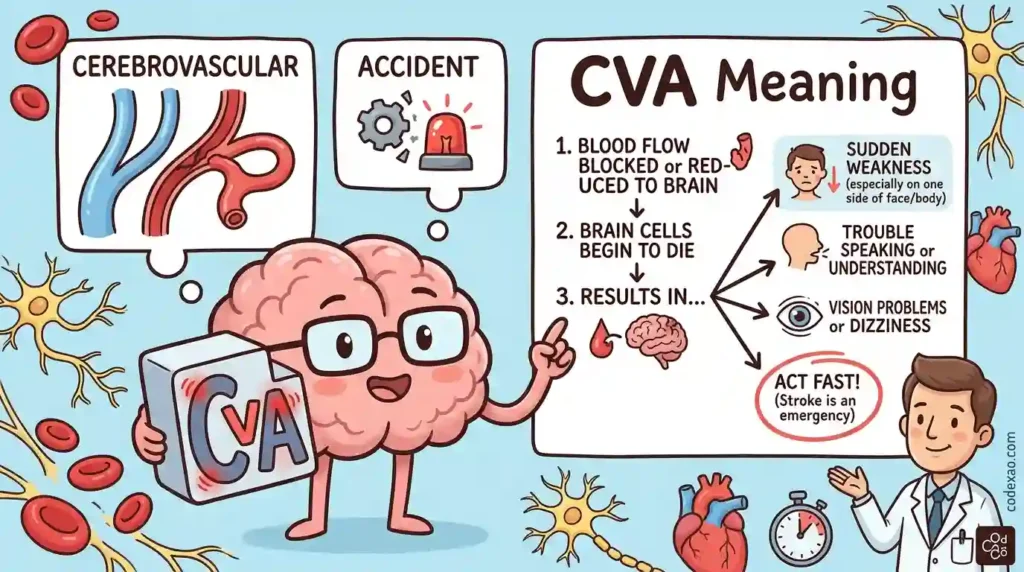
CVA most commonly stands for Cerebrovascular Accident, which is the medical term for a stroke. Depending on the context, it can also refer to Customer Value Analysis, Credit Valuation Adjustment, or other specialized industry terms.
The meaning of CVA depends heavily on the conversation.
Most Common CVA Meanings
| Abbreviation | Meaning | Industry |
|---|---|---|
| CVA | Cerebrovascular Accident | Healthcare |
| CVA | Customer Value Analysis | Marketing |
| CVA | Credit Valuation Adjustment | Finance |
| CVA | Certified Veterinary Assistant | Animal Care |
| CVA | Cash Value Added | Business |
Origin of CVA
The medical abbreviation CVA has been used for decades by healthcare professionals to describe a stroke. As industries evolved, other sectors adopted the same abbreviation for specialized concepts.
Today, CVA appears in hospitals, financial reports, marketing presentations, educational programs, and professional certifications.
Pronunciation
Most people pronounce it by saying each letter individually:
Cee Vee Aye
How to Use CVA Correctly in Texts and Chat
Unlike popular slang abbreviations such as LOL or BRB, CVA is generally not a mainstream texting acronym.
Instead, it is usually used within professional or specialized communities.
Healthcare Context
Example:
“Patient was admitted after a suspected CVA.”
Meaning:
The patient may have suffered a stroke.
Business Context
Example:
“We completed a CVA to understand customer preferences.”
Meaning:
A Customer Value Analysis was conducted.
Finance Context
Example:
“The CVA adjustment affected the final valuation.”
Meaning:
Credit Valuation Adjustment influenced the financial calculation.
Platform-Specific Usage
SMS and Text Messages
Rarely used unless discussing healthcare, education, or work-related topics.
Common in professional group chats involving healthcare workers or business teams.
Uncommon in casual captions but may appear in educational content.
X
Often appears in finance and healthcare discussions.
Discord
Mostly used in niche communities rather than general conversations.
Frequently seen in industry-specific subreddits involving medicine, finance, and investing.
When Not to Use CVA
Avoid using CVA with people unfamiliar with the abbreviation.
For example:
Instead of:
“She had a CVA last year.”
Consider:
“She suffered a stroke last year.”
This improves clarity for general audiences.
Real Conversation Examples Using CVA
Between Healthcare Professionals
Doctor:
“The CT scan confirms a CVA.”
Nurse:
“Understood. I’ll prepare the treatment plan.”
What it conveys: A formal medical diagnosis.
In a Business Meeting
Manager:
“Let’s run a CVA before launching the new product.”
Analyst:
“That should help identify customer priorities.”
What it conveys: Data-driven customer research.
In a Finance Discussion
Investor:
“Did the CVA affect the pricing model?”
Analyst:
“Yes, it changed the valuation significantly.”
What it conveys: Financial risk assessment.
In a Student Discussion
Student:
“What does CVA stand for in this chapter?”
Teacher:
“In this lesson, it means Cerebrovascular Accident.”
What it conveys: Educational clarification.
In a Professional Group Chat
Employee:
“The report includes updated CVA metrics.”
Colleague:
“Great, I’ll review them before the presentation.”
What it conveys: Workplace communication.
Common Mistakes and Misunderstandings
Assuming There Is Only One Meaning
Many people believe CVA always refers to a stroke.
In reality, multiple industries use the abbreviation differently.
Using CVA Without Context
Writing only “CVA” can confuse readers.
Always provide context when communicating with mixed audiences.
Misinterpreting Industry Discussions
Someone reading a finance article may incorrectly think the author is discussing healthcare.
The surrounding content usually reveals the intended meaning.
Generational Differences
Older professionals may instantly recognize CVA in healthcare.
Younger users who spend more time on social platforms may be unfamiliar with the abbreviation altogether.
Regional Differences
The medical meaning remains consistent globally, but business and financial interpretations can vary by country and industry.
CVA Across Different Platforms and Demographics
Gen Z
Most Gen Z users are more familiar with internet slang than professional abbreviations.
Unless they study medicine or finance, they may not immediately recognize CVA.
Millennials
Millennials working in healthcare, finance, or business often encounter CVA regularly.
Older Generations
Professionals with longer industry experience tend to recognize CVA quickly.
TikTok
The abbreviation occasionally appears in educational healthcare content.
Medical educators and business coaches may use CVA in informational posts.
Discord
Found mostly in specialized servers focused on investing, healthcare, or education.
Professional Settings
CVA is considered formal and appropriate in professional communication.
Safe for Work
Yes. CVA is completely safe for work and commonly used in professional environments.
Related Slang, Abbreviations and Alternatives
| Term | Meaning |
| LOL | Laughing Out Loud |
| BRB | Be Right Back |
| IMO | In My Opinion |
| TBH | To Be Honest |
| FYI | For Your Information |
| KPI | Key Performance Indicator |
| ROI | Return on Investment |
| CPR | Cardiopulmonary Resuscitation |
| EMT | Emergency Medical Technician |
| SWOT | Strategic planning framework |
Synonyms and Alternatives
Depending on context:
- Stroke instead of Cerebrovascular Accident
- Customer Research instead of Customer Value Analysis
- Valuation Adjustment instead of Credit Valuation Adjustment
Antonyms
CVA does not have a direct antonym because it represents specific concepts rather than general expressions.
FAQs:
What does CVA mean in healthcare?
In healthcare, CVA means Cerebrovascular Accident, which is the medical term for a stroke. It occurs when blood flow to part of the brain is interrupted or reduced.
What does CVA mean in business?
In business, CVA often stands for Customer Value Analysis. Companies use it to evaluate what customers value most in products and services.
What is the full form of CVA?
The most common full form is Cerebrovascular Accident. However, other industries use alternative definitions such as Customer Value Analysis and Credit Valuation Adjustment.
Is CVA commonly used in texting?
Not usually. CVA is more common in professional, educational, healthcare, and financial conversations than in casual texting.
Is CVA a formal abbreviation?
Yes. CVA is generally considered a formal abbreviation used in professional communication and industry-specific discussions.
Why does CVA have multiple meanings?
Many abbreviations are adopted independently by different industries. Over time, CVA became associated with healthcare, finance, business, and other specialized fields.
Conclusion:
CVA meaning varies based on context, but the most recognized definition is Cerebrovascular Accident, the medical term for a stroke.
The abbreviation also appears in business, finance, veterinary care, and several other professional fields. Understanding the surrounding conversation is the key to identifying the correct meaning.
The next time you encounter CVA, you’ll know exactly how to interpret it and avoid common misunderstandings.
Language evolves quickly, and knowing these abbreviations helps you stay informed in both professional and digital communication.
Explore more slang, abbreviations, and internet meanings to keep your digital vocabulary sharp and beyond.

Hi, I’m John Mark, the voice behind codexao.com, where meanings aren’t just explained, they’re simplified for the way people actually talk today.
I’ve always been curious about words, how they change, how they trend, and how a simple phrase can carry completely different meanings depending on context. That curiosity turned into codexao, a space where I break down slang, text abbreviations, and everyday words into clear, easy-to-understand explanations.