Somebody hears three seconds of a growling German rock song, catches the words du hast mich, and immediately opens a search bar.
Sound familiar? You’re not alone. This phrase has been confusing English speakers since 1997, and honestly, that confusion is kind of the point.
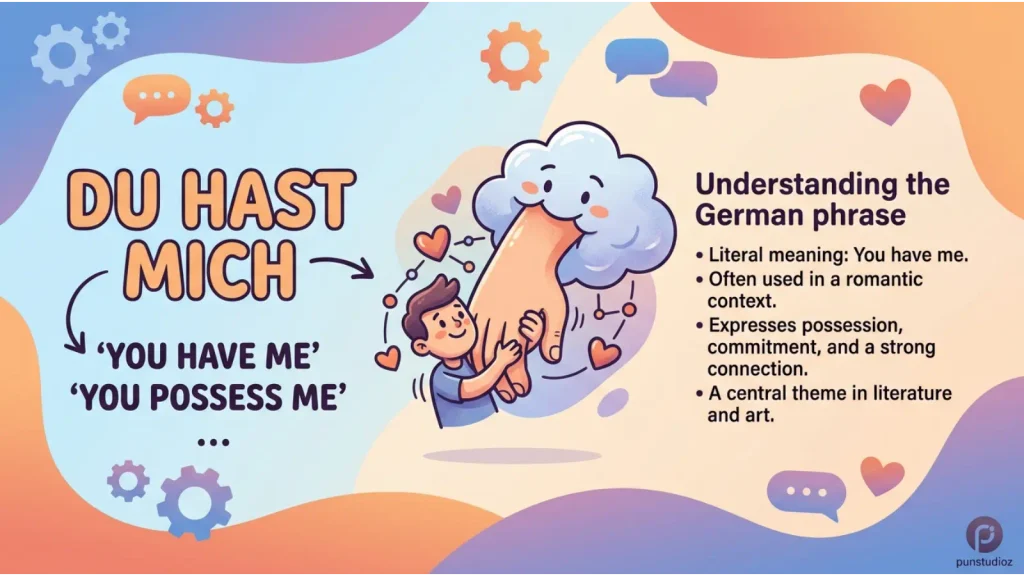
Du hast mich literally means you have me in German. But if you’ve ever heard this line blasted through a car stereo or a gym playlist, you know there’s more going on than a simple translation.
It’s tangled up with one of the most famous language tricks in rock music history, courtesy of the German band Rammstein.
This guide breaks down exactly what du hast mich means, where it came from, why it sounds like something totally different, and how fans still use the phrase today.
No German degree required.
What Does du hast mich Mean?
Quick Answer: Du hast mich translates to you have me in English. Du is the informal you, hast is the second person form of haben meaning to have, and mich means me. Put together, it’s a simple, almost tender statement.
Here’s where it gets interesting. German has a nearly identical sounding phrase, du hasst mich, which means you hate me. The verb haben, to have, and hassen, to hate, conjugate to almost the same sound in the second person. Say them both out loud fast. You’ll hear it.
This near-homophone isn’t an accident that Rammstein stumbled into. It’s the entire engine of their song Du Hast, released in 1997 on the album Sehnsucht. The band leans into the sound-alike on purpose, letting listeners assume they’re hearing a declaration of hatred before flipping the meaning entirely.
The line evolves across the song into a callback to traditional German wedding vow language, essentially asking a version of will you have and hold this person. So the phrase quietly shifts from what sounds like resentment into a question about lifelong commitment. That contrast, hatred versus marriage, is exactly why the line stuck in people’s heads for almost three decades.
Pronunciation-wise, du hast mich sounds roughly like “doo hahst mikh,” with that last sound being the soft German ch you’d hear in Bach.
How People Use du hast mich in Chats and Captions
You won’t typically drop this phrase into a casual English text thread the way you’d use LOL or IDK. It functions differently, more like a cultural reference than everyday slang. Still, it shows up in specific corners of the internet.
Common usage patterns:
- Caption text under gym or workout videos, since the song is a staple lifting anthem
- Comment sections on Rammstein clips, often just the lyric typed out as a fan reaction
- TikTok sounds where creators lip sync or air guitar to the track
- Nostalgia posts from people who grew up on late 90s and early 2000s rock radio
- German language learners posting about the famous wordplay as a teaching example
On platforms like TikTok, Instagram, and Discord, you’ll usually see it typed in all lowercase as a low key inside joke among fans, almost never capitalized formally unless someone’s quoting the actual song title. In gaming voice chats, it sometimes gets shouted ironically, riffing on the song’s aggressive delivery.
One thing to know: this isn’t office appropriate small talk. It’s tied to a specific song with a specific cultural weight, so dropping it in a professional Slack channel will probably just confuse your coworkers rather than land as clever.
Real Conversation Examples
Between friends texting about music
Friend A: bro put on some rock for the drive
Friend B: say less, du hast mich is loading
Meaning conveyed: pure enthusiasm and shared music taste, using the phrase as shorthand for the whole song.
In a gaming Discord server
Player 1: that boss fight needed a better soundtrack
Player 2: next time queue up du hast mich, instant power up
Meaning conveyed: playful exaggeration, treating the song as a hype trigger.
On a TikTok comment section
Commenter: the way this beat drops right as du hast mich hits
Meaning conveyed: appreciation for a specific musical moment, referencing the lyric as a timestamp everyone recognizes.
Between coworkers at the gym, informally
Coworker A: what’s your deadlift playlist looking like
Coworker B: honestly just Rammstein on loop, du hast mich carries me through set three
Meaning conveyed: humor mixed with genuine motivation, using the phrase to describe an emotional or physical boost.
A German learner explaining it to a friend
Learner: okay so du hast mich actually just means you have me, not what everyone thinks
Friend: wait so the whole internet’s been wrong
Meaning conveyed: a small aha moment, correcting a common misconception in a friendly, non-lecturing way.
Common Mistakes and Misunderstandings
Mistake one: assuming it always means you hate me. This is the single biggest mix-up. Because of the sound-alike with du hasst mich, tons of people confidently translate the phrase wrong. It’s an easy trap, and honestly the band wanted you to fall into it at first.
Mistake two: thinking it’s modern internet slang. Some younger listeners discover the phrase through TikTok and assume it originated as a meme format rather than a nearly 30 year old song line. It’s not slang in the traditional sense, it’s a lyric that became a cultural reference point.
Mistake three: mixing up formal and informal you. German has du for informal you and Sie for formal. Du hast mich only works in casual or emotionally close contexts. Using du incorrectly in formal German conversation is an actual grammar mistake, not just a stylistic choice.
Generational gap: Gen Z fans mostly know the phrase through short form video trends and workout content. Millennials and Gen X often connect it to actual radio play, MTV rotation, or the 1998 soundtrack placement in The Matrix. Older German speakers, meanwhile, just hear it as clever, very German wordplay rooted in poetry traditions.
If someone looks confused when you reference it, the easiest fix is just saying it’s a lyric from a German rock song, then briefly explaining the have versus hate pun. That usually clears it up fast.
Du hast mich Across Platforms and Demographics
On TikTok, the phrase rides the coattails of periodic Rammstein sound revivals, especially clips using the song’s heavy opening riff. It tends to spike whenever a workout trend, a gothic aesthetic trend, or a throwback rock nostalgia wave cycles back through the app.
Instagram usage skews toward captions on concert throwback photos or gym content. Discord and Reddit communities built around metal and industrial rock treat the phrase almost like a badge of genre knowledge, dropping it as a quick nod that signals you know your music.
It’s considered informal across the board and firmly not workplace language. There’s no real formal register for this phrase since it only exists as a fan reference tied to one specific, fairly intense song.
As for viral moments, the track has had a long tail of internet life, from its original MTV push in the late 90s, to a resurgence tied to The Matrix soundtrack, to periodic TikTok trend cycles that introduce it to entirely new generations who weren’t alive for its original release.
Related Slang, Abbreviations and Alternatives
| Term | Meaning |
|---|---|
| du hasst mich | you hate me, the phrase people often confuse it with |
| ich liebe dich | I love you, the classic German romantic phrase |
| willst du | do you want, echoing the vow style question in the song |
| Rammstein | the German band behind the original song |
| Neue Deutsche Härte | the genre label often applied to Rammstein’s sound |
| industrial rock | broader genre category the song fits into |
| earworm | slang for a song stuck in your head, often describes this track |
| throwback anthem | casual term for older songs that resurface in trends |
| Sehnsucht | the 1997 album that features the original track |
| power ballad energy | slang description fans use for the song’s intensity |
If you’re curious about the difference between casual and formal German, it pairs well with learning du versus Sie usage. Fans exploring more Rammstein wordplay often also look into the band’s other lyric based puns across their catalog.
FAQs:
What does du hast mich mean in English?
It translates literally to you have me. In the Rammstein song, it’s part of a pun where du hast sounds like du hasst, meaning you hate, so listeners hear a double meaning before the real message lands.
Is du hast mich the same as du hasst mich?
No. Du hast mich means you have me while du hasst mich means you hate me. They’re spelled and mean differently but sound nearly identical when sung fast, which is the entire joke of the song.
Why is du hast mich connected to Rammstein?
Because it’s the opening line and title concept of their breakout single Du Hast, released in 1997. The band deliberately built the song around this sound-alike confusion between having and hating.
What is the actual message behind the song Du Hast?
Beneath the wordplay, the song borrows the structure of German wedding vows, turning a line that sounds like hatred into a question about commitment and marriage instead.
Do people still search this phrase in 2026?
Yes. The song resurfaces constantly through TikTok audio trends, gym playlists, and nostalgia posts from millennials who grew up on late 90s rock radio.
Conclusion:
Du hast mich is a short phrase carrying a surprisingly deep trick. On the surface it just means you have me, plain and simple German grammar.
But layered underneath is one of the smartest lyric puns in modern rock, built entirely around how close hast and hasst sound when sung with enough grit behind them.
That’s really the whole appeal here. A three word line manages to make you think you’re hearing hatred, then quietly pivots into a question about lifelong commitment borrowed straight from wedding vow tradition.
Almost thirty years later, that tension still hooks new listeners who stumble across it through a TikTok clip or a gym playlist shuffle.
So next time du hast mich pops up in your feed, you’ll know exactly what’s going on, both the literal translation and the clever trap hiding behind it.
Got a favorite lyric that plays with language like this? Drop it in the comments.

Hi, I’m Isabella Brown, the voice behind Codexao.com, where meanings aren’t just explained, they’re made easy to understand.
I’ve always been fascinated by how words shape the way we think, speak, and connect. But let’s be honest—most definitions out there feel confusing, outdated, or just plain boring.
That’s exactly why I created Codexao. Here, I break down words, slang, and modern expressions into simple, clear meanings you can actually use in real life.