Your manager approves your expense report three weeks after you already spent the money. Your friend calls it “ex post facto approval” and you nod like you totally get it. Do you?
If you have ever met this phrase in a news headline, a law class, or a workplace email, you know it sounds fancy and a little intimidating. Good news. The ex post facto meaning is much simpler than it looks, and it comes down to three words in plain English: after the fact.
This guide breaks the phrase down without the legal fog. You will learn where it came from, how courts use it, how everyday people use it, and which mistakes make writers cringe. You will also get real conversation examples, a quick comparison table of look-alike terms, and answers to the questions people actually search for.
This page is built for students, curious readers, and anyone who wants to sound sharp without sounding stiff. Grab a coffee. This one is quick, useful, and surprisingly fun.
What Does Ex Post Facto Mean?
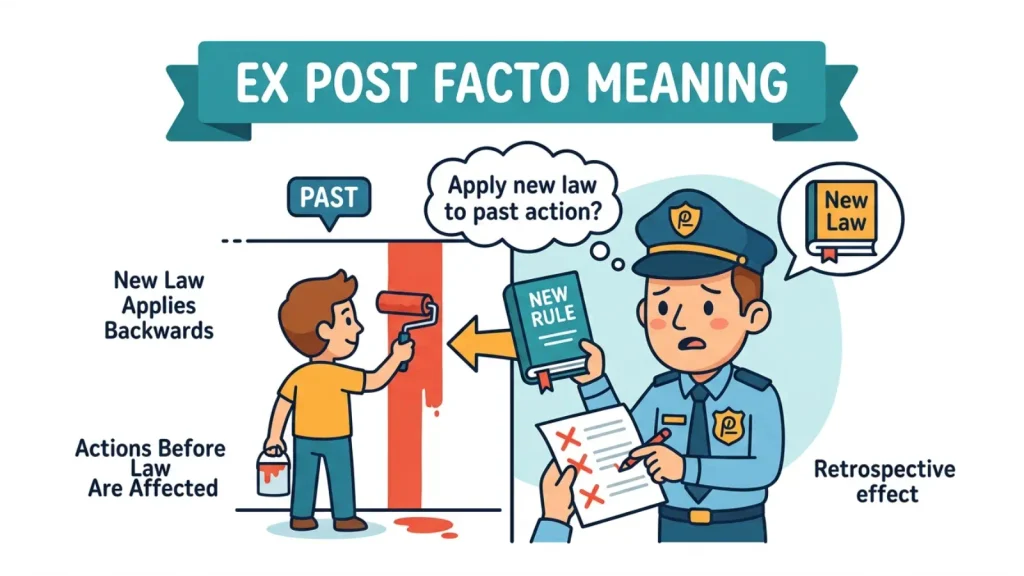
Ex post facto means “after the fact.” It points to something that happens, or gets decided, after the event it affects.
Quick Answer: Ex post facto is Latin for “from a thing done afterward.” In everyday speech it means after the fact. In law it describes a rule that reaches back and changes the status of something already done.
Where the phrase comes from
The phrase is pure Latin. Ex means “from,” post means “after,” and facto comes from factum, which means “a deed.” Stack them together and you get “from a deed done afterward.”
Lawyers and scholars used the phrase in legal writing across Europe for centuries. English carried it over, and it stuck around because no short English phrase does the same job so neatly.
How the meaning grew
At first the phrase lived almost entirely in courtrooms. It described laws that punished people for acts that were fine when they happened.
Over time regular people borrowed it. Today you will hear it in business, science, and even casual talk. Someone might describe an ex post facto explanation, meaning a reason invented after the event to make it look planned.
Pronunciation guide
Say it like this: eks pohst FAK-toh. The stress lands on “fak.” Some speakers say “eks” as “ecks” and that is fine.
How to Use Ex Post Facto Correctly in Writing and Conversation
This phrase works as an adjective or an adverb. Both are common.
- As an adjective, you say “an ex post facto law” or “ex post facto approval.”
- As an adverb, you say “the committee approved the budget ex post facto.”
Tone and context
The phrase carries a formal, slightly serious flavor. It fits best in legal, academic, and professional settings. In casual chat it can sound playful or a bit dramatic, which is often the point.
When to use it
Use it when timing is the whole story. If something was approved, explained, or punished after it already happened, this phrase fits.
When not to use it
Skip it in messages where plain words work better. “We got permission after the fact” is friendlier than “we secured ex post facto permission” in a quick chat with a coworker.
Do not use it for anything that simply happened later. It needs a link back to an earlier event.
Formatting tips
- Write it as three separate words. No hyphens needed, though some older texts hyphenate it when it acts as a modifier.
- Italics are common in formal writing because the phrase is Latin. Many modern style guides no longer require them.
- Lowercase is standard, unless it starts a sentence.
The legal meaning in one minute
A law is ex post facto when it does one of these things after the act took place:
- It makes a harmless act a crime.
- It makes a crime more serious than it was.
- It adds a heavier punishment than the one that applied at the time.
- It lowers the proof needed to convict someone.
Those four categories come from the 1798 US Supreme Court case Calder v. Bull, and courts still lean on them.
The US Constitution bans these laws for criminal matters. Article I, Section 9 covers Congress, and Section 10 covers the states. Many other countries protect the same idea. Article 12 of the Constitution of Pakistan, for example, guards against retrospective punishment.
Real Conversation Examples Using Ex Post Facto
Here are five scenarios, each with a quick note on what the phrase really says.
Example 1: Between friends
Maya: Did you ask before borrowing my hoodie?
Zain: I’m asking ex post facto. Can I keep it?
Maya: Bold. Fine.
What it conveys: Zain admits he acted first and is now seeking permission. The phrase adds a joking, guilty tone.
Example 2: In a law class
Professor: Suppose a new law makes last year’s harmless act a crime. Is that allowed?
Student: No, that would be an ex post facto law.
Professor: Exactly.
What it conveys: Serious, precise legal meaning. No humor needed.
Example 3: Work chat
Sara: Finance just signed off on the software purchase.
Ali: Ex post facto approval, since we bought it in March.
Sara: Please never say that in the meeting.
What it conveys: A mildly sarcastic note about breaking process. Ali is pointing out the timeline problem.
Example 4: Family dinner
Dad: Why did you pick that major?
Hina: Honestly, I made up a strategy ex post facto. I just liked the classes.
Dad: At least you’re honest.
What it conveys: An explanation built after the decision. Hina is admitting there was no grand plan.
Example 5: Gaming Discord
Kai: The dev patched the exploit and banned everyone who used it last week.
Rin: That’s ex post facto punishment. The rule didn’t exist then.
Kai: Tell that to the ban hammer.
What it conveys: Fairness complaint. Rin argues players cannot be punished for breaking a rule that did not exist yet.
Common Mistakes and Misunderstandings
Mistake 1: Using it to mean “later”
Ex post facto does not mean “at a later time.” It means acting on something already done. A meeting scheduled for next week is not ex post facto.
Mistake 2: Thinking it applies to every retroactive law
The constitutional ban covers criminal laws and punishment. Civil laws, such as tax changes or new regulations, can sometimes apply to past events without breaking the ex post facto rule. Courts look at whether a law is really punishment or just regulation.
A well-known example is Smith v. Doe from 2003, where the Supreme Court found Alaska’s sex offender registry was civil, not punishment, so it did not violate the clause.
Mistake 3: Confusing it with “post hoc”
Post hoc means “after this,” and it often shows up in the phrase “post hoc ergo propter hoc,” a fallacy that says because B followed A, A caused B. Ex post facto is about timing of rules or approvals. They sound alike but live in different worlds.
Generational and cultural differences
Older readers often meet the phrase in law or civics classes and treat it as a serious legal term. Younger readers may see it first in memes, online debates, or gaming communities, where it sounds more casual. Both uses are valid. Just match your tone to your audience.
How to clarify when someone looks confused
Keep a simple rescue line ready. Try “I mean after the fact” or “it just means done after the event.” Nobody minds a quick translation.
Ex Post Facto in Legal, Workplace and Online Contexts
Legal and academic use
This is home turf. Courts, law students, and journalists use the phrase to talk about fairness. The core idea is simple. People deserve to know the rules before they act.
The principle also appears in international human rights law. Article 11 of the Universal Declaration of Human Rights and Article 15 of the International Covenant on Civil and Political Rights both reject retroactive criminal punishment.
Workplace use
Businesses use it for approvals, reimbursements, and paperwork completed after the action. “Ex post facto sign-off” is common in finance and compliance teams. It often hints that someone skipped a step.
Social media and Discord
On Reddit, X, and Discord, the phrase shows up mostly in debates about fairness. Gamers use it when developers change rules and punish old behavior. Commenters use it when a company changes a policy and applies it to past actions.
It is not slang in the strict sense. Still, people wear it like slang because it adds a little intellectual flavor to an argument.
Is it formal or casual?
Formal by origin, flexible by use. It is safe for work and safe for school. Just do not overuse it in texts. Once per conversation is plenty.
Related Terms, Alternatives and Look-Alikes
| Term | Simple meaning |
|---|---|
| Retroactive | Applies to things that happened in the past |
| Retrospective | Looking back at something that already happened |
| Post hoc | After this, often used for reasoning that assumes cause from timing |
| Ex ante | Before the event, based on expectation |
| A priori | Known or reasoned without needing evidence |
| Ab initio | From the beginning |
| Nunc pro tunc | “Now for then,” a court order applied as if made earlier |
| Bill of attainder | A law that punishes a person without a trial |
| Nullum crimen sine lege | No crime without a law |
| Grandfather clause | Lets older cases keep old rules |
Casual synonyms: after the fact, in hindsight, retroactively, looking back.
Casual opposites: ahead of time, in advance, beforehand, upfront.
Want to go deeper? Learn more about ex ante vs ex post, or read our guide on retroactive laws explained.
FAQs:
What does ex post facto mean in simple words?
It means “after the fact.” Something is done, decided, or approved after the event has already taken place. In everyday use it can describe explanations, permissions, or decisions made later. In law it describes rules that change the meaning or punishment of past acts.
What is an ex post facto law?
An ex post facto law changes the legal outcome of an act after that act has already been committed. It might make something illegal that was legal before, increase a punishment, or make convictions easier. Courts usually strike these laws down in criminal cases.
Are ex post facto laws illegal in the United States?
Criminal ex post facto laws are banned by the Constitution. Article I, Section 9 stops Congress from passing them, and Section 10 stops states. The ban mostly covers criminal punishment. Civil laws that apply to past events are treated differently and can sometimes stand.
What is an example of an ex post facto law?
Imagine a city legalizes a certain activity in 2020. In 2024 it bans that activity and fines people for what they did in 2021. That fine would be ex post facto, because the act was legal when the person did it.
How do you pronounce ex post facto?
Say “eks pohst FAK-toh.” Put the stress on the “fak.” Some people pronounce the first word “ecks,” and both versions are widely understood. It comes straight from Latin, so small regional variations are normal.
Is ex post facto the same as retroactive?
They are close cousins, not twins. Retroactive is the broad idea of applying something to the past. Ex post facto is a narrower term, mostly used when a rule punishes or changes the status of an act after it happened, especially in criminal law.
Conclusion:
The ex post facto meaning boils down to something simple. It is about acting on the past after the past is already over. In law, that idea protects fairness. In daily life, it explains late approvals and made up reasons.
Now you can spot it in a news story, use it in an argument, and explain it without reaching for a dictionary. Just remember the timing rule.
If the event came first and the decision came later, you are in ex post facto territory.
Your turn. Drop your favorite Latin phrase in the comments below, and tell us where you first heard ex post facto.
Explore more: ex ante vs ex post, what “de facto” means, and retroactive laws explained.

Hi, I’m Isabella Brown, the voice behind Codexao.com, where meanings aren’t just explained, they’re made easy to understand.
I’ve always been fascinated by how words shape the way we think, speak, and connect. But let’s be honest—most definitions out there feel confusing, outdated, or just plain boring.
That’s exactly why I created Codexao. Here, I break down words, slang, and modern expressions into simple, clear meanings you can actually use in real life.