Picture this. You are scrolling through a university website and every second course page uses the word interdisciplinary.
Interdisciplinary studies. Interdisciplinary research. Interdisciplinary team. It sounds important, but what does it actually say? Most people nod along without a clear answer.
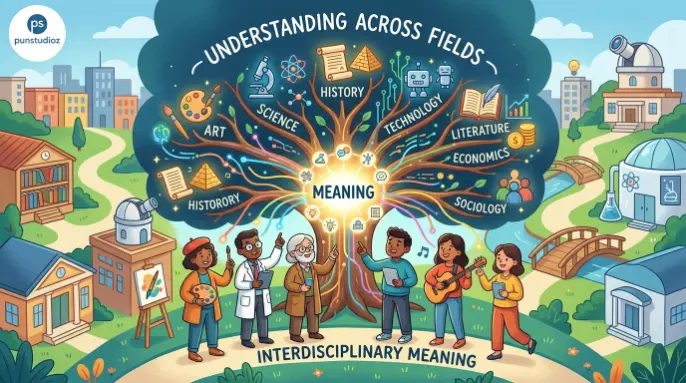
The interdisciplinary meaning is simple once you strip away the academic polish. It describes work that pulls ideas, methods, and tools from two or more fields and blends them into something new. Not a side by side arrangement. A real mix.
This word shows up in job ads, degree programs, research grants, and everyday chats about careers.
Knowing it helps you choose a major, read a job description, or sound sharp in a meeting.
This guide, Walks you through the definition, the origin, real conversation examples, common mistakes, and related terms. By the end, you will use the word with confidence and explain it to anyone in one breath.
What Does Interdisciplinary Mean?
Let us start with the plain answer.
Quick Answer: Interdisciplinary means combining knowledge, methods, and perspectives from two or more academic fields to solve a problem or create something new.
Break the word apart and it makes sense. “Inter” means between. “Disciplinary” refers to disciplines, which are fields of study like biology, economics, or art. So interdisciplinary literally means between disciplines.
Think of it as the space where subjects overlap and start talking to each other. A biologist and a computer scientist working on DNA data are standing in that space. The result is bioinformatics, a field neither of them could have built alone.
Where the Word Came From
The term took hold in the early twentieth century. It is commonly traced to American social science research circles in the 1920s, where scholars wanted to tackle problems that no single department could handle. Universities were splitting knowledge into narrower and narrower boxes. Researchers pushed back and asked a fair question. What if real problems do not respect those boxes?
They were right. Climate change, public health, and artificial intelligence do not belong to one department.
How the Meaning Has Evolved
Back then, interdisciplinary was mostly a scholar’s word. Today it has moved into everyday life. Companies call their teams interdisciplinary. Schools advertise interdisciplinary learning. Job seekers put it on their profiles.
The core idea stayed the same, but the tone shifted. It used to sound experimental. Now it sounds practical and even fashionable.
Pronunciation Guide
Say it as in-ter-DIS-ih-plih-nair-ee. Stress the third syllable. If it feels like a tongue twister, you are not alone. Say it slowly three times and it clicks.
How to Use Interdisciplinary Correctly in Writing and Conversation
Here is the good news. The word is easy to use once you know its job. It is an adjective, so it describes nouns like approach, team, course, project, or degree.
Correct examples:
- She studies an interdisciplinary program in art and technology.
- Our interdisciplinary team includes a nurse, an engineer, and a designer.
- The school offers interdisciplinary courses that mix history and data science.
Tone and Context
Interdisciplinary is a neutral to formal word. It fits comfortably in essays, emails, lectures, job applications, and LinkedIn posts. It also works in casual talk, especially when you discuss college majors or career plans.
Use it when you want to signal that different fields are working together as one. Skip it when only one field is involved. Calling a plain biology project interdisciplinary makes it sound fancier than it is.
Where You Will See It
- University websites and course catalogs. Very common.
- Job descriptions. Often paired with words like collaborative and cross-functional.
- Research papers and grant proposals. Funders love the term.
- LinkedIn and resumes. A strong way to describe a varied background.
- Social media. Creators use it for blended careers, like a designer who codes.
When Not to Use It
Avoid it in casual chats where it sounds stiff. If you tell a friend “that movie has an interdisciplinary plot,” they will laugh at you. Say it mixes genres instead.
Formatting Tips
Write it as one word, with no hyphen. Lowercase is correct unless it starts a sentence or sits in a title. Some writers use “cross-disciplinary” with a hyphen, but that is a related word with a slightly different feel.
Real Conversation Examples Using Interdisciplinary
Definitions are useful, but examples make the word stick. Here are five short scenarios.
Between College Friends
Maya: I cannot decide between psychology and computer science.
Ravi: Why not pick both? My cousin did an interdisciplinary degree in cognitive science.
Maya: Wait, that is a real thing?
This example shows the word offering a way out of a tough choice. It tells Maya she does not have to pick one box.
In a Work Chat
Manager: We need this launch to succeed, so let us build an interdisciplinary squad.
Priya: You mean marketing, engineering, and design in one room?
Manager: Exactly. No handoffs, just one team.
Here the word signals shared ownership. Everyone contributes their skills to one goal instead of passing tasks down a line.
On a Date
Sam: So what do you do?
Jordan: I am an interdisciplinary artist. I mix sculpture, sound, and code.
Sam: Okay, that is honestly more interesting than my accounting job.
The word works as a friendly label for a creative person who refuses to stay in one lane. It sounds confident without sounding boastful.
At the Family Dinner Table
Dad: What is this new course you are taking?
Nina: It is interdisciplinary. Half of it is environmental science and half is economics.
Dad: So you are learning about trees and money?
Nina: Pretty much. Forests are worth a lot of both.
Dad’s joke is actually close to the truth. It shows how the word can confuse people outside academia, and how a quick example clears things up.
In a Game Development Server
Leo: Our indie game needs a storyteller, a coder, and a sound artist.
Kai: That is a very interdisciplinary project.
Leo: Yes, and also a very chaotic one.
Games are a perfect example. Writing, art, music, and programming all have to fit together. The word carries a hint of humor about how hard that can be.
Common Mistakes and Misunderstandings
Even smart people trip over this word. Here are the top three slip-ups.
Mistake 1. Confusing It With Multidisciplinary
This is the big one. Multidisciplinary means several fields work on the same topic, but each keeps its own methods. Interdisciplinary means the fields actually merge.
Here is a quick way to remember it. A multidisciplinary panel has an economist, a sociologist, and a historian each giving a separate talk. An interdisciplinary project has them building one shared framework together.
Mistake 2. Assuming It Means “Jack of All Trades”
Some people think interdisciplinary means shallow knowledge across many topics. That is unfair. Strong interdisciplinary work usually needs depth in at least one field, plus the ability to connect it with others.
Mistake 3. Using It as a Buzzword
Companies sometimes stick the word on anything to sound modern. If a job post says interdisciplinary but describes a single narrow task, be skeptical. The word should describe real integration, not decoration.
Generational and Cultural Differences
Older professionals may see interdisciplinary as an academic term and prefer “cross-functional” in business. Younger workers use it freely to describe hybrid careers and side projects. In some countries, universities use “cross-disciplinary” or “integrated studies” more often, so the same idea can wear different labels.
How to Clarify When Someone Does Not Get It
Keep it simple. Say, “It means mixing two or more fields to solve one problem.” Then give one example, like bioinformatics or cognitive science. That usually ends the confusion in ten seconds.
Interdisciplinary Across Different Fields and Demographics
The word travels well. Different groups use it in slightly different ways.
Students and Gen Z
Gen Z students often use it to describe majors, minors, and portfolios that do not fit a single label. You will hear it in college application essays and creator bios. It carries a sense of freedom and curiosity.
Millennials and Professionals
Millennials tend to use it in workplace settings. Product teams, design studios, and startups love it. It hints at agility and collaboration.
Older Generations and Academics
Academics have used the word for decades and often treat it more precisely. Senior researchers may care deeply about the difference between interdisciplinary, multidisciplinary, and transdisciplinary. For them, the distinction is real and worth defending.
Fields Where It Thrives
- Healthcare. Doctors, nurses, therapists, and data analysts work as one care team.
- Technology. AI ethics blends computer science, law, and philosophy.
- Environment. Climate work draws on chemistry, economics, politics, and geography.
- Arts. Creators mix film, music, and code.
- Education. Schools design lessons that link math with art or history with science.
Is It Formal or Informal?
It sits in the middle. It is safe for work, safe for school, and safe for social media. You will not offend anyone with it. You might just get a curious question, which is a nice bonus.
A Word on Popularity
Interest in the term keeps climbing as jobs get more complex and technology reshapes every industry. Problems like pandemics and AI safety clearly need more than one kind of expert. That reality keeps the word in the spotlight.
Related Terms Synonyms and Alternatives
Several words orbit interdisciplinary. Some are close cousins. Others are only distant relatives. Here is a quick guide.
| Term | Simple Definition |
|---|---|
| Multidisciplinary | Several fields work on one topic, each staying separate |
| Cross-disciplinary | Uses one field’s ideas to study another, often used loosely as a synonym |
| Transdisciplinary | Goes beyond academia and includes real-world stakeholders in the process |
| Intradisciplinary | Works within a single discipline across its sub-areas |
| Cross-functional | A business term for teams from different departments |
| Integrative | Focused on combining parts into a unified whole |
| Holistic | Looks at the whole picture, not isolated pieces |
| Hybrid | A mix of two different things, often used for careers or roles |
| Specialized | Focused deeply on one field, the opposite of interdisciplinary |
| Siloed | Working in isolation without sharing across fields |
Learn more about the difference between multidisciplinary and interdisciplinary if you want to go deeper on the most confused pair.
Casual Alternatives
In everyday talk, you can say “mixed-field,” “cross-subject,” or “blended.” When you want to sound plain, say “it combines a few different areas.”
Antonyms in Casual Language
The opposite is single-focus, narrow, or specialized. You may also hear “stuck in a silo,” which describes teams that never talk to each other.
FAQs:
What does interdisciplinary mean in simple words?
It means mixing two or more subjects to understand or solve something better. Instead of looking at a problem through one lens, you use several at once. A team of doctors, coders, and designers building a health app is a classic example.
What is an example of an interdisciplinary subject?
Cognitive science is a strong example. It combines psychology, neuroscience, linguistics, computer science, and philosophy to study how the mind works. Environmental science, biotechnology, and urban planning are other well-known interdisciplinary subjects taught at universities worldwide.
What is the difference between interdisciplinary and multidisciplinary?
Multidisciplinary work places several fields side by side, each keeping its own methods. Interdisciplinary work integrates them, so the methods and ideas merge into a shared approach. Think of a salad versus a smoothie. Both use several ingredients, but only one blends them.
Is interdisciplinary a good thing on a resume?
Yes, in most cases. It signals that you can connect ideas across fields, communicate with different specialists, and solve messy real-world problems. Employers in tech, healthcare, education, and policy often look for exactly this flexible skill set.
How do you pronounce interdisciplinary?
Say it as in-ter-DIS-ih-plih-nair-ee. The stress falls on the third syllable, DIS. Many people stumble over it because it is long, so break it into chunks and practice it slowly a few times.
Conclusion:
The interdisciplinary meaning comes down to one idea. Different fields work together, and the result is stronger than any single field could deliver alone. It is about connection, not collection.
Now you know where the word came from, how to use it, and how to avoid the classic mix-up with multidisciplinary.
You also have real examples to lean on the next time someone asks what it means. That is a solid win for a word that scares people off with its length.
So here is your challenge. Think of one problem in your own life or work that needs more than one skill set.
Then tell us about it. Drop your favorite interdisciplinary field in the comments below!

Hi, I’m Isabella Brown, the voice behind Codexao.com, where meanings aren’t just explained, they’re made easy to understand.
I’ve always been fascinated by how words shape the way we think, speak, and connect. But let’s be honest—most definitions out there feel confusing, outdated, or just plain boring.
That’s exactly why I created Codexao. Here, I break down words, slang, and modern expressions into simple, clear meanings you can actually use in real life.