Ever spotted a bird that looks almost completely white, but still has dark eyes? Not quite albino, yet clearly different.
That’s where understanding the leucistic meaning becomes fascinating.
In today’s world of viral wildlife photos and TikTok nature clips, unusual animal appearances grab attention fast.
But many people confuse leucistic animals with albinism, when they’re actually very different.
This guide breaks it all down in plain English. You’ll learn what leucistic really means, how it shows up in animals, and why it matters in science and everyday conversation.
Plus, we’ll explore real examples and common misconceptions.
Updated for 2026, this is your go-to resource for understanding leucism, whether you’re a student, animal lover, or just curious.
What Does “Leucistic” Mean?
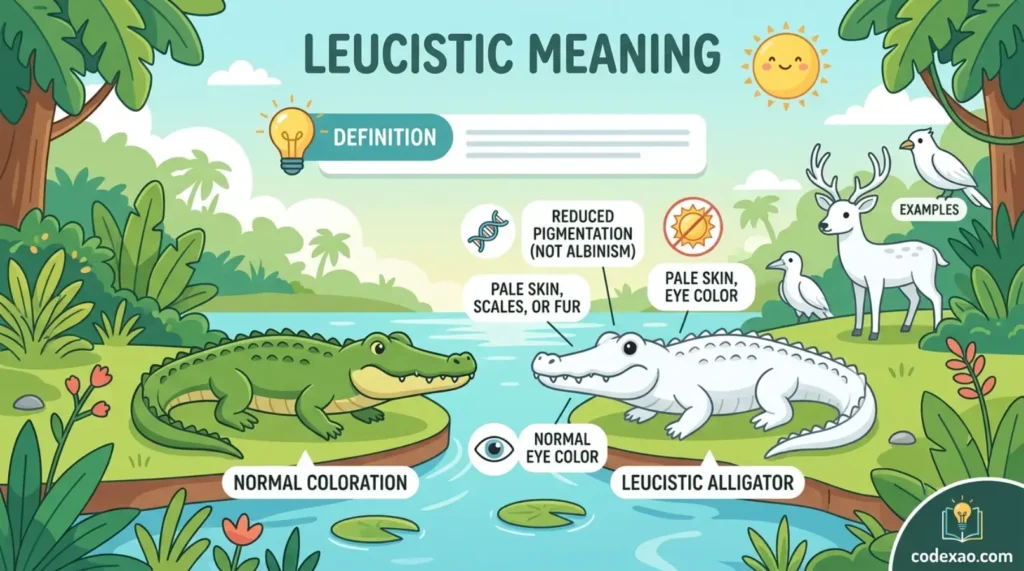
Leucistic meaning refers to animals that have reduced or absent pigmentation due to a genetic condition known as Leucism.
Quick Answer:
A leucistic animal has pale or white coloring caused by partial pigment loss, but still has normal eye color, unlike albinism.
Origin & Etymology
The term “leucistic” comes from the Greek word leukos, meaning “white.” Scientists began using it to describe animals with abnormal pigmentation that didn’t fit the definition of albinism.
How It Evolved
Originally used mainly in scientific studies, the term gained popularity online as people started sharing rare animal sightings. Today, it’s widely used in wildlife communities, documentaries, and social media.
Pronunciation Guide
loo-SIS-tik
How to Use “Leucistic” Correctly in Texts & Chat
Unlike slang terms, “leucistic” is more scientific, but it still appears in casual conversation, especially among animal lovers.
Where You’ll See It
- Instagram captions: Wildlife photos
- Reddit threads: Animal identification discussions
- TikTok comments: Viral rare animal videos
- Discord groups: Nature or science communities
Correct Usage
Use “leucistic” when describing an animal with:
- Pale or white coloring
- Normal eye color
- Partial pigment loss
When NOT to Use It
- ❌ Don’t use it interchangeably with “albino”
- ❌ Avoid using it for humans (not scientifically accurate)
- ❌ Not appropriate in casual slang unless context is clear
Formatting Tips
- Usually lowercase: leucistic owl
- No abbreviation
- Often paired with species name
Real Conversation Examples Using “Leucistic”
1. Between Friends (Wildlife Spotting)
A: “Why is that deer white?”
B: “It’s probably leucistic, not albino.”
Shows casual educational tone
2. Instagram Comment
“Wow, a leucistic peacock! That’s so rare 😍”
Expresses amazement and awareness
3. Reddit Discussion
“Based on the eye color, this bird is leucistic, not albino.”
Analytical, informative usage
4. Classroom Setting
“The professor explained that leucistic animals still produce some pigment.”
Academic tone
5. Wildlife Documentary Chat
“That lion isn’t albino, it’s leucistic, which is different genetically.”
Clarifies a common misconception
Common Mistakes & Misunderstandings
1. Confusing Leucistic with Albino
This is the biggest mix-up.
- Leucistic: normal eyes
- Albino: red or pink eyes
2. Assuming It Means Completely White
Leucistic animals can have:
- Patchy colors
- Pale tones
- Not always fully white
3. Misusing It for Humans
Leucism is primarily used for animals, not people.
Generational Confusion
Older generations may not recognize the term, while Gen Z often learns it through social media wildlife content.
“Leucistic” Across Different Platforms & Demographics
Gen Z vs Millennials
- Gen Z: Learns through TikTok and viral videos
- Millennials: More likely to encounter it in documentaries
Platform Popularity
- TikTok: High (rare animal clips)
- Instagram: Medium (photography pages)
- Reddit: High (science discussions)
- Twitter/X: Moderate
Formal or Informal?
- Semi-formal
- Safe for educational and casual use
Viral Trends
Leucistic animals often trend due to their unique appearance, especially rare white peacocks, lions, and birds.
Related Slang, Abbreviations & Alternatives
| Term | Meaning |
|---|---|
| Albino | Complete lack of pigmentation |
| Melanistic | Excess dark pigmentation |
| Piebald | Patchy pigmentation |
| Partial albinism | Incomplete albinism (often confused) |
| Genetic mutation | DNA change affecting traits |
| Pigmentation disorder | General term |
| White morph | Color variation |
| Rare variant | Uncommon genetic trait |
FAQs:
What does leucistic mean in animals?
Leucistic animals have reduced pigmentation due to a genetic condition. They often appear pale or white but still have normal eye color, which distinguishes them from albinism.
Is leucistic the same as albino?
No. Leucistic animals retain normal eye color, while albinism have red or pink eyes due to a complete lack of melanin.
Can humans be leucistic?
No, the term “leucistic” is not typically used for humans. Human pigmentation conditions are classified differently in medical science.
Are leucistic animals rare?
Yes, leucism is relatively rare in the wild. Animals with this condition may face survival challenges due to visibility to predators.
What causes leucism genetically?
Leucism is caused by a partial loss of pigmentation due to genetic mutations affecting pigment cell development.
Conclusion:
Understanding the leucistic meaning clears up one of the most common wildlife misconceptions.
It’s not albinism, it’s a completely different genetic condition with its own unique traits.
From viral animal videos to scientific discussions, leucism continues to capture attention. And now, you’ll know exactly what you’re looking at.
Next time you see a pale-colored animal with normal eyes, you’ll recognize it instantly: leucistic.
Got a favorite rare animal sighting? Drop it in the comments, or explore more fascinating terms below.

Hi, I’m John Mark, the voice behind codexao.com, where meanings aren’t just explained, they’re simplified for the way people actually talk today.
I’ve always been curious about words, how they change, how they trend, and how a simple phrase can carry completely different meanings depending on context. That curiosity turned into codexao, a space where I break down slang, text abbreviations, and everyday words into clear, easy-to-understand explanations.