Have you ever heard someone say they felt a sense of liberation after quitting a stressful job, ending a toxic relationship, or finally achieving a personal goal? The word carries a powerful emotional weight, yet many people are unsure about its exact meaning and how to use it correctly.
The liberation meaning goes far beyond simply being free. It often describes a life-changing moment when someone breaks away from limitations, control, fear, or oppression.
Whether you’re reading historical texts, scrolling through social media, or improving your vocabulary, understanding this term can help you communicate more clearly.
This guide explains what liberation means, where the word comes from, how people use it today, and plenty of real-world examples that make the concept easy to understand.
What Does Liberation Mean?
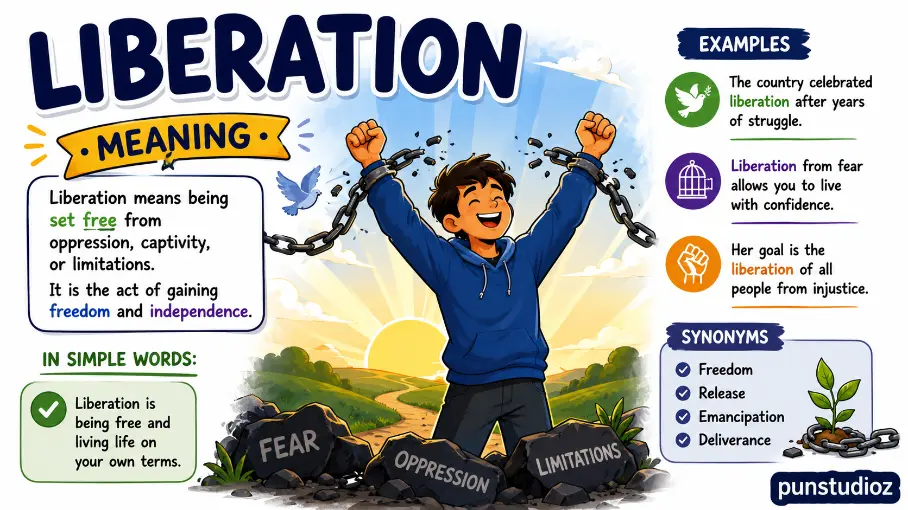
Liberation refers to the act of gaining freedom from something that restricts, controls, or oppresses a person, group, or society.
The word can apply to physical freedom, emotional healing, social equality, political independence, or personal growth.
Quick Answer
Liberation means being freed from restrictions, oppression, control, fear, or limitations. It often describes a transition from confinement or hardship to freedom and empowerment.
Origin of Liberation
The word liberation comes from the Latin word liberare, which means “to set free.” It entered the English language centuries ago and has been widely used in political, religious, psychological, and social discussions.
Historically, the term became especially prominent during movements for independence, civil rights campaigns, and struggles against oppression.
How the Meaning Has Evolved
Originally, liberation was mostly associated with political freedom and the release of people from domination. Today, it is commonly used in personal development, mental health discussions, workplace conversations, and social media content.
Pronunciation Guide
Liberation is pronounced as:
lih-buh-RAY-shun
How to Use Liberation Correctly in Texts and Chat
The word liberation is versatile and can fit many situations.
Casual Conversations
People often use liberation when describing a feeling of relief or newfound freedom.
Examples:
- “Deleting that app felt like liberation.”
- “Graduation brought a sense of liberation.”
Emotional Contexts
The term frequently appears when discussing mental or emotional growth.
Examples:
- “Therapy gave her emotional liberation.”
- “Forgiveness brought him liberation from years of anger.”
Social Media Usage
On platforms like Instagram, TikTok, and X, liberation is often used in captions about personal transformation.
Examples:
- “A new chapter. Pure liberation.”
- “Finally choosing myself. Liberation feels amazing.”
Professional Settings
While the word is acceptable in professional writing, it should be used thoughtfully.
Appropriate:
- “The new policy brought greater creative liberation.”
Less Appropriate:
- Overusing it for minor inconveniences can make the statement sound exaggerated.
Formatting Tips
- Usually written in lowercase.
- Often paired with words like freedom, empowerment, growth, and independence.
- Common emoji pairings include ✨, 🕊️, 🌅, and 🎉.
Real Conversation Examples Using Liberation
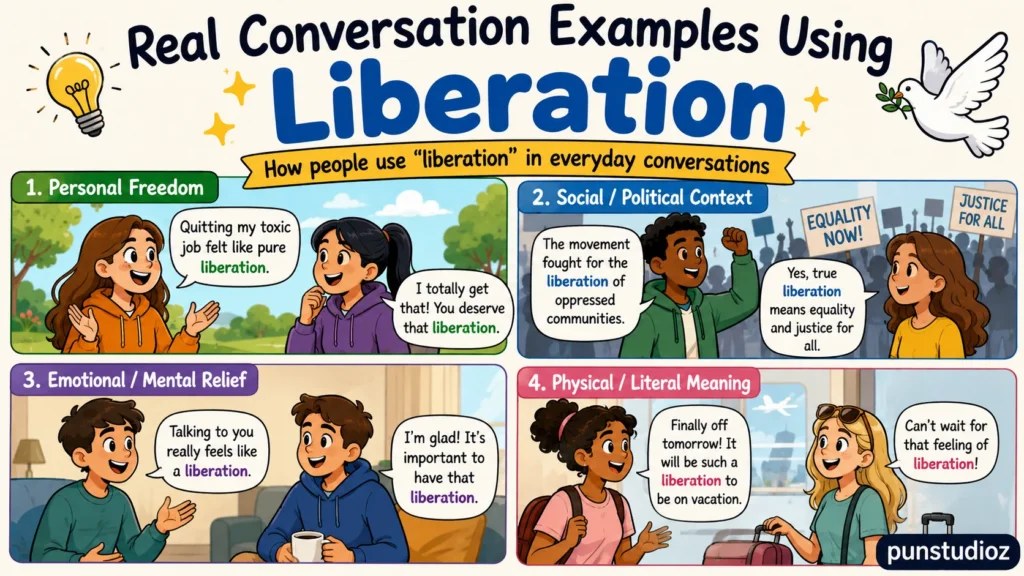
Between Friends
Alex: I finally paid off my student loans.
Jordan: That must feel like complete liberation.
Meaning: Jordan is expressing that Alex has gained freedom from a major financial burden.
In a Dating Conversation
Taylor: Ending that relationship was hard.
Sam: Hard, yes. But maybe it’s also a form of liberation.
Meaning: Liberation here refers to emotional freedom and personal growth.
Family Discussion
Mom: Now that the kids are grown up, I have more time for myself.
Dad: Sounds like a new kind of liberation.
Meaning: The term describes freedom from previous responsibilities.
Workplace Chat
Employee: The flexible schedule has changed everything.
Manager: Many people describe that as workplace liberation.
Meaning: Greater freedom and control over work-life balance.
Gaming Community
Player 1: We finally defeated the final boss.
Player 2: What a feeling of liberation.
Meaning: Relief and freedom from a difficult challenge.
Liberation Meaning in Buddhism
In Buddhism, liberation means freedom from the cycle of suffering, attachment, craving, and repeated rebirth. It is closely associated with Nirvana (Nibbāna), the state in which ignorance and craving the forces that keep suffering going have been overcome.
Rather than meaning escape from the world, Buddhist liberation is about seeing reality clearly and no longer being controlled by desires, attachments, or aversion. The Buddha taught that this freedom is developed through the Noble Eightfold Path, including ethical conduct, mental discipline, and wisdom.
At its deepest level, liberation means awakening to the nature of existence and ending the causes of dukkha, often translated as suffering or unsatisfactoriness. In Theravāda Buddhism, this goal is traditionally described as Nibbāna. In Mahāyāna Buddhism, liberation is also connected with awakening (bodhi) and, in many traditions, the compassionate aspiration to help all beings become free from suffering.
Common Mistakes and Misunderstandings
Mistake 1: Using Liberation for Minor Situations
Some people use liberation for very small events.
Example:
- “I found my missing pen. Total liberation.”
This can sound exaggerated unless used humorously.
Mistake 2: Confusing Liberation with Freedom
Freedom and liberation are related but different.
- Freedom is the state of being free.
- Liberation is the process or act of becoming free.
Mistake 3: Assuming It Is Always Political
Many people associate liberation only with political movements.
In reality, the term is widely used for emotional healing, self-improvement, and personal development.
Generational Differences
Older generations may primarily connect liberation with historical events and civil rights movements.
Younger generations often use it to describe personal empowerment, mental health breakthroughs, and lifestyle changes.
How to Clarify the Meaning
If someone seems confused, simply explain the source of freedom being discussed.
For example:
- Emotional liberation
- Financial liberation
- Political liberation
- Spiritual liberation
Liberation Across Different Platforms and Demographics
Gen Z Usage
Gen Z frequently uses liberation when discussing:
- Self-care
- Personal boundaries
- Mental wellness
- Authentic self-expression
Millennials
Millennials often use liberation in conversations about:
- Career changes
- Financial independence
- Life transitions
Older Generations
Older adults may connect the term more strongly to:
- Historical events
- Social justice movements
- National independence struggles
Social Platforms
TikTok
Popular in transformation videos and personal growth content.
Common in captions about achievements and fresh starts.
Discord
Occasionally used in gaming and community discussions.
Frequently appears in discussions about life improvement, relationships, and mental health.
Formal or Informal
Liberation works in both formal and informal settings, making it a versatile word.
Safe for Work
Yes. Liberation is generally considered professional and workplace-friendly.
Liberation Meaning in Farsi
The English word “liberation” can be translated into Farsi as رهایی (Rahāyi), آزادی (Āzādi), or رستگاری (Rastgāri), depending on the context.
- رهایی (Rahāyi) freedom, release, or liberation from something
- آزادی (Āzādi) freedom or liberty
- رستگاری (Rastgāri) salvation, deliverance, or spiritual liberation
For a spiritual or Buddhist context, رهایی is often a natural choice because it conveys the idea of being released from suffering, attachment, and the cycle of rebirth.
For example:
Liberation means freedom from suffering.
رهایی به معنای آزادی از رنج است.
Rahāyi be ma’nā-ye āzādi az ranj ast.
In a Buddhist context, “liberation” can therefore be understood in Farsi as رهایی از رنج و چرخه تولد دوباره “freedom from suffering and the cycle of rebirth.”
Related Slang, Abbreviations and Alternatives
| Term | Meaning |
|---|---|
| Freedom | State of being free |
| Emancipation | Release from legal or social restrictions |
| Independence | Self-governance and autonomy |
| Release | Being freed from something |
| Deliverance | Rescue from hardship |
| Empowerment | Gaining confidence and control |
| Autonomy | Ability to make one’s own decisions |
| Self-determination | Controlling one’s own future |
| Breakthrough | Major positive progress |
| Renewal | Fresh start or transformation |
Synonyms
- Freedom
- Independence
- Emancipation
- Release
- Deliverance
- Autonomy
Casual Opposites
- Restriction
- Oppression
- Confinement
- Limitation
- Control
Liberation Meaning in Medical Terms
In medical language, liberation generally means being freed, released, or separated from something that is restricting normal function. It is not usually a diagnosis by itself. Instead, doctors may use the word to describe a procedure, treatment, or process that removes an obstruction, releases trapped tissue, or frees a structure.
For example, nerve liberation can refer to surgically releasing a nerve that has become compressed or trapped by surrounding tissue. Similarly, tissue liberation may describe freeing tissue during a surgical procedure so that it can move or function normally.
The exact meaning depends heavily on the medical context. You might encounter liberation in an operative report, rehabilitation note, or description of a surgical technique.
Simple example:
“The surgeon performed liberation of the nerve.”
This means the surgeon released the nerve from surrounding tissue or pressure that was interfering with its normal function.
So, when you see “liberation” in medical terms, think of it as release or freeing of a body structure, rather than “freedom” in the everyday sense.
FAQs:
What is the simple meaning of liberation?
Liberation means becoming free from something that limits, controls, or oppresses you. It can apply to emotional, physical, social, or political situations.
Is liberation a positive word?
Yes. Liberation generally carries a positive meaning because it represents freedom, empowerment, and overcoming obstacles.
Can liberation be used in everyday conversations?
Absolutely. People commonly use it when discussing personal growth, life changes, emotional healing, and major achievements.
What is the difference between liberation and emancipation?
Both involve freedom, but emancipation often has legal or historical implications, while liberation has broader applications in personal and social contexts.
Why is liberation important?
Liberation represents growth, progress, and the ability to live without unnecessary restrictions. It often marks an important turning point in a person’s life.
Can liberation refer to emotions?
Yes. Emotional liberation is a common phrase used to describe releasing negative feelings, fears, regrets, or emotional burdens.
Conclusion:
The liberation meaning centers on one powerful idea: freedom from limitations, control, oppression, or burdens.
Whether the context is personal, emotional, social, or political, the word describes a journey toward greater independence and empowerment.
What makes liberation such a meaningful term is its flexibility. It can describe a nation gaining independence, a person overcoming fear, or someone finally embracing their true self.
The next time you hear or use the word liberation, you’ll understand that it represents much more than freedom. It symbolizes transformation, growth, and the courage to move forward.
Explore more vocabulary guides and share your favorite word or expression in the comments below.

Hi, I’m Isabella Brown, the voice behind Codexao.com, where meanings aren’t just explained, they’re made easy to understand.
I’ve always been fascinated by how words shape the way we think, speak, and connect. But let’s be honest—most definitions out there feel confusing, outdated, or just plain boring.
That’s exactly why I created Codexao. Here, I break down words, slang, and modern expressions into simple, clear meanings you can actually use in real life.