Have you ever seen a vacation package advertised as “all inclusive” and wondered what you’re actually getting for your money? You’re not alone.
The phrase appears everywhere, from travel websites and hotel brochures to social media posts and everyday conversations.
The all inclusive meaning is simple on the surface, but many people misunderstand what it truly covers.
Some assume everything is free once they arrive, while others worry about hidden fees and surprise costs.
Understanding this term can help you make smarter travel decisions, avoid unexpected expenses, and know exactly what to expect before booking a trip.
Guide, you’ll learn the definition of all inclusive, where the phrase came from, how it’s used today, real-life examples, common mistakes, and answers to the most frequently asked questions.
What Does All Inclusive Mean?
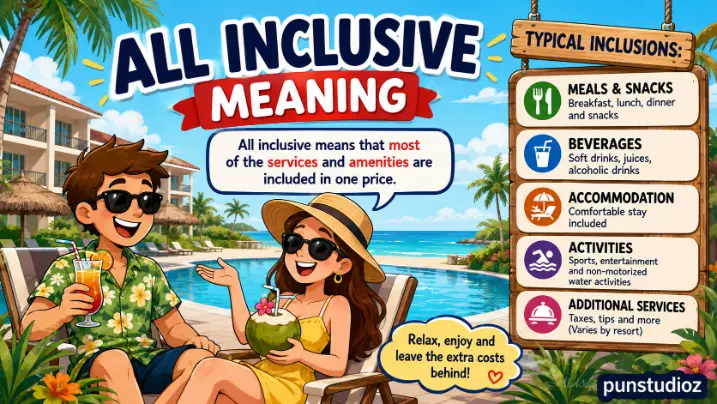
The term all inclusive describes a package, service, or arrangement where most or all expenses are covered by a single upfront payment.
In travel, it usually means your hotel stay, meals, drinks, entertainment, and selected activities are included in the total price.
Quick Answer:
All inclusive means paying one price that covers most major costs, reducing the need for separate payments later.
Origin of the Term
The phrase “all inclusive” has been used for decades in the hospitality and travel industries. It became especially popular with resorts that wanted to simplify vacation planning for guests.
Instead of paying separately for meals, activities, and accommodations, travelers could enjoy everything under one package price.
Over time, the concept expanded beyond travel. Today, people use all inclusive to describe events, memberships, services, and business packages that bundle multiple offerings together.
Pronunciation Guide
All Inclusive
Pronunciation:
awl in-kloo-siv
How to Use All Inclusive Correctly in Texts and Conversations
The phrase is straightforward and can be used in both casual and professional settings.
Casual Usage
People commonly use it when discussing vacations, cruises, resorts, or events.
Examples:
- We booked an all inclusive resort for our honeymoon.
- The conference ticket is all inclusive, so meals are covered.
- I prefer all inclusive vacations because budgeting is easier.
Professional Usage
Businesses often use the term in marketing and customer communication.
Examples:
- Our all inclusive package includes installation and support.
- The event fee is all inclusive with no hidden charges.
Platform-Specific Usage
SMS and WhatsApp
Short and practical.
Example:
“Is the hotel all inclusive or do we pay separately for meals?”
Often appears in travel captions.
Example:
“Living my best life at an all inclusive beach resort.”
X and Threads
Used when sharing travel tips and reviews.
Example:
“Found an amazing all inclusive deal for summer.”
Frequently discussed in travel communities.
Example:
“What’s actually included in this all inclusive package?”
Discord
Common in travel and vacation planning groups.
Example:
“Anyone stayed at an all inclusive resort recently?”
When Not to Use It
Avoid using all inclusive when costs are clearly separated.
Incorrect:
- This restaurant is all inclusive.
Correct:
- The wedding package is all inclusive.
Real Conversation Examples Using All Inclusive
Between Friends
Alex: Where are you staying in Mexico?
Jordan: An all inclusive resort near the beach.
Alex: Nice. No need to worry about meal costs.
Meaning: Jordan highlights that most vacation expenses are already covered.
Dating Scenario
Emma: Did you book the honeymoon?
Ryan: Yes, we chose an all inclusive package.
Emma: Perfect. That makes planning easier.
Meaning: Convenience and predictable costs are emphasized.
Family Discussion
Mom: Are meals included at the hotel?
Dad: Yes, it’s all inclusive.
Mom: Great, that saves us money.
Meaning: The phrase reassures family members about budgeting.
Workplace Conversation
Manager: Does the conference fee cover food?
Employee: Yes, it’s all inclusive.
Meaning: Everything necessary is included in one price.
Gaming Community Chat
Player 1: Is the premium membership worth it?
Player 2: It’s basically an all inclusive package with every expansion.
Meaning: The term is used metaphorically to describe complete access.
All Inclusive List Meaning
An all-inclusive list is a complete or comprehensive list that aims to include all the relevant items, people, features, services, or options within a particular category. In simple terms, it means nothing important has been intentionally left out.
For example, if a hotel provides an “all-inclusive list” of what your package covers, it might include accommodation, meals, drinks, entertainment, activities, and other services. The exact meaning depends on the context, so an all-inclusive list should clearly state what is included and, when relevant, what is excluded.
Example:
“The website provides an all-inclusive list of the benefits available to members.”
Here, all-inclusive emphasizes that the list is intended to cover the full range of relevant benefits.
In short: All-inclusive list = a complete list covering all relevant items or options.
Common Mistakes and Misunderstandings
Assuming Everything Is Included
Many travelers believe all inclusive means absolutely everything.
In reality, premium dining, spa treatments, excursions, and certain activities may cost extra.
Ignoring the Fine Print
Not every all inclusive package offers the same benefits.
Always check:
- Meals included
- Beverage policies
- Activity access
- Transportation options
- Resort fees
Confusing It With Full Board
Full board usually covers breakfast, lunch, and dinner.
All inclusive often includes meals plus drinks, entertainment, and activities.
Generational Differences
Older travelers may expect basic accommodations and meals.
Younger travelers often expect unlimited drinks, Wi-Fi, and entertainment.
Regional Differences
The exact meaning can vary by country, hotel chain, or travel provider.
Always verify what is included before booking.
All Inclusive Across Different Platforms and Demographics
Gen Z
Gen Z travelers love all inclusive options because they simplify budgeting and often provide social experiences.
Popular on:
- TikTok travel videos
- Instagram reels
- Travel vlogs
Millennials
Millennials frequently choose all inclusive vacations for convenience and value.
Common reasons include:
- Family travel
- Honeymoons
- Group trips
Older Generations
Many retirees appreciate predictable expenses and stress-free vacation planning.
Social Media Popularity
The term appears regularly in:
- Travel reviews
- Resort comparisons
- Vacation planning content
- Destination guides
Formal or Informal
All inclusive works in both formal and informal contexts.
It is considered professional, business-friendly, and safe for work.
All Inclusive Meaning at a Hotel

An all-inclusive hotel is a hotel or resort where your booking price covers most of the essentials you would normally pay for separately. This often includes your room, meals, snacks, drinks, and selected activities or entertainment.
In simple terms, instead of constantly reaching for your wallet during your stay, you pay one main price upfront and enjoy many hotel services without separate charges.
What Does “All-Inclusive” Usually Include?
The exact package varies by hotel, but an all-inclusive stay commonly covers:
- 🛏️ Accommodation Your room or suite
- 🍳 Breakfast, lunch, and dinner Often served at buffets or restaurants
- 🍹 Drinks Soft drinks, water, coffee, and sometimes alcoholic beverages
- 🍿 Snacks Available between regular meals at participating locations
- 🏊 Recreational activities Such as swimming pools, beach access, games, or fitness facilities
- 🎭 Entertainment Live shows, music, themed nights, or other scheduled activities
- 🏖️ Resort facilities Depending on the property and package
However, “all-inclusive” does not literally mean everything is free. Premium restaurants, spa treatments, excursions, room service, airport transfers, water sports, premium alcohol, and other extras may cost more.
All-Inclusive vs. Regular Hotel
The biggest difference is how you pay for food and services.
At a traditional hotel, you might pay separately for your room, breakfast, dinner, drinks, and activities. At an all-inclusive resort, many of these costs are bundled into one package price.
For example, if an all-inclusive resort costs $250 per night, that price may cover your room plus meals, selected drinks, entertainment, and certain activities. You should still check the hotel’s inclusions before booking because packages differ.
What Should You Check Before Booking?
Don’t assume the word “all-inclusive” covers every service. Check the hotel’s package details for:
- Which meals are included
- Whether drinks are included
- Which restaurants are covered
- Whether alcohol is included and what brands are offered
- Which activities are free
- Whether Wi-Fi is included
- Whether taxes and resort fees are included
- Which services require additional payment
In short: an all-inclusive hotel means your stay is bundled with many meals, drinks, activities, and amenities for one upfront price, making budgeting easier and reducing the need to pay separately throughout your vacation.
Related Slang, Terms and Alternatives
| Term | Meaning |
|---|---|
| Package Deal | Multiple services sold together |
| Full Board | Accommodation plus meals |
| Half Board | Accommodation with breakfast and one additional meal |
| Resort Package | Vacation bundle with amenities |
| Bundle | Several products combined into one purchase |
| Premium Package | Enhanced version with extra benefits |
| Unlimited Access | No restrictions on included services |
| Inclusive Pricing | Most charges included upfront |
| Cruise Package | Travel package aboard a cruise ship |
| Vacation Bundle | Combined travel services in one price |
Related reading opportunities:
- Learn more about package deal meaning
- Learn more about bundle meaning
- Learn more about premium package meaning
- Learn more about full board meaning
- Learn more about vacation package meaning
FAQs:
What does all inclusive mean in travel?
In travel, all inclusive usually means accommodations, meals, drinks, and selected activities are covered by one upfront payment. Exact inclusions vary by provider.
Does all inclusive mean everything is free?
No. Services are prepaid rather than free. Some premium experiences, excursions, or specialty items may still require additional payment.
Is food included in all inclusive resorts?
Yes. Food is generally one of the core features of an all inclusive package. Most resorts offer multiple dining options within the package.
Are drinks included in all inclusive packages?
Many packages include both non-alcoholic and alcoholic beverages. However, premium brands may not be covered.
Is an all inclusive vacation worth it?
For travelers who plan to enjoy meals, drinks, entertainment, and activities, an all inclusive package can offer excellent value and easier budgeting.
Can families benefit from all inclusive resorts?
Absolutely. Families often appreciate predictable costs, kid-friendly activities, and the convenience of having meals and entertainment included.
What is the difference between all inclusive and ultra all inclusive?
Ultra all inclusive packages typically include additional luxury services, premium beverages, extended dining options, and enhanced amenities.
Conclusion:
The all inclusive meaning is all about simplicity, convenience, and predictable costs. Instead of paying separately for every service, you pay one price that covers most major expenses.
Whether you’re booking a tropical resort, planning a cruise, or evaluating a business package, understanding what all inclusive means can help you avoid confusion and get better value.
Next time you see an all inclusive offer, take a quick look at what’s covered, compare options carefully, and enjoy the peace of mind that comes with knowing most of your expenses are already handled.
Drop your favorite travel destination in the comments and explore more travel and lifestyle terms to expand your vocabulary.

Hi, I’m Isabella Brown, the voice behind Codexao.com, where meanings aren’t just explained, they’re made easy to understand.
I’ve always been fascinated by how words shape the way we think, speak, and connect. But let’s be honest—most definitions out there feel confusing, outdated, or just plain boring.
That’s exactly why I created Codexao. Here, I break down words, slang, and modern expressions into simple, clear meanings you can actually use in real life.