Turn on the news from almost any region on earth and you will eventually hear the word sectarianism thrown around, usually right before a story about violence, a contested election, or a community split down the middle.
Yet ask most people to define it on the spot and you will get a shrug.
That gap matters. Sectarianism shapes wars, voting patterns, workplace politics, and even the group chats we avoid because a family member always brings up religion.
Understanding sectarianism meaning properly helps you read the news with sharper eyes, avoid using the word incorrectly, and recognize the pattern when it shows up closer to home than a headline.
This guide breaks the term down in plain language, walks through where it comes from, shows how it plays out in the real world, and clears up the mix ups people constantly make between sectarianism, racism, and extremism. No jargon, no lecture, just a clear picture of what the word actually covers.
What Does Sectarianism Mean?
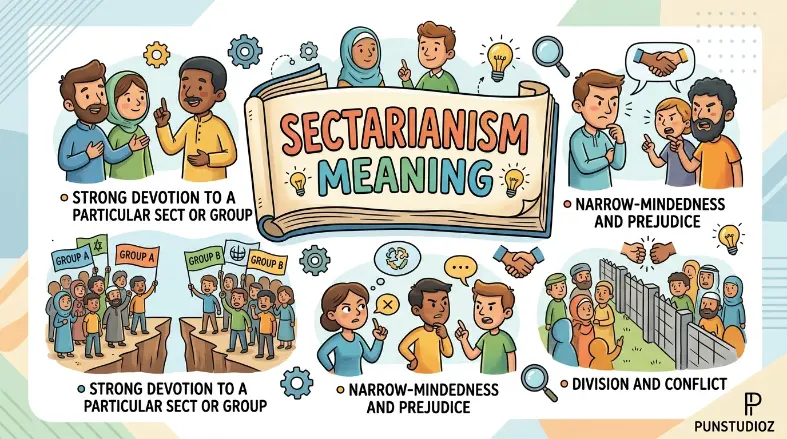
Sectarianism is the tendency to divide people rigidly by sect, showing loyalty to one’s own group and hostility, suspicion, or discrimination toward another, usually within a shared religion, nation, or ideology.
Quick Answer: Sectarianism is prejudice or conflict between subgroups of the same broader community, most commonly religious denominations, based purely on group membership rather than individual belief or behavior.
The word traces back to “sect,” from the Latin secta, meaning a path or a school of thought. A sect originally just meant a distinct religious or philosophical faction. Sectarianism entered common usage during periods of religious upheaval in Europe, particularly around the Protestant Reformation, when Catholic and Protestant communities split violently across the continent.
The meaning has broadened significantly since then. It no longer applies only to Christianity. Today it describes Sunni versus Shia tensions in the Middle East, Catholic versus Protestant divisions in Northern Ireland, caste based splits in South Asia, and even bitter internal party rivalries that have nothing to do with religion at all.
Pronunciation is straightforward: sek-TAIR-ee-uh-niz-um, with the stress on the second syllable.
How Sectarianism Shows Up in Real Life
Sectarianism rarely announces itself with a label. It usually hides inside ordinary decisions that quietly favor one group over another.
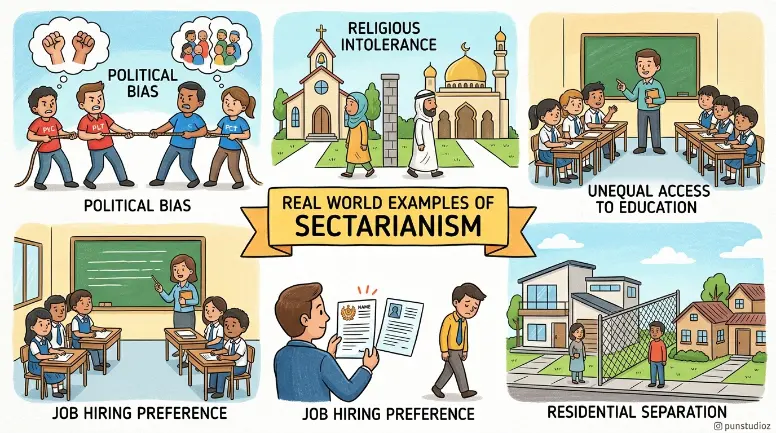
1. In politics, it shows up when parties recruit almost exclusively along religious or ethnic lines, and voters choose candidates based on which sect they belong to rather than their actual policies.
2. In employment, it appears as hiring patterns that consistently favor one community, or workplace cliques that form strictly along religious or ideological lines instead of shared skills or interests.
3. In neighborhoods, sectarianism can mean informal but very real boundaries, streets, schools, or even hospitals that one group avoids because of who typically uses them.
Online, it looks like comment sections and forums where users pile on anyone identified as belonging to a rival sect, regardless of what that individual person actually said or believes.
The common thread is always the same: the group label matters more than the individual. That is the core of what makes something sectarian rather than just an ordinary disagreement.
Real World Examples of Sectarianism
Example 1, historical conflict The Troubles in Northern Ireland from the late 1960s through the 1998 Good Friday Agreement is one of the most studied sectarian conflicts of the modern era, pitting predominantly Protestant unionists against predominantly Catholic nationalists. This shows how sectarianism can fuse religion with national identity and fuel decades of violence even after the original theological disputes fade into the background.
Example 2, regional politics In several Middle Eastern countries, government positions and parliamentary seats are informally or formally allocated based on Sunni, Shia, or Christian identity rather than pure merit. This demonstrates institutional sectarianism, where the divide is baked directly into how power is distributed.
Example 3, everyday family life A person from a mixed religious family says their grandparents still refuse to attend weddings held in the “other” sect’s place of worship, even though the couple getting married loves each other deeply. This captures how sectarian attitudes can persist quietly for generations, long after the original grievance is forgotten.
Example 4, workplace tension A manager quietly promotes employees who share their political or religious affiliation while overlooking equally qualified colleagues from a rival group. This is a subtler, modern form of sectarianism that rarely gets labeled as such but causes real harm.
Example 5, online communities A gaming or fandom community fractures into hostile camps over a leadership dispute, and members start refusing to interact with anyone loyal to the “other side,” even outside the original disagreement. This shows sectarian thinking is not limited to religion or politics; it is really a pattern of tribal loyalty that can attach itself to almost any group identity.
Common Misunderstandings About Sectarianism
Mistake one: confusing sectarianism with racism. Racism targets people based on race or ethnicity. Sectarianism targets people based on which faction or denomination they belong to, and it frequently occurs between people of the exact same ethnicity.
Mistake two: assuming it is always about religion. Religion is the most historically documented form, but sectarian dynamics apply just as easily to political parties, sports rivalries, and online subcultures.
Mistake three: treating sectarian conflict as ancient and unsolvable. Many sectarian divides feel centuries old but are actually reinforced or reignited by modern politicians who benefit from keeping communities divided rather than by unbroken historical hatred.
Generational gaps add another layer of confusion. Older generations who lived through a specific sectarian conflict often use the term with heavy emotional weight, while younger people encountering it mainly through history class or news headlines may underestimate how personal and painful the divisions still are for those who lived them.
Regional context matters enormously too. A term or symbol considered neutral in one country can be read as a sectarian marker in another, so it always helps to ask rather than assume when a situation feels unclear.
Sectarianism Across Regions and Communities
Sectarianism does not look the same everywhere, and the specific fault lines shift depending on the region’s history.
1. In parts of the Middle East, the Sunni-Shia divide remains the most commonly cited example, though local politics and colonial history shaped it far more than pure theology did.
2. In South Asia, sectarianism often overlaps with caste and religious identity, creating layered divisions that are harder to separate from social class.
3. In Europe, historical Catholic-Protestant tensions have mostly faded from daily life, though Northern Ireland remains a notable exception where identity politics still trace back to that split.
4. In East Africa and parts of the Sahel, sectarian dynamics increasingly overlap with ethnic and clan identity rather than pure religious doctrine.
Across all these regions, one pattern holds steady: sectarianism tends to intensify during periods of political instability, economic hardship, or weak central government, because divided communities are easier for opportunistic leaders to mobilize than united ones.
Related Slang, Abbreviations and Alternatives
| Term | What It Means |
|---|---|
| Denominationalism | Emphasis on differences between branches of the same faith, milder than sectarianism |
| Tribalism | Strong in group loyalty, often used more broadly for ethnic or political groups |
| Factionalism | Division into competing internal groups, common in politics and organizations |
| Communalism | Term often used in South Asia for religious community based division |
| Schism | A formal split within a religious body, often the starting point of sectarianism |
| Bigotry | Intolerance toward those with different opinions, a close cousin of sectarian attitudes |
| Xenophobia | Fear or dislike of people from other nations, distinct from sectarianism but sometimes overlapping |
| Ecumenism | The opposite pole, efforts to promote unity between different religious groups |
| Pluralism | Peaceful coexistence of different groups within one society, the healthy alternative to sectarianism |
| Polarization | Broader term for a society splitting into two opposing camps on any issue |
Learn more about how tribalism and factionalism differ from sectarianism, and explore the difference between sectarianism and racism for a deeper dive into commonly confused terms.
FAQs:
What is the simple meaning of sectarianism?
It means treating people differently, often unfairly, because of which religious or political sect they belong to, even when both sides technically share the same broader religion or nation.
Is sectarianism the same as racism?
No. Racism targets people based on perceived race or ethnicity. Sectarianism targets people based on sect, denomination, or ideological faction, often within the same ethnic or national group.
What causes sectarianism?
It usually grows from a mix of historical grievances, competition for political power, economic inequality, and leaders who exploit group identity to build loyalty or win elections.
Can sectarianism exist outside religion?
Yes. Political parties, workplaces, sports fandoms, and online communities all develop sectarian dynamics whenever people sort themselves into rigid us-versus-them camps.
How is sectarianism different from extremism?
Extremism refers to holding radical views that justify extreme action. Sectarianism refers to division along group lines. A sectarian conflict can turn extremist, but sectarianism itself is about identity and division, not necessarily radical ideology.
Conclusion:
Sectarianism is not some distant historical footnote confined to textbooks about old European wars. It is a living pattern that keeps reappearing wherever people organize themselves into rigid camps and start treating group membership as more important than individual character.
Understanding the real definition helps you spot the pattern early, whether it shows up in a news story about a distant conflict or in something as ordinary as a workplace clique that quietly favors its own. Knowing the difference between sectarianism, racism, and extremism also keeps conversations about these sensitive topics far more accurate.
The healthiest antidote is not pretending differences do not exist, but building enough trust and contact between groups that identity stops being treated as a battle line. Share this guide with anyone trying to make sense of a sectarian headline, and drop your own examples or questions in the comments below.

Hi, I’m Isabella Brown, the voice behind Codexao.com, where meanings aren’t just explained, they’re made easy to understand.
I’ve always been fascinated by how words shape the way we think, speak, and connect. But let’s be honest—most definitions out there feel confusing, outdated, or just plain boring.
That’s exactly why I created Codexao. Here, I break down words, slang, and modern expressions into simple, clear meanings you can actually use in real life.