Someone comments “he’s so staunch” under a couple’s photo and you’re left squinting at your screen wondering if that’s a good thing or a diss.
Good news, it’s a huge compliment, and once you understand it, you’ll start seeing it everywhere from Instagram captions to group chat debates about who has the most loyal partner.
Staunch meaning has quietly become one of the most searched slang terms of the year, especially among people trying to decode dating culture and relationship lingo online.
It’s not a new word exactly, but its slang usage has exploded, and the way people throw it around today is very different from how your grandparents might have used it.
This guide breaks down exactly what staunch means, where it came from, how to use it without sounding awkward, and the mistakes that make people misread it completely. This is the only resource you’ll need to fully get it.
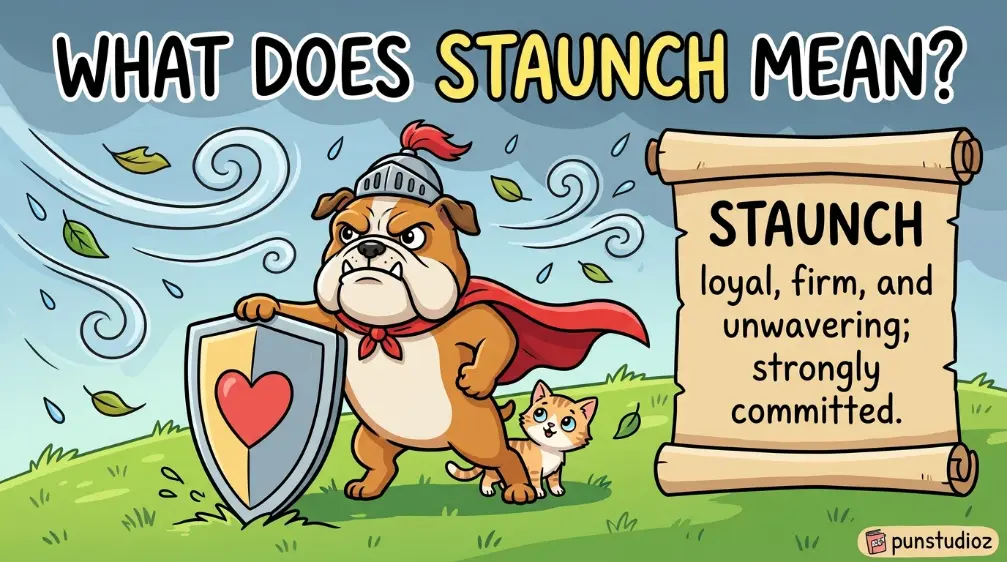
What Does Staunch Mean?
Staunch means fiercely loyal, steady, and unwavering, especially when it comes to supporting a person, cause, or relationship. Someone described as staunch doesn’t bend, doesn’t flip, and doesn’t leave when things get hard.
Quick Answer: Staunch means unwaveringly loyal and dependable. It’s used to praise someone, usually a partner or friend, who stays committed through everything without switching sides or losing interest.
Pronunciation: stawnch, rhymes with launch.
Origin story
Staunch is centuries old. It comes from Old French estanche, meaning watertight, and was originally used to describe ships that didn’t leak or structures that held firm under pressure. For a long time it lived a quiet life in formal English, describing staunch supporters of a political party or a staunch defender of a cause.
The slang glow-up happened through hip-hop and Caribbean influenced internet culture in the mid to late 2010s, where staunch got repurposed to describe romantic loyalty. Think of it as the word escaping the dictionary and moving into the group chat. By the early 2020s it had fully crossed over into mainstream dating slang, and it hasn’t slowed down since.
How the meaning has shifted
The formal meaning still exists in news and politics, where you’ll see phrases like a staunch critic of the policy. But the slang version, the one most people are actually googling, is almost entirely about relationships and friendship loyalty now. That shift matters because using the old formal tone in a casual text can come off stiff or confusing.
How to Use Staunch Correctly in Texts and Chat
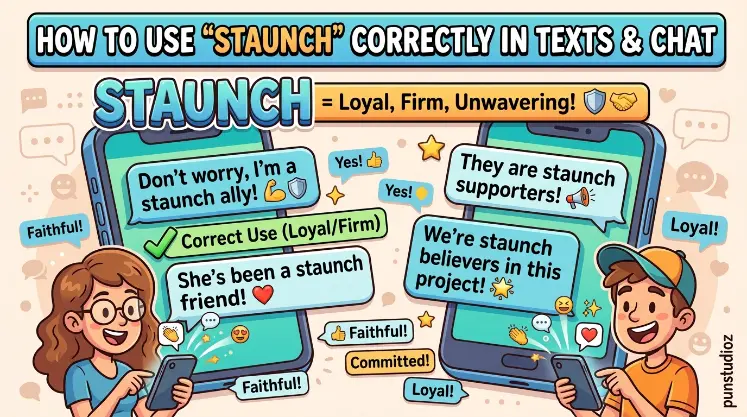
Tone matters a lot here. Staunch works best as a genuine compliment, not sarcasm, though sarcastic use does exist and we’ll get to that.
Casual and sincere: This is the main lane. You use it to hype up a partner, a friend, or yourself.
Sarcastic: Occasionally used to poke fun, like calling someone staunch right after they flaked on plans. Context and tone indicators like lol or emojis usually signal the joke.
Platform by platform
- SMS and iMessage: Short and direct, often paired with a heart emoji. “my man is so staunch fr”
- WhatsApp: Common in relationship group chats and status updates
- Instagram DMs and captions: Frequently used under couple photos or anniversary posts
- Twitter slash X: Shows up in viral relationship discourse threads, often with hot takes attached
- Discord: Less romantic here, more about gaming loyalty, like being staunch to your squad
- Reddit: Used in relationship advice subreddits, often debating what actually counts as staunch behavior
When not to use it
Skip it in professional emails, job interviews, or formal writing unless you mean the traditional definition, like a staunch advocate for workplace safety. In casual slang form, it reads as too informal for a resume or client message.
Formatting tips
Lowercase is standard in texting. No punctuation needed at the end for casual vibes. Pairs naturally with 🔒, 💯, and 🤞 emojis to reinforce the loyalty theme.
Real Conversation Examples Using Staunch
Between friends Person A: girl how’s the new boyfriend Person B: staunch. hasn’t looked at another girl since day one This shows genuine admiration, the friend is impressed by the partner’s consistency and faithfulness.
In a dating context Person A: how do you know he’s the one Person B: he’s staunch, canceled plans with the boys to help me move Here staunch is being used as proof, an example that backs up the claim of loyalty.
In a group chat Person A: y’all still together after 3 years?? Person B: yup, he’s staunch, never even glances at his ex’s story The tone is casual bragging, using staunch to shut down any doubt about the relationship’s strength.
Family setting Mom: your brother drove four hours just to help you move apartments You: yeah he’s staunch like that, always shows up Slightly more wholesome usage, applied outside romance to describe family reliability.
Gaming or friend group Player A: bro carried the whole squad again Player B: staunch teammate fr, never abandons a match Shows the word stretching beyond romance into loyalty within a friend group or team.
Common Mistakes and Misunderstandings
Mistake one: Confusing it with stubborn. Staunch implies loyalty, not rigidity or refusing to compromise. Someone can be staunch and still flexible in other areas of life.
Mistake two: Using it for one-time acts. Calling someone staunch after a single nice gesture misses the point. It’s meant to describe a pattern over time, not a one-off.
Mistake three: Overusing it sarcastically without context. Sarcastic use without clear tone markers can genuinely confuse readers, especially non-native speakers, who might take it at face value.
Generational gap
Older generations, particularly Gen X and boomers, often only know the formal definition, think staunch conservative or staunch ally. They may not immediately connect it to relationship slang, leading to funny mix-ups when a parent reads their kid’s text and assumes it’s political language.
Regional differences
The slang usage is especially strong in Caribbean, UK, and African diaspora online communities, where it originally gained traction before spreading globally through social media. In some regions it carries extra weight tied to cultural ideas about commitment and provision in relationships.
How to clarify if someone’s confused
Simply add context. “Staunch, like super loyal, never strays” clears it up instantly without killing the vibe of the conversation.
Staunch Across Different Platforms and Demographics
Gen Z uses staunch constantly in relationship content, often layered with irony or paired with trending sounds on TikTok. It shows up in comment sections under couple content almost as a stamp of approval.
Millennials tend to use it more sincerely and less ironically, often in longer captions describing partners or best friends.
Older generations mostly stick to the traditional definition in news, politics, and formal writing, rarely touching the slang version at all.
Frequency and virality
TikTok comment sections are arguably where staunch slang thrives the most, frequently appearing under relationship reveal videos or loyalty test content. Instagram captions use it in a similar celebratory way, while Discord and gaming spaces apply it more to teammates than romantic partners.
Is it safe for work? Generally yes, since it’s not vulgar, though the romantic connotation might feel a bit out of place in a strictly professional message.
Related Slang Abbreviations and Alternatives
| Term | Meaning |
|---|---|
| Loyal | General faithfulness, less intense than staunch |
| Real one | Someone genuine and trustworthy |
| Down bad | Extremely infatuated, sometimes to a foolish degree |
| Ride or die | Someone who stays through anything, often high stakes situations |
| Solid | Dependable and consistent |
| Wifey material | Someone seen as ideal long term partner material |
| Ick | The opposite vibe, a sudden turn off in a partner |
| Red flag | Warning sign of bad relationship behavior |
| Green flag | A positive sign in a partner’s behavior |
| Simp | Someone seen as overly devoted, sometimes used negatively |
Synonyms in casual language: solid, real, down for you, all in. Antonyms: flaky, fickle, wishy washy, unreliable.
If you’re curious how staunch stacks up against other loyalty terms, it’s worth exploring the difference between staunch and ride or die, since people often confuse the two despite subtle tone differences.
FAQs:
What does staunch mean in slang?
Staunch means being extremely loyal and dependable. In slang it describes a partner, friend, or ally who never wavers, never flips, and always has your back through anything, good times or bad.
Is staunch a compliment?
Yes, and a strong one. Calling someone staunch signals deep trust and respect, usually reserved for people who’ve proven their loyalty repeatedly rather than just talked about it.
What is the difference between staunch and loyal?
Loyal is broad and general. Staunch is more intense, implying unshakable devotion that holds firm under pressure. Think of staunch as loyal turned up several notches.
Where did staunch slang come from?
It originates from Old French, originally describing watertight ships. Hip-hop and Caribbean influenced internet culture revived it in the 2010s to describe unwavering romantic and social loyalty.
Can staunch be used for a boyfriend or girlfriend?
Yes, this is actually its most common modern use. Calling your partner staunch means they’re faithful and dependable, and it’s a frequent compliment in relationship posts and captions.
Conclusion:
Staunch has quietly gone from an old fashioned word about sturdy ships to one of the highest compliments you can give someone in a relationship or friendship today.
It’s not about being stubborn, it’s about being the person who shows up every single time, no exceptions.
Once you know the difference between the formal and slang meanings, you’ll never misread another caption or comment again.
Whether you’re describing your partner, your best friend, or even your most reliable teammate, staunch says exactly what you mean in one word.
So next time someone earns it, don’t hold back. Call them staunch and mean it. Drop your favorite loyalty slang term in the comments below, we want to know what you use instead.

Hi, I’m Isabella Brown, the voice behind Codexao.com, where meanings aren’t just explained, they’re made easy to understand.
I’ve always been fascinated by how words shape the way we think, speak, and connect. But let’s be honest—most definitions out there feel confusing, outdated, or just plain boring.
That’s exactly why I created Codexao. Here, I break down words, slang, and modern expressions into simple, clear meanings you can actually use in real life.