You have probably seen someone drop the term tl;dr meaning in a comment, email, or social post and wondered what it actually means. At first glance, it looks confusing, almost like random keyboard smashing.
But in reality, it is one of the most useful internet slang terms used in modern digital communication.
In a world where people scroll fast, read faster, and skip even faster, TL DR has become a shortcut for clarity.
Whether you are on Reddit, Twitter, Discord, or reading long emails at work, this small abbreviation saves time and attention.
Understanding tl;dr meaning is important in 2026 because online communication is even more compressed than before.
People want quick answers, not long explanations. This guide will break everything down in a simple, human way so you can use it confidently in chats, social media, and everyday digital conversations.
What Does tl;dr Meaning Mean?
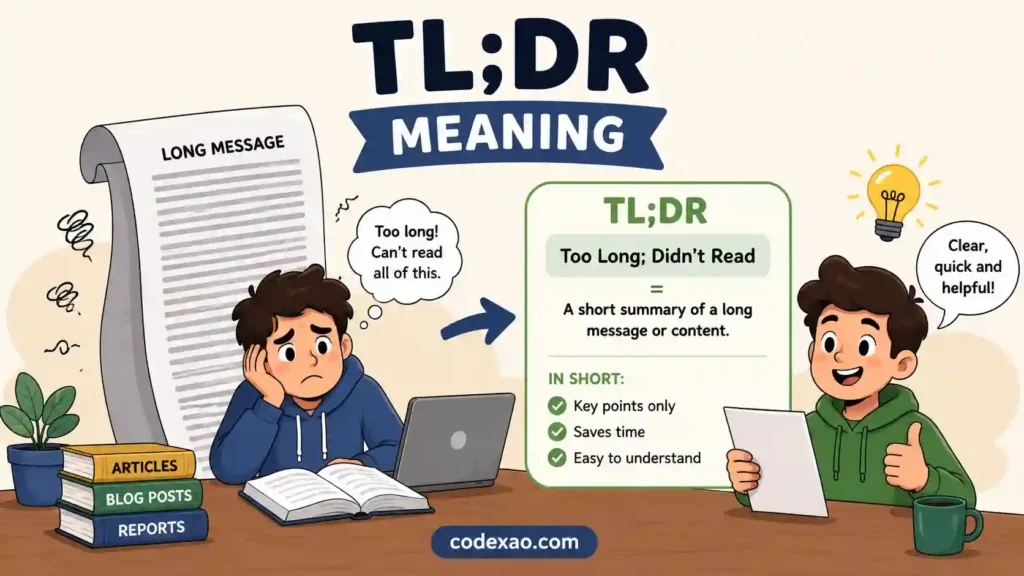
TL DR meaning stands for too long did not read. It is used to summarize a long piece of text into a short, easy to understand version.
Quick Answer
TL DR means too long did not read. It is used to give a short summary of long content so readers can quickly understand the main idea.
Origin of TL DR
The term started in early internet forums in the early 2000s. It became especially popular on platforms like Reddit, where users often posted long discussions. People who did not want to read everything would scroll down looking for a summary labeled TL DR.
Over time, writers began adding TL DR themselves at the end of posts to help readers. This turned it from a complaint into a helpful communication tool.
How the meaning evolved
Originally, TL DR had a slightly negative tone, meaning someone did not bother reading. Today, it is mostly positive and used to help others save time.
Pronunciation
People usually just say T L D R letter by letter.
How to Use tl;dr Meaning Correctly in Texts and Chat
Using tl;dr meaning correctly depends on context and tone.
Best usage situations
- Summarizing long messages
- Ending long explanations
- Writing online posts or blogs
- Email summaries at work
- Social media threads
Platform usage
- WhatsApp and SMS: casual summaries
- Instagram captions: short recap of long story
- Twitter or X: thread summaries
- Discord: gaming discussions or guides
- Reddit: full post summaries
When NOT to use it
- Formal job applications
- Academic essays
- Professional legal documents
- Sensitive conversations
Style tips
- Keep it lowercase or uppercase, both work
- Use a colon after it for clarity like TL DR
- Pair it with emojis like 📌 or 🔥 for casual tone
Real Conversation Examples Using tl;dr Meaning
Between friends
Friend 1: I just explained the whole trip planning and costs
Friend 2: TL DR we are going or not
Meaning: Asking for a simple yes or no summary
Group chat
Someone: Long explanation about movie storyline
Reply: TL DR sounds confusing but interesting
Meaning: Requesting short version of story
Work chat
Manager: Detailed project update message
Employee: TL DR deadline moved to Friday
Meaning: Quick summary of important update
Social media comment
User: Huge paragraph about fitness routine
Comment: TL DR eat healthy and stay consistent
Meaning: Simplifying advice
Gaming chat
Player: Long strategy explanation in Discord
Reply: TL DR rush mid lane
Meaning: Quick strategy takeaway
Common Mistakes and Misunderstandings
Mistake 1: Thinking it is always rude
Some people assume TL DR is disrespectful. It is not always true. Tone matters.
Mistake 2: Using it without summary
Writing TL DR without actually summarizing defeats its purpose.
Mistake 3: Overusing it in formal chats
Using it in job emails or formal communication looks unprofessional.
Cultural misunderstanding
Older generations may not understand it and think it is slang for ignoring messages.
How to fix confusion
Simply explain: TL DR means short summary of the message.
tl;dr Meaning Across Different Platforms and Demographics
Gen Z uses TL DR naturally in chats and memes. Millennials use it in emails and workplace communication. Older users may still find it unfamiliar.
On TikTok, it appears in captions summarizing long videos. On Reddit, it is almost standard practice. On Discord, it helps gamers share quick strategy notes.
It is considered informal but widely accepted in digital spaces.
Related Slang, Abbreviations and Alternatives
- FYI meaning: for your information
- IMO meaning: in my opinion
- BRB meaning: be right back
- IDK meaning: I do not know
- TBH meaning: to be honest
- ICYMI meaning: in case you missed it
- NGL meaning: not gonna lie
- SMH meaning: shaking my head
- Recap: short summary of events
- Summary: condensed version of text
FAQs:
What does TL DR mean in simple words
It means too long did not read and is used to give a short summary of long text.
Is TL DR used in professional emails
Yes, but only for summarizing key points at the end of long emails.
Can TL DR be used at the start of a message
Yes, some people put it at the beginning to give a quick preview.
Why do people use TL DR
Because online content is often long and people prefer quick summaries.
Is TL DR still relevant today
Yes, it is still widely used in 2026 across social media and messaging apps.
Conclusion:
The tl;dr meaning is simple but powerful. It helps people communicate faster, clearer, and more efficiently in a world full of long messages and short attention spans.
From social media to workplace chats, TL DR has become a universal shortcut for summarizing information without losing meaning.
If you are active online, learning this slang will make your communication smoother and more modern. Try using it next time you want to summarize something quickly.
What internet slang do you want explained next

Hi, I’m John Mark, the voice behind codexao.com, where meanings aren’t just explained, they’re simplified for the way people actually talk today.
I’ve always been curious about words, how they change, how they trend, and how a simple phrase can carry completely different meanings depending on context. That curiosity turned into codexao, a space where I break down slang, text abbreviations, and everyday words into clear, easy-to-understand explanations.