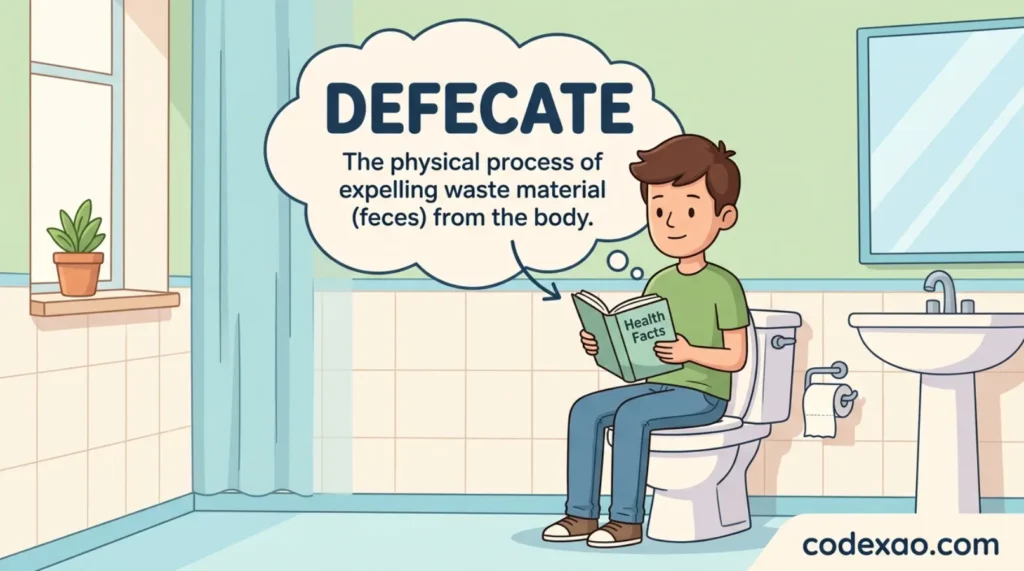
Ever come across the word defecate meaning in a medical report or biology book and thought, “Wait… why not just say poop?” You’re not alone.
English is full of formal words that sound overly serious for everyday life, and “defecate” is one of them.
The word defecate meaning refers to the biological process of removing waste from the body, but its usage goes far beyond just talking about digestion.
It shows up in hospitals, textbooks, exams, and even scientific research papers.
Knowing it helps you understand formal English without confusion, especially if you’re a student, healthcare learner, or just curious about medical vocabulary.
In this guide (updated for 2026), you’ll learn exactly what defecate means, where it comes from, how to use it correctly, real-life examples, and common mistakes people make.
By the end, you’ll never be confused when you see this word again.
What Does “Defecate Meaning” Mean?
The defecate meaning is simple: it means to pass stool (feces) out of the body through the anus after digestion.
Quick Answer: Defecate means to remove solid waste (stool) from the body as part of the digestive process.
The word comes from the Latin term “defaecare”, which means “to clean or purify.” Over time, it entered English medical vocabulary and became a standard term in anatomy, biology, and healthcare.
Originally, it wasn’t a casual word at all, it was strictly used in scientific and formal writing. Even today, doctors and researchers prefer it because it sounds precise and professional.
Pronunciation: def-uh-kayt (/ˈdɛf.ə.keɪt/)
Over time, the meaning has stayed the same, but its usage context has become more defined, mostly formal, rarely conversational.
How to Use “Defecate” Correctly in Texts & Chat
Even though it’s a real English word, you won’t see “defecate” in casual WhatsApp chats or Instagram captions. It belongs to formal communication.
Here’s how it fits in different contexts:
- Medical context: Doctors, nurses, and reports
- Academic context: Biology or health science textbooks
- Scientific writing: Research papers or studies
When to use it:
- Writing an assignment on digestion
- Reading medical reports
- Studying human anatomy
When NOT to use it:
- Casual texting (“I need to defecate 😂” , no, just no)
- Friendly conversations
- Social media jokes (unless very specific humor)
Style tips:
- Keep it lowercase unless starting a sentence
- No emojis in formal writing
- Avoid replacing simple words like “poop” in everyday speech
Think of it as the “professional suit” version of a very normal human function.
Real Conversation Examples Using “Defecate”
🧑⚕️ In a medical setting
Doctor: “Has the patient been able to defecate normally after surgery?”
Shows clinical observation of bowel health.
📚 In a classroom
Teacher: “The large intestine helps the body defecate waste efficiently.”
Used in biological explanation.
🏥 Between nurse and doctor
Nurse: “The patient has not defecated in 48 hours.”
Indicates possible constipation concern.
🧪 In research discussion
Scientist: “The study measures how diet affects the frequency of defecation.”
Formal scientific usage.
😅 Casual misunderstanding moment
Friend 1: “Bro what does defecate mean?”
Friend 2: “Just say poop, please.”
Highlights why it’s rarely used in everyday speech.
Each example shows how the word stays strictly professional and informational, not emotional or casual.
Common Mistakes & Misunderstandings
People often get confused about the defecate meaning, especially learners of English.
1. Thinking it’s a rude word
It actually isn’t rude, it’s just formal. It sounds awkward in casual talk, but it’s medically correct.
2. Using it in everyday conversation
Saying “I need to defecate” in normal chat sounds unnatural and overly technical.
3. Confusing it with urination
Defecation = solid waste (stool)
Urination = liquid waste (urine)
Cultural note
In some cultures, people avoid even casual discussion of bodily functions, which makes this word even less commonly used outside medical spaces.
How to clarify meaning
If someone doesn’t understand, simply say:
“It means to poop or pass stool.”
Simple always wins.
“Defecate” Across Different Platforms & Demographics
Language use changes depending on who is speaking and where.
Gen Z
- Rarely uses the word
- Prefers slang like “poop” or emojis 😂
- Mostly encounters it in memes or school content
Millennials
- Understand it but don’t use it casually
- More likely to see it in health articles or parenting contexts
Medical professionals
- Use it regularly in documentation
- Consider it standard terminology
Social media trends
- Rarely viral
- Occasionally appears in educational TikTok videos or science explainers
Formality level
- Very formal
- Not safe for casual communication tone
- Best reserved for academic or medical use
Related Slang, Abbreviations & Alternatives
Here are common alternatives and related terms:
- Poop – casual everyday term
- Bowel movement – polite medical alternative
- Pass stool – formal clinical phrase
- Excretion – broader biological waste removal
- Digestive process – full system context
- Constipation – difficulty defecating
- Diarrhea – loose, frequent stool
- Elimination – general waste removal term
- Go to the toilet – polite everyday expression
- Poo (UK slang) – softer informal version
These alternatives help you switch tone depending on audience.
FAQs:
What is the simplest defecate meaning?
It simply means passing stool (pooping) from the body after digestion.
Is defecate a medical term?
Yes, it is widely used in medical, biological, and scientific fields.
Why do doctors use the word defecate?
Because it is precise, professional, and avoids casual or slang language.
Can I use defecate in daily conversation?
Technically yes, but it sounds too formal. “Poop” or “go to the toilet” is more natural.
What is the opposite of defecate?
There is no exact opposite, but related functions include urination or digestion processes.
Conclusion:
The defecate meaning is straightforward in science but often misunderstood in everyday language. It simply refers to the body’s process of passing stool after digestion.
While it’s not a word you’ll use in casual chat, it plays an important role in medical, academic, and scientific communication.
Understanding it helps you read textbooks, health articles, and research papers with confidence.
Next time you see it, you won’t be confused, you’ll just know it’s the formal way of saying something very human and very normal.
If you’re into language and slang breakdowns, keep exploring more terms, you’ll be surprised how many “fancy” words just mean simple everyday things.
Got a word you want explained next? Drop it and let’s decode it together.

Hi, I’m John Mark, the voice behind codexao.com, where meanings aren’t just explained, they’re simplified for the way people actually talk today.
I’ve always been curious about words, how they change, how they trend, and how a simple phrase can carry completely different meanings depending on context. That curiosity turned into codexao, a space where I break down slang, text abbreviations, and everyday words into clear, easy-to-understand explanations.