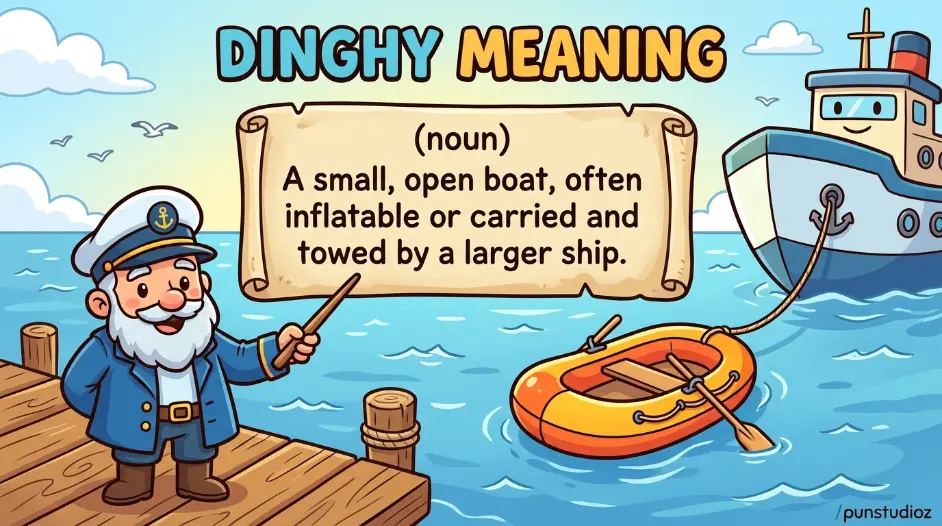
If you have ever scrolled past a photo of a yacht anchored offshore with a tiny rubber boat tied to the back of it, you have already seen a dinghy without knowing its name.
It is one of those words people hear constantly around boats, lakes, and coastal towns, yet very few can actually define with confidence.
That gap matters more than you might think. Boating listings, sailing forums, insurance paperwork, and even travel brochures throw the word around like everyone already knows it.
This guide breaks down exactly what a dinghy is, where the word came from, how it is used correctly in a sentence, and the mistakes people make with it most often.
This is the clearest explanation of dinghy meaning you will find anywhere online.
By the end, you will not just know the definition. You will know the difference between a dinghy and a dingy, the different types of dinghies people actually own, and how to use the word naturally instead of sounding like you just looked it up.
What Does “Dinghy” Mean?
Quick Answer: A dinghy is a small, open boat, typically under 15 feet, used for short trips, fishing, or as a tender carried aboard a larger vessel.
A dinghy is a small boat, generally open on top, that can be rowed with oars, sailed, or fitted with a small outboard motor. It is not built for long ocean crossings. Its entire purpose is short-distance, practical transport.
Pronunciation: DING-ee. The “gh” is silent, which throws off a lot of people the first time they see the word written down.
Origin story: The word traces back to the Hindi and Bengali term “dingi,” referring to small river boats used in India. British sailors picked it up during the colonial period in the 1800s and brought it into English, where it gradually became the standard term for any small auxiliary boat.
How the meaning evolved: Originally it described a specific style of native rowing boat. Over the last two centuries, the word broadened to cover almost any small boat, whether it is a wooden rowboat, an inflatable raft, or a lightweight sailing craft used in racing.
How to Use “Dinghy” Correctly in a Sentence
Getting the word right in conversation or writing comes down to context and grammar, not tone or platform slang. It behaves like a completely ordinary noun.
Correct usage examples:
- “We rowed the dinghy from the yacht to the beach.”
- “He keeps a small sailing dinghy for weekend races.”
- “The cruise ship lowered a dinghy to rescue the swimmer.”
Grammar notes:
- Plural form: dinghies, not dinghys
- It functions as a countable noun, so you can say “a dinghy” or “three dinghies”
- It is almost always paired with action verbs like row, sail, tow, launch, or anchor
When NOT to confuse it: Never swap it for “dingy,” which is an adjective describing something dirty or poorly lit. “The dinghy was dingy” is a real sentence, and yes, it looks like a typo even when it is grammatically perfect.
Real Examples of “Dinghy” in Context
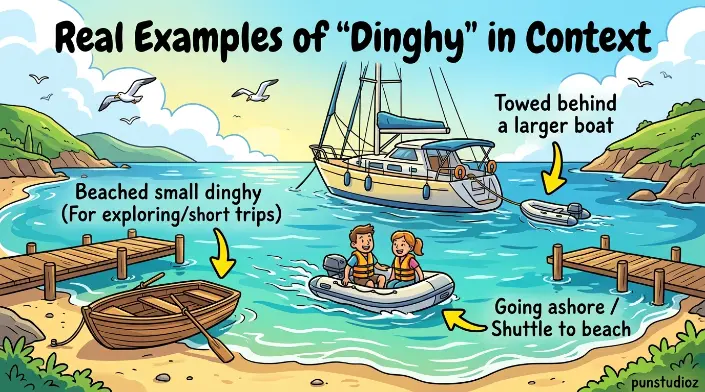
In a sailing conversation: “Did you bring the dinghy down to the dock already?” “Yeah, it’s tied up and ready whenever you want to head out.” This shows the word used as everyday equipment talk between people who sail regularly.
In a travel or vacation context: “The resort uses a dinghy to ferry guests from the yacht to the private island.” Here the word signals a short shuttle trip, not the main mode of travel.
In an emergency or safety context: “Every passenger ship is required to carry enough dinghies for a full evacuation.” This usage ties directly to maritime safety regulations.
In a fishing context: “My uncle still fishes off an old wooden dinghy he built himself in the seventies.” This example shows the word describing a personal, hands-on hobby boat rather than commercial equipment.
In a news or reporting context: “Coast guard crews spotted the stranded dinghy about two miles offshore.” News writing often uses the word for small, at-risk vessels spotted during rescues.
Common Mistakes and Misunderstandings
Mixing it up with “dingy.” This is by far the most common error. Spell checkers do not always catch it because both are real words, so proofreading matters more than autocorrect here.
Assuming it means inflatable only. Many people picture only rubber inflatable boats, but wooden and fiberglass dinghies are just as common, especially in sailing clubs.
Thinking size is fixed. There is no strict legal size cutoff. Anything roughly under 15 feet used for short-distance or auxiliary purposes generally qualifies, and the exact line is more about function than a tape measure.
Regional differences: In the UK and Australia, “dinghy” often specifically refers to small sailing boats used in racing and instruction. In the US, it more commonly refers to the small tender boat carried by a larger yacht.
Types of Dinghies You Should Know
Not all dinghies serve the same purpose. Here is how the main types break down.
| Type | Main Use | Typical Material |
|---|---|---|
| Sailing dinghy | Racing, sailing lessons | Fiberglass, wood |
| Inflatable dinghy | Yacht tender, shore trips | PVC, rubber |
| Rowing dinghy | Fishing, calm water rowing | Wood, aluminum |
| RIB dinghy | Faster tender with rigid hull | Fiberglass hull, inflatable tubes |
| Life dinghy | Emergency evacuation | Reinforced rubber |
Knowing these categories helps explain why the same word shows up in such different settings, from Olympic sailing events to cargo ship safety drills.
Related Words and Alternatives
- Tender – a small boat used to ferry people and supplies to a larger ship
- Rowboat – a boat propelled only by oars
- Skiff – a small, light boat similar to a dinghy, often flat-bottomed
- Lifeboat – an emergency rescue boat, sometimes overlapping with dinghy use
- Raft – a flat, simple flotation craft, less structured than a dinghy
- Canoe – a narrow boat propelled by paddling, not rowing
- Kayak – a small, enclosed paddle boat, distinct from an open dinghy
- Punt – a flat-bottomed boat pushed with a pole, common on shallow rivers
- RIB – rigid inflatable boat, a sturdier cousin of the inflatable dinghy
- Zodiac – a well-known inflatable boat brand name often used generically like “dinghy”
FAQs:
Is a dinghy the same as a rowboat?
Not exactly. A rowboat is rowed only, while a dinghy can be rowed, sailed, or powered by a small motor. Every rowboat could be called a dinghy, but not every dinghy is just a rowboat.
How do you pronounce dinghy?
It is pronounced DING-ee, rhyming with “stingy.” The silent “h” trips up a lot of first-time readers.
What is the difference between dinghy and dingy?
Dinghy is a small boat. Dingy is an adjective meaning dirty, dull, or shabby. They sound almost identical but mean completely different things.
What size is considered a dinghy?
Most dinghies range from about 7 to 15 feet long. Anything smaller overlaps with kayaks and canoes, while anything larger usually gets called a tender or a small craft.
Why do yachts carry a dinghy?
Larger boats carry a dinghy so passengers can reach shore when the main vessel cannot dock directly, and to serve as a backup lifeboat in an emergency.
Conclusion:
A dinghy is simply a small boat built for short trips, whether that means rowing to shore, sailing in a local race, or serving as backup transport for a much bigger ship.
The word has traveled a long way from its roots in Indian river boats to becoming a standard term across sailing clubs, cruise ships, and coastal towns everywhere.
The real trick is remembering it has nothing to do with the word dingy, and that its meaning covers far more than the inflatable rafts most people picture first.
Wooden rowboats, fiberglass racers, and rubber tenders all fall under the same word.
Next time you spot a small boat trailing behind a yacht or tucked into a garage near the water, you will know exactly what to call it.
And if you want to dig deeper into boating terms, check out related guides on tender boats, skiffs, and the difference between a dinghy and a lifeboat.

Hi, I’m Isabella Brown, the voice behind Codexao.com, where meanings aren’t just explained, they’re made easy to understand.
I’ve always been fascinated by how words shape the way we think, speak, and connect. But let’s be honest—most definitions out there feel confusing, outdated, or just plain boring.
That’s exactly why I created Codexao. Here, I break down words, slang, and modern expressions into simple, clear meanings you can actually use in real life.