Have you ever read a medical article and come across the word etiology only to wonder what it actually means?
You’re not alone. Medical terminology can feel intimidating, especially when a single word seems to carry a lot of meaning.
Understanding etiology meaning is useful not only for healthcare professionals but also for students, patients, researchers, and anyone interested in how diseases or events begin.
The term appears frequently in medical reports, scientific studies, psychology textbooks, and health discussions.
Knowing what it means can help you better understand diagnoses, treatment plans, and research findings.
In this updated 2026 guide, you’ll learn the definition of etiology, where the term came from, how it is used, practical examples, common misconceptions, and related terms you should know.
What Does Etiology Mean?
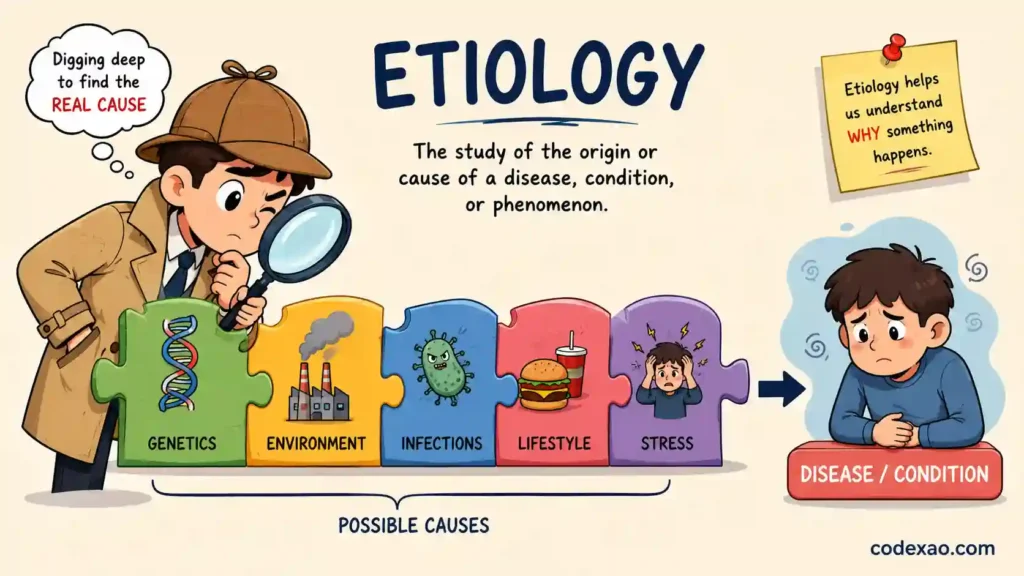
Etiology refers to the cause, origin, or reason behind a disease, condition, phenomenon, or event.
In healthcare, etiology focuses on identifying what causes a disease to develop. Understanding the cause allows doctors and researchers to improve treatment and prevention strategies.
Quick Answer
Etiology meaning is the study or investigation of causes and origins, especially the causes of diseases and medical conditions.
Origin of the Word
The word “etiology” comes from Greek roots:
- Aitia meaning cause
- Logia meaning study or explanation
Together, the term literally means “the study of causes.”
How the Meaning Has Evolved
Historically, people often explained diseases through myths or supernatural beliefs. Modern medicine transformed etiology into a scientific field focused on evidence-based causes such as:
- Bacteria
- Viruses
- Genetics
- Environmental factors
- Lifestyle choices
Today, etiology plays a central role in medicine, psychology, epidemiology, and scientific research.
Pronunciation Guide
Etiology is commonly pronounced:
ee-tee-OL-uh-jee
How to Use Etiology Correctly
The word etiology is typically used in academic, scientific, and medical contexts.
Common Usage
Examples include:
- The etiology of diabetes remains complex.
- Researchers investigated the etiology of the outbreak.
- Doctors are studying the etiology of the patient’s symptoms.
Appropriate Contexts
Etiology works well in:
- Medical reports
- Scientific journals
- Health articles
- Psychology research
- Educational discussions
When Not to Use It
In casual conversations, people usually say:
- Cause
- Reason
- Origin
Instead of:
- “What is the etiology of your headache?”
Most people would simply ask:
- “What caused your headache?”
Writing Tips
When using the term:
- Use lowercase unless it starts a sentence.
- Pair it with diseases, conditions, or events.
- Keep the audience in mind when writing for non-experts.
Real Conversation Examples Using Etiology
Although etiology is more formal than internet slang, it still appears in everyday educational and professional discussions.
Medical Consultation
Doctor: We’re still investigating the etiology of your symptoms.
Patient: So you’re trying to find what’s causing them?
Doctor: Exactly.
Meaning: The doctor is looking for the root cause of the symptoms.
Medical Student Discussion
Student 1: Do you know the etiology of malaria?
Student 2: Yes, it’s caused by parasites transmitted through mosquito bites.
Meaning: They are discussing the disease’s cause.
Research Team Meeting
Researcher: Our study focuses on the etiology of childhood asthma.
Colleague: Are you looking at environmental factors?
Meaning: The research examines what causes asthma.
Psychology Class
Professor: Understanding the etiology of anxiety disorders is essential.
Student: Because treatment depends on the cause?
Professor: Exactly.
Meaning: The conversation centers on understanding origins and causes.
Public Health Discussion
Health Official: The etiology of the outbreak is still under investigation.
Reporter: So the source hasn’t been confirmed?
Meaning: Authorities are identifying the cause of the outbreak.
Common Mistakes and Misunderstandings
Many people misunderstand etiology when they first encounter the term.
Mistake 1: Confusing Etiology With Diagnosis
A diagnosis identifies a disease.
Etiology explains what caused it.
For example:
- Diagnosis: Pneumonia
- Etiology: Bacterial infection causing pneumonia
Mistake 2: Assuming Every Disease Has One Cause
Some conditions have multiple causes.
Examples include:
- Heart disease
- Cancer
- Depression
- Diabetes
Their etiology can involve genetics, environment, and lifestyle factors.
Mistake 3: Thinking Etiology Is Only Medical
While commonly used in medicine, etiology appears in:
- Psychology
- Sociology
- Criminology
- Public health
- Scientific research
Anything with an identifiable cause can have an etiology.
Generational Differences
Younger audiences may rarely encounter the term outside school.
Healthcare professionals and academics use it frequently.
As a result, some people mistake it for a disease name rather than a concept about causes.
Etiology Across Different Fields and Demographics
The meaning remains largely consistent across disciplines.
In Medicine
Etiology identifies causes of:
- Diseases
- Infections
- Disorders
- Syndromes
This is the most common usage.
In Psychology
Psychologists examine the etiology of:
- Anxiety
- Depression
- Behavioral disorders
- Personality disorders
In Public Health
Researchers investigate:
- Disease outbreaks
- Environmental health risks
- Population-wide health trends
In Education
Students encounter etiology in:
- Biology
- Medicine
- Nursing
- Psychology
- Health sciences
Formal or Informal?
Etiology is considered highly formal.
It is:
✅ Appropriate for academic and professional settings
❌ Uncommon in casual conversations
Safe for Work?
Absolutely. It is a professional and educational term.
Related Terms, Abbreviations and Alternatives
| Term | Meaning |
|---|---|
| Cause | Something that produces an effect |
| Origin | The beginning or source of something |
| Diagnosis | Identification of a disease |
| Pathology | Study of disease processes |
| Epidemiology | Study of disease patterns in populations |
| Prognosis | Predicted outcome of a condition |
| Risk Factor | Element increasing disease likelihood |
| Syndrome | Group of related symptoms |
| Infection | Invasion by harmful microorganisms |
| Prevention | Actions taken to avoid disease |
Synonyms
- Cause
- Source
- Origin
- Root cause
- Underlying reason
Related Concepts
- Disease causation
- Medical investigation
- Clinical research
- Health sciences
- Biological mechanisms
FAQs:
What is the meaning of etiology?
Etiology refers to the cause, origin, or study of causes behind diseases, conditions, behaviors, or events. In medicine, it is most often used to explain why a disease occurs.
Why is etiology important in medicine?
Understanding etiology helps healthcare providers identify the underlying cause of an illness. This knowledge improves diagnosis, treatment, prevention, and patient outcomes.
What is an example of etiology?
An example is influenza. Its etiology is a viral infection caused by influenza viruses. Identifying this cause helps guide treatment and prevention measures.
Is etiology the same as pathology?
No. Etiology focuses on what causes a disease, while pathology studies the disease’s effects, processes, and physical changes within the body.
How do doctors determine etiology?
Doctors use medical history, physical examinations, laboratory tests, imaging studies, and research evidence to identify the cause of a condition.
Can a disease have multiple etiologies?
Yes. Many diseases result from a combination of genetic, environmental, lifestyle, and infectious factors rather than a single cause.
Conclusion:
Understanding etiology meaning is simpler than it first appears. The term refers to the cause or origin of a disease, condition, or event and plays a major role in medicine, psychology, and scientific research.
Whether you’re reading a medical report, studying health sciences, or simply expanding your vocabulary, knowing what etiology means helps you understand how experts investigate the reasons behind illnesses and other phenomena.
The next time you encounter etiology, you’ll know that the discussion is focused on one important question: What caused it?
Explore more medical and educational terms to build your understanding of health, science, and modern communication.

Hi, I’m Isabella Brown, the voice behind Codexao.com, where meanings aren’t just explained, they’re made easy to understand.
I’ve always been fascinated by how words shape the way we think, speak, and connect. But let’s be honest—most definitions out there feel confusing, outdated, or just plain boring.
That’s exactly why I created Codexao. Here, I break down words, slang, and modern expressions into simple, clear meanings you can actually use in real life.