Have you ever heard someone say, “We’re entering the fourth quarter,” or “Can I borrow a quarter?” The interesting thing is that the same word can mean completely different things depending on the situation.
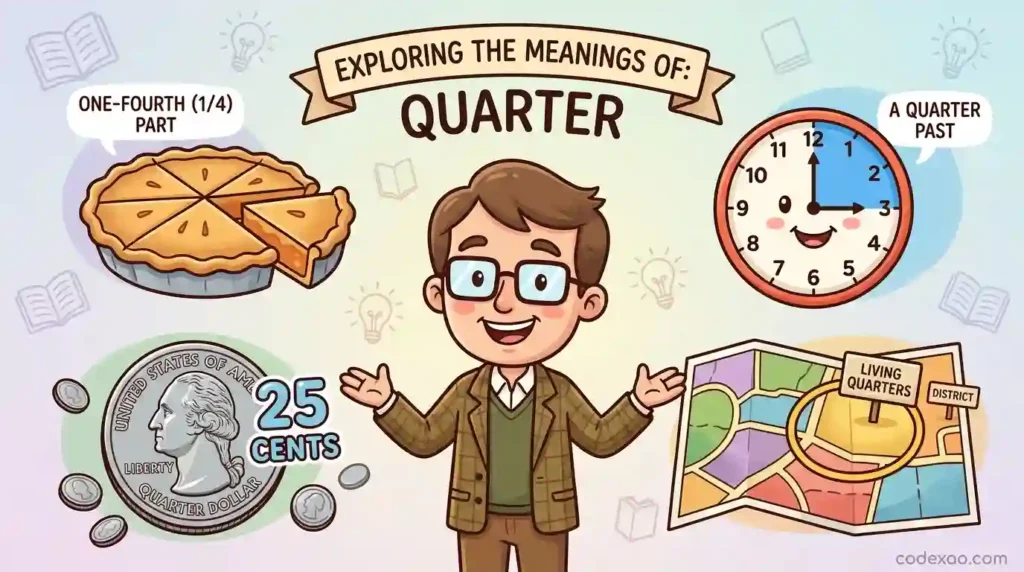
The quarter meaning changes based on context. It might refer to a piece of money, a period of time, a section of a city, or simply one-fourth of something.
Because the word appears in business, education, sports, finance, and everyday conversations, understanding it can save you from confusion.
Whether you’re learning English, improving your vocabulary, or simply curious about the term, this guide breaks down everything you need to know. You’ll discover definitions, origins, examples, common mistakes, and real-world uses..
What Does Quarter Mean?
The basic quarter meaning is one of four equal parts of a whole.
For example:
- A quarter of a pizza equals 25 percent of the pizza.
- A quarter of a year equals three months.
- A quarter dollar equals 25 cents.
Quick Answer
Quarter means one-fourth of something. Depending on context, it can refer to time, money, locations, measurements, or divisions of a larger whole.
Origin of the Word Quarter
The word quarter comes from the Latin word quartus, meaning fourth.
It entered English through Old French and Middle English centuries ago. Originally, it described something divided into four equal sections. Over time, people began using it in many different areas of life, including:
- Mathematics
- Geography
- Military terminology
- Business reporting
- Sports competitions
- Currency systems
Today, it remains one of the most versatile words in the English language.
Pronunciation
Quarter is pronounced:
KWOR-ter
Phonetic spelling:
/ˈkwɔːrtər/
How to Use Quarter Correctly in Texts and Chat
Unlike many internet abbreviations, quarter is a standard English word that appears in both formal and informal communication.
Casual Conversations
People commonly use quarter when discussing:
- Money
- Time periods
- Portions
- Sports
Examples:
- “I only have a quarter in my pocket.”
- “We’re already a quarter through the movie.”
- “The team dominated the first quarter.”
Business Communication
Quarter is especially common in professional settings.
Examples:
- “Sales increased during the second quarter.”
- “Our quarterly report exceeded expectations.”
Social Media Usage
On social platforms, quarter often appears when discussing:
- Financial updates
- Sports events
- Academic schedules
- Personal goals
Example:
“One quarter of the year is already gone. Time flies!”
When Not to Use It
Avoid assuming people know which meaning you intend.
For example:
“I need a quarter.”
Someone may wonder whether you need:
- 25 cents
- One-fourth of something
- A school quarter
- A business quarter
Adding context prevents misunderstandings.
Formatting Tips
- Lowercase in most situations
- Capitalize only at sentence beginnings
- Pair naturally with percentages
- Frequently used with dates and financial figures
Real Conversation Examples Using Quarter
Between Friends
Friend A: How much pizza is left?
Friend B: About a quarter of it.
Meaning: One-fourth remains.
Family Conversation
Parent: How far are you through the book?
Child: I’m about a quarter done.
Meaning: Roughly 25 percent completed.
Workplace Chat
Manager: How did we perform this quarter?
Employee: Revenue increased by twelve percent.
Meaning: A three-month business period.
Sports Discussion
Fan A: What happened in the third quarter?
Fan B: That’s when the game completely changed.
Meaning: One of four game periods.
Shopping Situation
Customer: Do you have change for a dollar?
Cashier: Sure, here’s a quarter and some smaller coins.
Meaning: A 25-cent coin.
What These Examples Convey
In every example, the core idea remains the same: a division into four parts. The specific interpretation comes from the surrounding context.
Common Mistakes and Misunderstandings
Confusing Quarter with Half
A quarter equals 25 percent.
A half equals 50 percent.
Many English learners accidentally mix these fractions.
Incorrect:
“I ate a quarter of the cake” when half was eaten.
Correct:
“I ate half the cake.”
Assuming Quarter Always Means Money
Many people immediately think of the American coin.
However, quarter can also mean:
- Three months
- One-fourth
- A district
- A game segment
Context matters.
Misunderstanding Business Quarters
A business quarter contains three months.
Many beginners mistakenly believe it refers to four months because there are four quarters in a year.
Correct breakdown:
- Q1: January to March
- Q2: April to June
- Q3: July to September
- Q4: October to December
Generational Differences
Older generations often associate quarter with coins or city districts.
Younger generations are more likely to encounter it in:
- Sports
- Business discussions
- School schedules
- Financial content online
Quarter Across Different Platforms and Demographics
Gen Z
Gen Z frequently encounters quarter in:
- Sports clips
- Productivity discussions
- Goal-setting posts
- Financial education content
Example:
“One quarter of the year is gone. Are you on track?”
Millennials
Millennials often use quarter in workplace and financial conversations.
Examples include:
- Quarterly reports
- Budget planning
- Investment updates
Older Generations
Older adults may use quarter when discussing:
- Coins
- Historical city quarters
- Property divisions
On TikTok
Quarter commonly appears in:
- Financial advice videos
- Sports highlights
- Personal development content
On Instagram
You’ll often see captions like:
- “First quarter recap”
- “Quarterly goals achieved”
On Discord and Gaming Platforms
Players frequently reference game quarters during sports-related discussions.
Formality Level
Quarter is completely acceptable in:
- Academic writing
- Professional communication
- Business reports
- Everyday conversation
It is considered safe for work and universally understood.
Related Slang, Abbreviations and Alternatives
| Term | Meaning |
|---|---|
| Half | One of two equal parts |
| Third | One of three equal parts |
| Fourth | Another way to say quarter |
| Percent | Portion out of 100 |
| Q1 | First quarter of the year |
| Q2 | Second quarter of the year |
| Q3 | Third quarter of the year |
| Q4 | Fourth quarter of the year |
| Segment | A section of a whole |
| Portion | A part of something larger |
Similar Expressions
- One-fourth
- Twenty-five percent
- Fourth part
- Equal division
Opposite Ideas
- Whole
- Entire
- Complete
- Full amount
FAQs:
What is the exact meaning of quarter?
Quarter means one of four equal parts of a whole. Depending on context, it may refer to a fraction, a time period, a coin, or a geographic area.
Why is a quarter equal to 25 percent?
A whole divided into four equal parts gives each part a value of one-fourth. One-fourth expressed as a percentage equals 25 percent.
What does quarter mean in business?
In business, a quarter refers to a three-month reporting period. Companies often release financial results every quarter to track performance.
What is a quarter in sports?
Many sports divide games into four sections called quarters. Each quarter represents one-fourth of the total game time.
What does quarter mean in money?
In the United States, a quarter is a coin worth 25 cents, which equals one-fourth of a dollar.
Can quarter mean a neighborhood?
Yes. Historically and geographically, quarter can describe a district or section of a town or city.
Is quarter formal or informal?
Quarter works in both formal and informal communication. It is widely accepted in academic, professional, and everyday settings.
Conclusion:
The quarter meaning may seem simple at first, but it’s surprisingly versatile. At its core, the word always points to the idea of dividing something into four equal parts.
Depending on the situation, quarter can refer to time, money, sports, geography, business, or percentages.
Understanding the context helps you identify the intended meaning instantly.
Now that you know the complete quarter meaning, you’ll recognize it confidently whether it appears in a financial report, a sports broadcast, a classroom discussion, or an everyday conversation.
Drop your favorite English vocabulary word in the comments below and keep exploring more language guides to expand your communication skills.

Hi, I’m Isabella Brown, the voice behind Codexao.com, where meanings aren’t just explained, they’re made easy to understand.
I’ve always been fascinated by how words shape the way we think, speak, and connect. But let’s be honest—most definitions out there feel confusing, outdated, or just plain boring.
That’s exactly why I created Codexao. Here, I break down words, slang, and modern expressions into simple, clear meanings you can actually use in real life.