You get a message from your boss that says “FYI, the meeting moved to 3 PM.” Do you panic? Do you need to reply? Or is it just a casual heads up? If you have ever stared at those three letters wondering what they really mean, you are not alone.
Understanding fyi meaning in text takes about ten seconds, but using it well takes a little more nuance.
FYI is one of the oldest and most useful abbreviations in digital chat. It started in office memos long before smartphones existed, and today it shows up in WhatsApp threads, work emails, Slack channels, and Discord servers every single minute.
The tone can feel helpful, neutral, or even a bit passive aggressive depending on how you use it.
This guide, Walks you through the exact definition, the origin story, real conversation examples, common mistakes, and platform by platform tips.
You will also find related slang, a handy comparison table, and answers to the questions people ask most. Ready? Let us get into it.
What Does FYI Mean in Text?
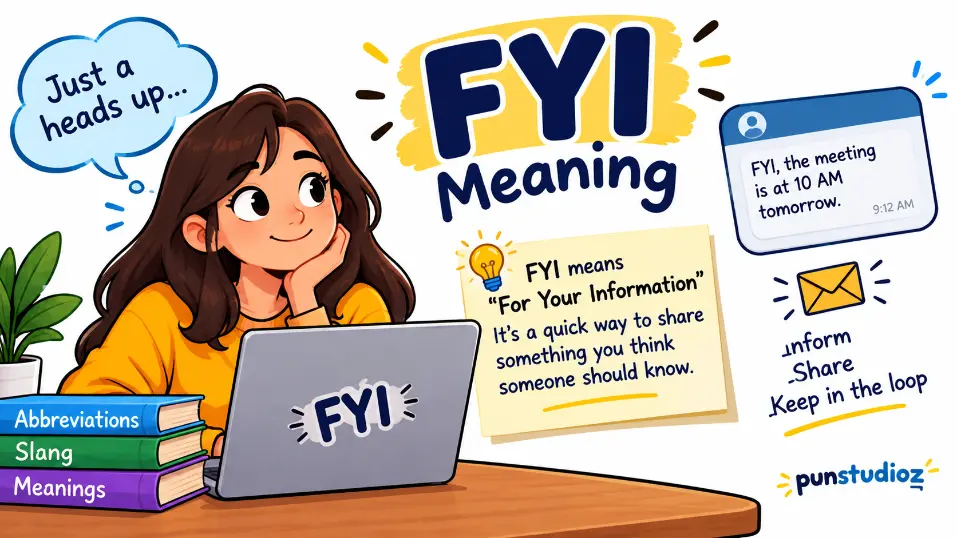
FYI stands for “for your information.” Someone sends it when they want you to know something. That is it. No hidden code and no secret meaning.
Quick Answer: FYI means “for your information.” In a text or chat, it introduces a fact, update, or heads up that the sender thinks you should know. It does not usually ask for a reply or an action.
You say it letter by letter, like “eff-why-eye.” Nobody says “fiy” out loud, and if someone does, they are joking.
Where Did FYI Come From?
FYI did not begin with texting. It grew out of office culture. Managers and secretaries scribbled it on memos and forwarded documents to say “read this, but you do not need to do anything.” Dictionaries trace the abbreviation back to the mid 1900s, which makes it older than most people who type it today.
Email carried it into the digital age. Then SMS, instant messengers, and social apps picked it up because it is short, clear, and easy to type with one thumb.
How the Meaning Has Evolved
The core meaning has barely moved. What changed is the tone. In old memos, FYI was purely neutral. Today it can also sound friendly, dry, sarcastic, or defensive.
Think about the difference between “fyi the store closes early today” and “FYI, I told you this yesterday.” Same three letters, very different energy.
How to Use FYI Correctly in Texts and Chat
Using FYI is simple. Put it at the start of a message, then share your information.
Here is the basic pattern: FYI + the useful detail. For example, “FYI, the Wi-Fi password changed.”
Choose the Right Tone
FYI works in several moods:
- Helpful: “FYI, parking is free after 6.”
- Casual: “fyi that movie is way longer than it looks.”
- Sarcastic: “FYI, water is wet.”
- Firm: “FYI, the deadline is not moving.”
Because the word itself is neutral, your surrounding words and punctuation do the emotional work. A friendly emoji softens it. A period and a capital FYI sharpen it.
Platform Tips
- SMS and WhatsApp: Lowercase “fyi” feels relaxed. Uppercase feels a bit more official.
- Instagram DMs: Casual and quick. Pair it with an emoji if you want to keep things light.
- Twitter and X: Great for adding a fact to a thread. “FYI, this photo is from 2019” is a classic.
- Discord: Perfect for game tips, server rules, and event updates.
- Reddit: Often used in comments to correct or add context, sometimes with a hint of attitude.
- Work chats: Common on Slack and Teams. Keep it short and professional.
When Not to Use FYI
Skip it in very formal situations, like a first email to a client or a message to a professor you have never met. Write a full sentence instead. “I wanted to let you know that the file has been updated” sounds more polished than “FYI file updated.”
Also avoid FYI during emotional conversations. Dropping “FYI, I am upset” in the middle of an argument can feel cold.
Formatting Tips
- Capital letters, FYI, look clear and professional.
- Lowercase, fyi, looks friendly and casual.
- A comma after FYI is standard. A colon also works in emails.
- One emoji is plenty. Two or three starts to look like you are shouting.
Real Conversation Examples Using FYI
Words make more sense in context, so here are six quick scenes.
Between coworkers on Slack
Priya: FYI, the client moved the deadline to Friday.
Sam: Oh no. Thanks for the heads up.
What it conveys: Helpful and neutral. Priya shares urgent news without blame.
Between friends
Jake: fyi the pizza place closes at 9 tonight
Mia: Why are you telling me this at 8:55?
What it conveys: Playful and casual. The lowercase spelling keeps it relaxed.
While dating
Dana: fyi I am terrible at texting during the day. Not ignoring you!
Chris: Ha, good to know. Same here.
What it conveys: Honest and reassuring. FYI sets a gentle expectation without pressure.
In a family group chat
Mom: FYI your cousin is visiting next weekend.
Ali: Wait, which cousin?
Mom: The tall one.
What it conveys: Informative with a touch of family chaos. Mom uses caps because that is simply how moms text.
On a gaming Discord
Rex: fyi the boss drops a rare shield in phase two
Nova: Legend. Adding that to my notes.
What it conveys: Friendly teamwork. FYI here shares a tip without sounding bossy.
When things get tense
Lena: FYI, I already sent that file twice.
Omar: Fair, my bad.
What it conveys: Passive aggressive. The capital letters and comma make the frustration obvious.
Common Mistakes and Misunderstandings
Even a tiny abbreviation can cause big confusion. Here are the top three slip ups.
1. Assuming FYI Always Means “No Reply Needed”
Often true, but not always. If your manager writes “FYI, please review this,” they secretly want action. In that case, the request matters more than the abbreviation. When in doubt, send a quick “Got it, thanks.”
2. Missing the Passive Aggressive Tone
Some people read every FYI as friendly. Others hear a hidden sigh. If someone uses FYI right after a disagreement, read the message twice before you respond.
3. Using FYI When You Actually Need Something
If you need an answer, do not hide behind FYI. Write “Can you confirm by noon?” instead. Clear requests beat vague heads ups.
Generational Differences
Older adults often learned FYI in the office and use it in a straightforward, professional way. Younger people, especially Gen Z, tend to use it more playfully or sarcastically. A boomer boss and a Gen Z coworker can send the exact same FYI and mean two different things.
Cultural and Regional Differences
English speakers in the US, UK, India, Pakistan, Nigeria, and beyond all recognize FYI, mostly through work culture. Non-native speakers usually learn it from emails first, so they tend to use it formally. Native speakers are more likely to stretch it into jokes and sarcasm.
How to Clarify When You Do Not Understand
Just ask. Try one of these:
- “Thanks. Do you need me to do anything about this?”
- “Got it. Is this urgent?”
- “Just checking, is this a heads up or a task?”
Nobody will judge you. Honestly, they will appreciate the clarity.
FYI Across Different Platforms and Demographics
Gen Z, Millennials, and Older Users
- Gen Z: Uses lowercase fyi, often with irony. “fyi I am not sorry” is a real sentence people send.
- Millennials: Balance work and casual use. They know when to switch tone.
- Older generations: Prefer uppercase FYI and full sentences. It feels natural to them because it started in their era.
How Often It Shows Up
FYI turns up most in work tools, email threads, and group chats. On TikTok and Instagram comments, you will see it whenever someone wants to correct a rumor or add a fun fact. On Discord servers, it appears in announcements, patch notes, and rule reminders.
Formal or Informal?
FYI sits in the middle. It is safe for work in most offices and perfectly fine for friends. It is not the best choice for legal notices, formal letters, or first contact with a very senior person.
Viral Moments
FYI has never had one giant viral moment like some slang terms. Instead, its popularity comes from steady daily use. Meme culture keeps it alive through “fyi” callouts on social media, usually to add a snarky correction. That quiet consistency is exactly why it has outlasted so many trends.
Related Slang, Abbreviations and Alternatives
FYI has plenty of cousins. Here is a quick comparison.
| Term | Meaning | Best Used When |
|---|---|---|
| BTW | By the way | Adding a side comment |
| FWIW | For what it is worth | Offering an opinion gently |
| ICYMI | In case you missed it | Sharing older news |
| PSA | Public service announcement | Warning or informing many people |
| TIL | Today I learned | Sharing a new fact |
| NB | Nota bene, note well | Formal emphasis in writing |
| FYA | For your action | Requesting a task |
| IIRC | If I recall correctly | Sharing a memory you are unsure about |
| TBH | To be honest | Giving a candid opinion |
Learn more about what BTW means in text if you often mix it up with FYI.
Synonyms in casual language: “heads up,” “just so you know,” “quick note.”
Opposites: FYA is the closest opposite, because it demands action. “ASAP” is another one, since it demands speed.
FAQs:
What does FYI mean in a text message?
FYI means “for your information.” Someone sends it to share a fact, update, or useful detail with you. It usually introduces something you might want to know, and it rarely needs a long reply. A quick “thanks” or a thumbs up is enough in most conversations.
Is FYI rude?
FYI is not rude on its own. It is a neutral phrase. The tone depends on the situation. After an argument or a missed message, a sharp “FYI” can sound passive aggressive. In friendly chats or at work, it usually comes across as helpful and polite.
Do I have to reply to an FYI message?
Most of the time, no. FYI signals that the sender only wants you informed. A short acknowledgment like “Got it” is polite, especially at work. If the message includes a request, such as “FYI, please check this,” then you should respond and take action.
Can I use FYI in a professional email?
Yes. FYI is common in office emails, forwards, and team chats. For very formal messages or first contact with senior clients, a full sentence sounds better. Try “I wanted to share an update” if you want a more polished tone.
What is the difference between FYI and BTW?
FYI passes along useful information the reader may need. BTW, meaning “by the way,” adds a side thought that may not connect to the main topic. Use FYI for updates and BTW for casual extras during a conversation.
Is FYI capitalized or lowercase?
Both work. Uppercase FYI looks clear and professional. Lowercase fyi feels casual and friendly. Choose the style that matches your audience and platform, and stay consistent within the same conversation.
Conclusion:
FYI is a tiny abbreviation with a simple job. It tells people, “Here is something you should know.” Now you understand the fyi meaning in text, where it came from, and how tone can change everything.
Use it when you want to share helpful updates. Skip it in stiff, formal situations. And if someone sends you a suspiciously sharp FYI, read between the lines before you reply.
Now it is your turn. Drop your favorite text abbreviation in the comments below, and tell us the funniest FYI you have ever received.
Explore more slang: What BTW means in text, what FWIW means in chat, and what ICYMI means online.

Hi, I’m Isabella Brown, the voice behind Codexao.com, where meanings aren’t just explained, they’re made easy to understand.
I’ve always been fascinated by how words shape the way we think, speak, and connect. But let’s be honest—most definitions out there feel confusing, outdated, or just plain boring.
That’s exactly why I created Codexao. Here, I break down words, slang, and modern expressions into simple, clear meanings you can actually use in real life.