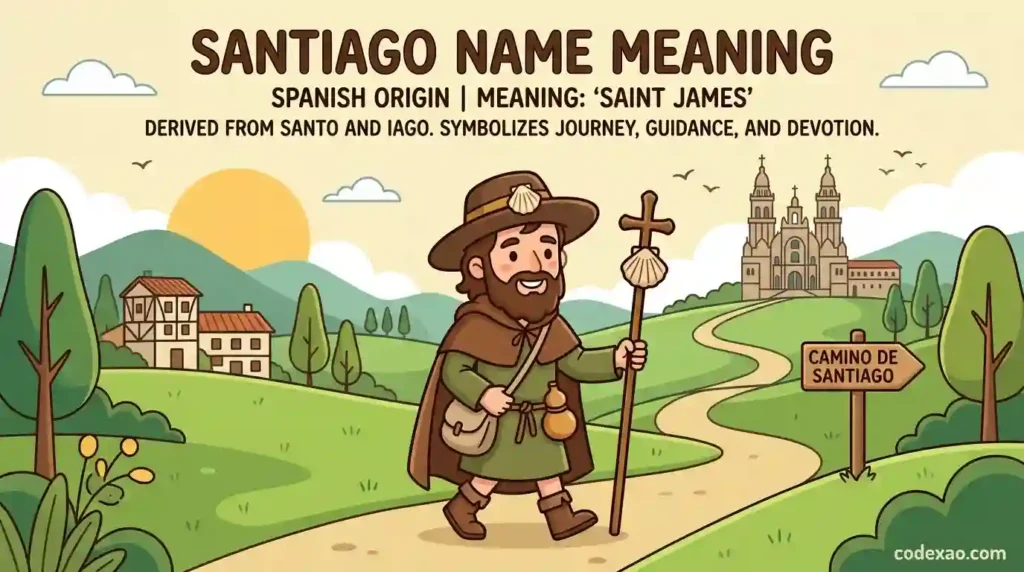
Have you ever come across the name Santiago and wondered what it truly means or why it’s so popular across different cultures? You’re not alone.
This powerful and timeless name carries deep historical roots, strong cultural identity, and a meaning that has evolved over centuries.
Understanding the Santiago name meaning is more than just curiosity. It helps parents choose meaningful names, gives insight into heritage, and even adds personality to how a name is perceived in modern conversations.
Whether you saw it in a book, heard it in a movie, or are considering it for a baby name, this guide breaks everything down clearly.
Updated for 2026, this is your complete resource to learn the origin, symbolism, usage, and real-life relevance of Santiago in today’s world.
What Does Santiago Mean?
Definition and Origin
The Santiago name meaning is widely understood as
Saint James or Saint Jacob
The name comes from Spanish roots and evolved from the phrase
Sant Iago which means Saint James
Over time, Sant Iago merged into a single word
Santiago
Quick Answer
Santiago means Saint James and originates from Spanish, derived from the Latin name Iacobus. It symbolizes strength, faith, and historical legacy.
Historical Background
Santiago is deeply connected to Saint James the Apostle, one of the twelve apostles of Jesus. In Spanish culture, Saint James became a highly revered figure, especially in medieval times.
The name gained prominence through the famous pilgrimage route known as Camino de Santiago in Spain, which helped spread its popularity across Europe and Latin America.
Evolution Over Time
- Early Latin form Iacobus
- Old Spanish Sant Iago
- Modern Spanish Santiago
Today, the name is used globally and is especially common in Spanish-speaking countries.
How to Use Santiago Correctly in Modern Context
Even though Santiago is a traditional name, it fits seamlessly into modern communication.
Tone and Context
- Formal use full name Santiago
- Casual use nicknames like Santi
- Friendly and warm tone
- Often associated with strength and charm
Platform-Based Usage
- WhatsApp and SMS Used as a first name or contact name
- Instagram Often seen in bios and usernames
- Discord Gaming profiles and nicknames
- Twitter X Used in handles and identity branding
When to Use and When Not
Use it
- Naming a child
- Writing stories or characters
- Cultural or religious references
Avoid using casually in jokes if the context is cultural or religious, as it may carry respect in some communities.
Formatting Tips
- Capitalize the first letter always
- Nicknames can be lowercase in casual chats
- Emoji pairings often include crown, star, or fire emojis
Real Conversation Examples Using Santiago
Between Friends
A
Yo, have you met Santiago yet
B
Yeah, he’s super chill
Meaning
The name carries a friendly and approachable vibe
In a Family Setting
Mom
We’re naming the baby Santiago
Dad
That’s a strong and beautiful name
Meaning
Used to reflect pride and cultural identity
In Dating Context
A
Who’s that guy you were talking to
B
His name is Santiago, he’s really sweet
Meaning
Adds charm and sophistication
In a Work Chat
Manager
Santiago will lead this project
Team
Sounds good
Meaning
Professional and respectful usage
In Gaming or Online Chat
Player1
Santiago carried the whole team
Player2
For real, MVP
Meaning
Used as a strong identity or username
Common Mistakes and Misunderstandings
Confusing It with a Place Only
Many people think Santiago is just a city name. While it is the name of several cities, it is originally a personal name.
Mispronunciation
Incorrect
San tee ago
Correct
Sahn tee ah go
Cultural Misinterpretation
Some assume it is only religious. While it has religious roots, today it is widely used as a modern name without strict religious context.
Generational Gap
Older generations may connect it strongly to tradition
Younger users see it as stylish and global
Santiago Across Platforms and Demographics
Generational Use
Gen Z
Uses Santiago in usernames and aesthetic profiles
Millennials
Prefer it as a meaningful baby name
Older Generations
Associate it with tradition and religion
Popularity Trends
- High usage in Latin America
- Growing popularity in the US and Europe
- Frequently appears in movies, literature, and pop culture
Formality Level
- Semi-formal to formal
- Safe for professional environments
- Universally accepted name
Related Names and Alternatives
Here are similar names and variations connected to Santiago
- Diego A shorter Spanish name with strong roots
- James English equivalent of Santiago
- Jacob Biblical origin similar meaning
- Thiago Portuguese variation
- Jaime Spanish variation of James
- Santino Italian-inspired name meaning little saint
- Mateo Popular Spanish name meaning gift of God
- Alejandro Classic Spanish name meaning defender
These names share similar cultural or linguistic backgrounds and can be great alternatives depending on preference.
FAQs:
Is Santiago a biblical name
Yes, Santiago is derived from Saint James, a biblical apostle. The name has strong roots in Christian history and tradition.
What does Santiago mean in English
In English, Santiago translates to Saint James. It carries the same historical and religious significance.
Is Santiago a popular name today
Yes, Santiago is widely popular, especially in Spanish-speaking countries and increasingly in global naming trends.
Can Santiago be used as a first name
Absolutely. Santiago is commonly used as a first name and is appreciated for its strong and elegant sound.
What is the nickname for Santiago
Common nicknames include Santi, Tiago, and Yago. These are used in casual and friendly conversations.
Conclusion:
The Santiago name meaning goes far beyond a simple definition. It represents history, culture, strength, and identity all wrapped into one timeless name.
From its origins linked to Saint James to its modern-day global popularity, Santiago continues to stand out as a name that feels both classic and fresh.
It works in professional settings, social conversations, and even digital identities.
If you’re considering this name or simply exploring its meaning, Santiago offers depth, character, and universal appeal.
Drop your favorite name or meaning in the comments and explore more fascinating name insights.

Hi, I’m Isabella Brown, the voice behind Codexao.com, where meanings aren’t just explained, they’re made easy to understand.
I’ve always been fascinated by how words shape the way we think, speak, and connect. But let’s be honest—most definitions out there feel confusing, outdated, or just plain boring.
That’s exactly why I created Codexao. Here, I break down words, slang, and modern expressions into simple, clear meanings you can actually use in real life.