If you’ve ever looked at MLB stats and seen the term WAR baseball meaning and felt completely lost, you’re not alone.
Baseball fans, fantasy players, and even casual viewers often run into this mysterious three-letter stat and assume it has something to do with actual war. It doesn’t.
In modern baseball analytics, WAR is one of the most powerful and widely used metrics for evaluating player performance.
It appears on sites like Fangraphs and Baseball Reference, and it often decides debates about MVPs, Hall of Fame careers, and player value.
This guide, updated for 2026, breaks everything down in simple terms.
You’ll learn what WAR means, how it works, how it’s used in real baseball conversations, and why it matters more than traditional stats like batting average or RBIs.
What Does WAR Baseball Meaning Mean?
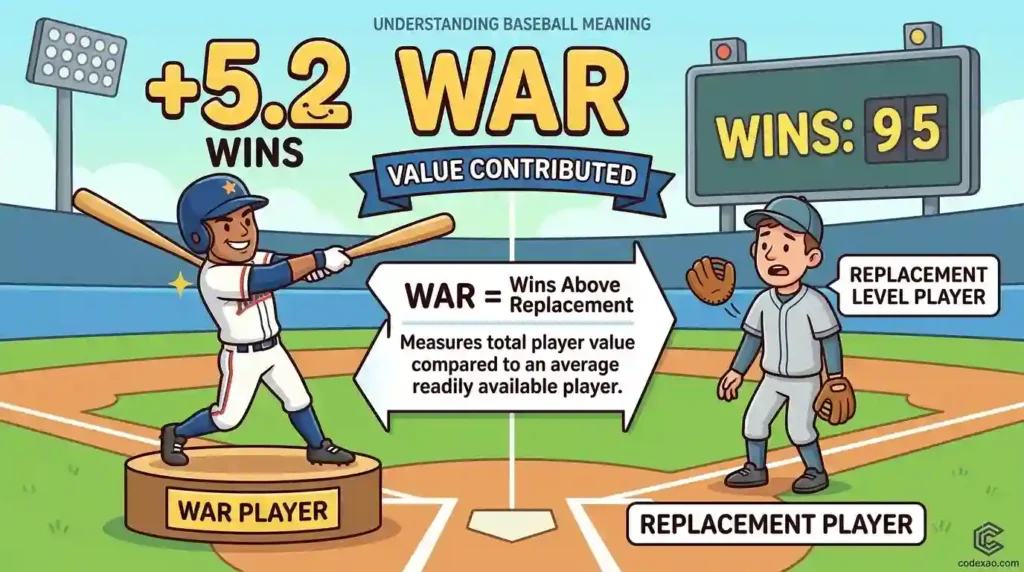
WAR baseball meaning refers to Wins Above Replacement, a statistic used in baseball to measure a player’s total value compared to a replacement-level player.
Quick Answer
WAR means Wins Above Replacement, a baseball statistic that estimates how many more wins a player contributes to their team compared to a replacement-level player at the same position.
WAR emerged from sabermetrics, the data-driven study of baseball performance that became popular in the late 20th century. Analysts wanted a single number that could summarize everything a player does, hitting, fielding, base running, and pitching.
Instead of looking at separate stats, WAR combines them into one value. The higher the WAR, the more valuable the player.
There are two major versions:
- Fangraphs WAR, often called fWAR
- Baseball Reference WAR, often called bWAR
Both aim to measure the same concept but use slightly different formulas.
How to Use WAR Baseball Meaning Correctly in Analysis and Chat
Understanding WAR baseball meaning is not just about definitions. It is about context.
WAR is commonly used in:
- Baseball debates online
- Fantasy baseball discussions
- Sports commentary on ESPN or MLB Network
- Reddit baseball communities
- Stat breakdown videos on YouTube and TikTok
When to use WAR
- Comparing two players at the same position
- Evaluating MVP candidates
- Measuring season or career value
- Analyzing team strength
When NOT to use WAR
- Casual conversations where people prefer simple stats
- Situations where audience is not familiar with analytics
- Emotional arguments where traditional stats are expected
WAR is informal in everyday conversation but highly respected in analytical baseball discussions.
Real Conversation Examples Using WAR Baseball Meaning
Between friends watching MLB
Friend A: Judge has way better power numbers
Friend B: True, but Ohtani has higher WAR this season
Meaning: Friend B is using WAR to argue overall value, not just home runs
Fantasy baseball group chat
Player A: Should I trade this pitcher?
Player B: Check his WAR, it shows he’s overperforming
Meaning: WAR is being used as a decision-making tool
Baseball Twitter discussion
User A: This guy is not an All Star
User B: He has 5 WAR already, that is elite level
Meaning: WAR is used to justify player recognition
Sports debate show
Analyst: Traditional stats do not tell the full story
Co host: That is why WAR matters so much today
Meaning: WAR is presented as a modern upgrade over older stats
Casual misunderstanding moment
Fan: What is WAR, like war fighting?
Friend: No, it means Wins Above Replacement
Meaning: Clearing confusion about the term
Common Mistakes and Misunderstandings About WAR Baseball Meaning
Many people misinterpret WAR baseball meaning because it sounds more complicated than it is.
Mistake 1: Thinking WAR is exact
WAR is an estimate, not a perfect measurement. Different sites calculate it differently.
Mistake 2: Comparing WAR across positions without context
A 4 WAR catcher is often more valuable than a 4 WAR first baseman because catchers have harder defensive roles.
Mistake 3: Believing WAR is the only stat that matters
WAR is powerful but not perfect. Scouts still consider leadership, clutch performance, and situational hitting.
Generational confusion
Older fans often trust batting average and RBIs more, while younger fans rely heavily on WAR and advanced metrics.
Cultural misunderstanding
Some casual fans think WAR is too complex or unnecessary, while analysts see it as essential.
WAR Baseball Meaning Across Different Platforms and Demographics
The use of WAR baseball meaning changes depending on where and who is talking.
Gen Z and analytics fans
- Frequently use WAR in TikTok breakdowns
- Compare players using charts and graphics
- Prefer advanced stats over traditional ones
Millennials
- Balanced use of WAR and traditional stats
- Common in fantasy baseball leagues
- Familiar with Fangraphs and Baseball Reference
Older generations
- Prefer batting average, home runs, RBIs
- May view WAR as overly complex
Platforms
- Twitter X: debates and quick WAR comparisons
- Reddit: deep analytical discussions
- YouTube: breakdown videos explaining WAR visually
- Instagram: simplified stat cards
WAR became mainstream in MLB discussions after Moneyball era analytics influenced how teams evaluate players.
Related Slang, Abbreviations and Alternatives
Here are related baseball analytics terms you should know:
- OPS On base plus slugging, measures hitting power and consistency
- wRC Plus Weighted runs created plus, offensive value metric
- ERA Earned run average, pitcher performance stat
- FIP Fielding independent pitching, pitcher skill-based stat
- BABIP Batting average on balls in play, luck influenced metric
- Sabermetrics Advanced baseball statistical analysis system
- Defensive Runs Saved Measures defensive impact
- RBI Runs batted in, traditional scoring stat
- OBP On base percentage, how often a player reaches base
- Slugging percentage Power hitting measurement
These metrics often work together with WAR to give a full picture of performance.
FAQs:
What does WAR mean in baseball
WAR stands for Wins Above Replacement, a statistic that estimates how many more wins a player adds compared to a replacement-level player.
Is WAR a good stat in baseball
Yes, WAR is widely considered one of the best all in one stats because it combines hitting, fielding, and base running into one number.
What is a good WAR in MLB
A WAR above 5 is considered All Star level, while anything above 8 is MVP level performance in most seasons.
Why are there different WAR calculations
Fangraphs and Baseball Reference use different formulas to estimate defensive value and pitching contributions, leading to slightly different results.
Can WAR determine the best player
WAR is very useful for comparisons, but it should not be the only factor. Context, position, and game impact also matter.
Conclusion:
Understanding WAR baseball meaning gives you a major advantage when watching or analyzing baseball today.
It is not just another stat, it is a complete snapshot of player value in one number.
Whether you are debating MVPs, building a fantasy team, or just trying to understand baseball broadcasts, WAR helps you see beyond traditional stats and understand true performance.
Baseball has evolved into a data driven sport, and WAR sits at the center of that evolution.
If you want to sound like someone who truly understands the game, mastering WAR is a great place to start.

Hi, I’m Isabella Brown, the voice behind Codexao.com, where meanings aren’t just explained, they’re made easy to understand.
I’ve always been fascinated by how words shape the way we think, speak, and connect. But let’s be honest—most definitions out there feel confusing, outdated, or just plain boring.
That’s exactly why I created Codexao. Here, I break down words, slang, and modern expressions into simple, clear meanings you can actually use in real life.