Have you ever watched anime, read manga, or spoken with someone learning Japanese and heard the word “sama”? Maybe you’ve seen names like “Sebastian-sama” or “Hime-sama” and wondered what they actually mean.
Understanding the sama Japanese meaning is more important than many people realize.
This small suffix carries a powerful message of respect, social status, and cultural etiquette. In Japan, choosing the correct honorific can completely change how your words are received.
Whether you’re an anime fan, language learner, traveler, or simply curious about Japanese culture, knowing when and how to use sama can help you avoid awkward mistakes and communicate more naturally.
Updated for 2026, this guide explains the meaning, origin, usage rules, examples, and cultural significance of sama in simple language anyone can understand.
What Does Sama Mean?
Quick Answer
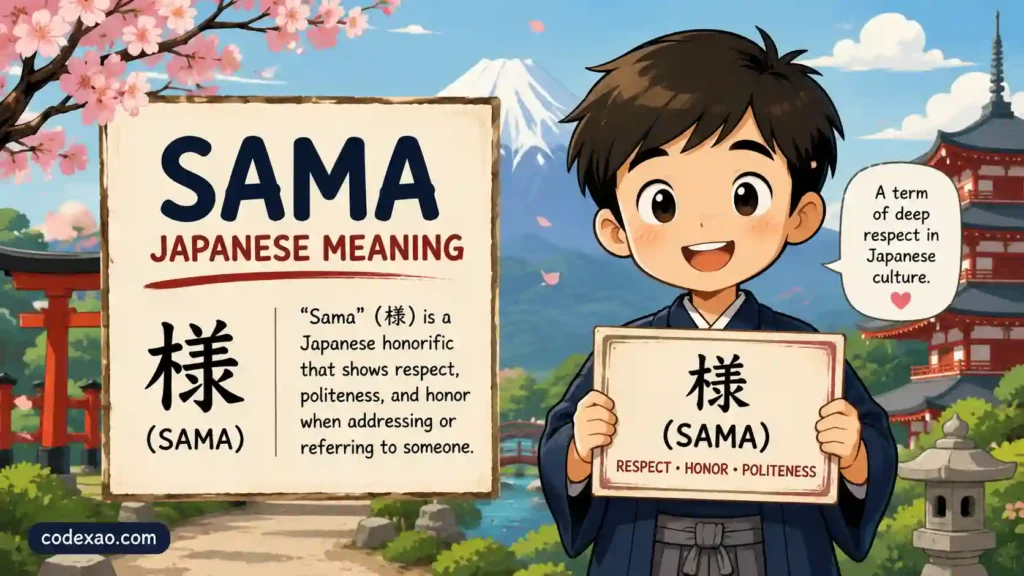
Sama is a Japanese honorific suffix used to show exceptional respect, formality, admiration, or deference toward a person. It is more respectful than the common suffix san.
Definition
In Japanese, “sama” is attached to a person’s name or title to indicate a high level of respect.
For example:
- Tanaka-sama
- Customer-sama
- Hime-sama
The suffix suggests that the person being addressed deserves special honor or recognition.
Origin of Sama
The term originates from classical Japanese language traditions that developed alongside Japan’s hierarchical social structure.
Historically, sama was used when addressing nobles, aristocrats, samurai leaders, religious figures, and individuals of high social standing.
Over time, its use expanded into business, customer service, and formal communication.
How the Meaning Has Evolved
Centuries ago, sama was reserved primarily for elite members of society.
Today, it remains highly respectful but is commonly used in:
- Business correspondence
- Customer service interactions
- Formal announcements
- Hospitality industries
- Anime and manga storytelling
Pronunciation Guide
Sama is pronounced:
SAH-MAH
The first syllable sounds like “sa” in “father,” followed by “mah.”
How to Use Sama Correctly in Texts and Chat
Using sama correctly depends heavily on context.
Formal Situations
Sama is appropriate when addressing:
- Customers
- Clients
- VIP guests
- Authority figures
- Highly respected individuals
Examples:
- Suzuki-sama, thank you for your visit.
- Yamada-sama, your reservation is confirmed.
Casual Conversations
Among friends, sama is generally uncommon.
However, it may appear:
- As a joke
- To exaggerate admiration
- In fandom communities
- During playful teasing
Example:
“Gaming-sama has arrived to carry our team again.”
Social Media Usage
Usually rare unless discussing Japanese culture.
Often seen among anime fans.
X
Used in fandoms to praise creators, artists, or celebrities.
Discord
Common in gaming communities with anime influence.
Frequently appears in Japanese language and anime discussions.
When Not to Use Sama
Avoid using sama:
- With close friends in serious conversation
- In situations where excessive formality feels strange
- When speaking casually with peers
Using sama unnecessarily can sound unnatural or overly dramatic.
Formatting Tips
Most people write it:
- Name-sama
- Character-sama
- Sensei-sama
Popular emoji pairings include:
- 🙏
- 👑
- ✨
- 🌸
Real Conversation Examples Using Sama
Between Friends
Friend A: Did you finish the project already?
Friend B: Of course.
Friend A: Productivity-sama strikes again.
Meaning: Playful admiration for someone’s efficiency.
In a Gaming Chat
Player 1: We won because of your strategy.
Player 2: Team effort.
Player 1: Strategy-sama carried us.
Meaning: Respect mixed with humor.
Anime Fan Discussion
Fan A: Who is your favorite character?
Fan B: Gojo-sama forever.
Meaning: Deep admiration for the character.
Customer Service Scenario
Employee: Tanaka-sama, your order is ready.
Customer: Thank you.
Meaning: Professional respect toward a customer.
Family Joke
Sibling: Mom cooked your favorite meal.
You: Mom-sama truly understands me.
Meaning: Humorous appreciation and affection.
Common Mistakes and Misunderstandings
Mistake 1: Thinking Sama Means Sir
Many learners assume sama directly translates to “sir.”
While similar in respect level, sama carries cultural nuances that do not perfectly match English titles.
Mistake 2: Using Sama With Everyone
Not every person requires the same honorific.
Using sama for every interaction can sound awkward and overly formal.
Mistake 3: Confusing Sama With San
Many beginners mix up these honorifics.
Quick comparison:
| Honorific | Respect Level | Common Usage |
|---|---|---|
| San | Standard polite | Everyday interactions |
| Sama | Highly respectful | Formal situations |
| Kun | Casual | Younger males |
| Chan | Affectionate | Children and close friends |
Generational Differences
Older Japanese speakers may associate sama with stronger traditional respect.
Younger internet users sometimes use it humorously or ironically.
Cultural Differences
Outside Japan, anime communities often use sama more casually than native Japanese speakers would.
This can create misunderstandings when speaking with Japanese people.
How to Clarify
If someone seems confused, simply explain:
“Sama is a Japanese honorific that shows extra respect.”
Sama Across Different Platforms and Demographics
Gen Z Usage
Gen Z often uses sama:
- Ironically
- Humorously
- In fandom culture
- During gaming conversations
Millennial Usage
Millennials are more likely to use sama:
- While discussing anime
- During Japanese language learning
- In online communities
Older Generations
Older users usually encounter sama through:
- Travel
- Business
- Formal Japanese communication
TikTok
Anime edits and fan content frequently feature sama in captions and comments.
Creators often use sama when praising favorite characters or artists.
Discord
Gaming servers regularly adopt honorifics as nicknames and playful titles.
Is Sama Formal or Informal?
The answer depends on context.
Traditional Japanese usage is highly formal.
Internet usage is often casual and humorous.
Is It Safe for Work?
Yes.
Sama is considered professional and respectful when used appropriately.
Related Slang, Abbreviations and Alternatives
| Term | Meaning |
| San | Standard respectful suffix |
| Kun | Casual suffix often used for boys |
| Chan | Affectionate suffix |
| Sensei | Teacher or expert |
| Senpai | Senior member of a group |
| Kohai | Junior member |
| Dono | Historical respectful title |
| Hime | Princess |
| Shacho | Company president |
| Kaicho | Organization chairman |
Synonyms in Casual Conversation
- Honored guest
- Respected person
- Esteemed individual
Casual Opposites
- Informal nickname
- First-name basis
- Casual address
FAQs:
Is sama higher than san?
Yes. Sama expresses a greater level of respect than san and is commonly used in formal situations and customer-facing environments.
Why do anime characters use sama?
Anime often uses sama to show admiration, loyalty, royalty, authority, or social hierarchy. It helps establish relationships between characters quickly.
Can foreigners use sama?
Absolutely. Language learners can use sama when speaking Japanese formally. The key is understanding when the situation requires that level of respect.
Is sama only used for people?
Mostly yes. However, in literature, religion, folklore, and anime, it may occasionally be used for deities, spirits, or symbolic figures.
What is the difference between senpai and sama?
Senpai refers to someone senior in experience or status within a group. Sama focuses on respect and formality rather than seniority.
Conclusion:
The sama Japanese meaning goes far beyond a simple title. It represents respect, courtesy, social awareness, and centuries of Japanese cultural tradition.
In formal Japanese communication, sama signals a high level of politeness. In online communities, anime fandoms, and gaming spaces, it often adds humor, admiration, or playful exaggeration.
Learning when to use sama correctly can make your Japanese sound more natural and help you better understand anime, manga, business communication, and modern internet culture.
Drop your favorite Japanese honorific in the comments below and keep exploring the fascinating world of Japanese language and digital slang.

Hi, I’m John Mark, the voice behind codexao.com, where meanings aren’t just explained, they’re simplified for the way people actually talk today.
I’ve always been curious about words, how they change, how they trend, and how a simple phrase can carry completely different meanings depending on context. That curiosity turned into codexao, a space where I break down slang, text abbreviations, and everyday words into clear, easy-to-understand explanations.