Have you ever seen someone mention an MS degree on LinkedIn, a resume, or a university website and wondered what it actually means?
You’re not alone. Many students and professionals come across the term but aren’t always sure how it differs from other graduate qualifications.
Understanding MS Degree Meaning is important if you’re planning higher education, exploring career opportunities, or simply trying to understand academic credentials.
An MS degree is one of the most respected postgraduate qualifications worldwide. It helps students gain advanced knowledge, practical skills, and research experience in their chosen field.
This guide explains exactly what an MS degree means, where it comes from, how it works, and whether it could be the right next step for your educational journey.
What Does MS Degree Mean?
Quick Answer
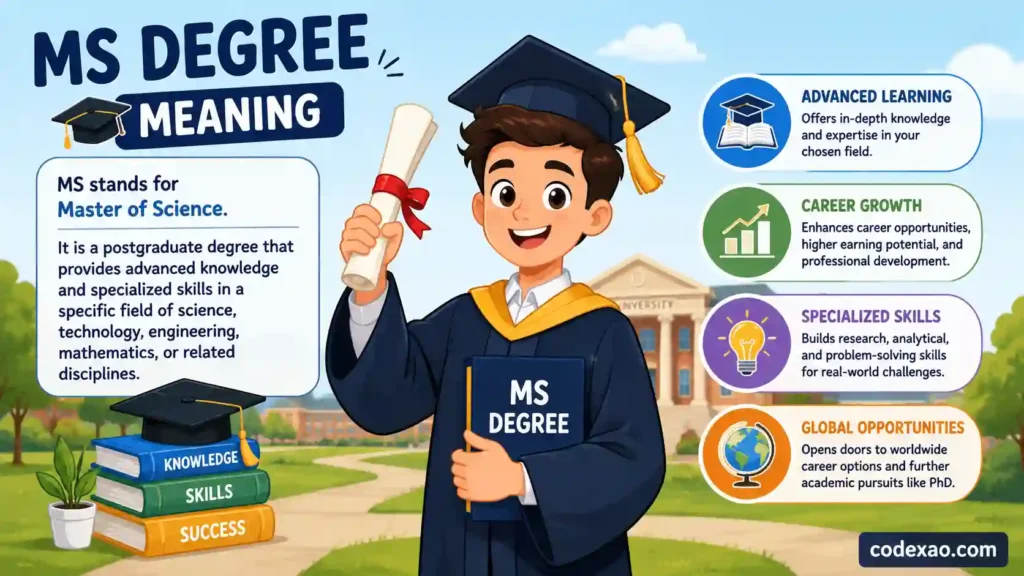
MS Degree Meaning refers to Master of Science, an advanced postgraduate degree awarded after completing specialized studies beyond a bachelor’s degree.
An MS degree focuses on developing deeper expertise in a particular subject. It is commonly associated with science, technology, engineering, mathematics, healthcare, business analytics, and other technical disciplines.
Students typically enroll in an MS program after earning a bachelor’s degree.
Pronunciation
MS is commonly pronounced as:
“Em Ess”
Master of Science is pronounced exactly as written.
Origin of the MS Degree
The Master of Science degree originated from European university traditions that emphasized advanced academic study and research.
As universities expanded globally, the degree became a standard postgraduate qualification in countries such as:
- United States
- Canada
- United Kingdom
- Australia
- Germany
- Singapore
Over time, MS programs evolved to include practical training, laboratory work, internships, and industry-focused projects.
Today, the degree is highly valued in both academic and professional settings.
How an MS Degree Works
An MS degree typically builds upon knowledge gained during undergraduate studies.
Students may complete:
Coursework
Advanced classes related to a specific field.
Examples include:
- Data Science
- Computer Science
- Biotechnology
- Finance
- Mechanical Engineering
Research
Many programs require independent research under faculty supervision.
Thesis or Capstone Project
Students often complete a substantial project demonstrating mastery of the subject.
Duration
Most MS programs require:
- 1 year for accelerated programs
- 2 years for traditional programs
- Up to 3 years for part-time students
Types of MS Degrees
Different universities offer specialized Master of Science programs.
Computer Science
Focuses on software development, artificial intelligence, cybersecurity, and data systems.
Data Science
Combines statistics, machine learning, and data analytics.
Engineering
Available in fields such as:
- Civil Engineering
- Electrical Engineering
- Mechanical Engineering
- Aerospace Engineering
Finance
Concentrates on financial analysis, investments, and risk management.
Healthcare and Nursing
Provides advanced training for healthcare professionals.
Environmental Science
Addresses sustainability, climate change, and environmental management.
How to Use the Term MS Degree Correctly
The phrase often appears in professional and academic contexts.
On a Resume
Bachelor of Science in Biology
MS Degree in Biotechnology
On LinkedIn
Currently pursuing an MS Degree in Computer Science.
In Academic Discussions
She earned her MS Degree before starting her PhD program.
In Professional Settings
The company prefers candidates with an MS degree in engineering.
When Not to Use It
Avoid confusing MS with:
- MSc when discussing country-specific degree naming conventions
- Medical abbreviations
- Other certifications that are not graduate degrees
Real Examples Using MS Degree
Student Profile
“I completed my MS degree in Data Science and received a job offer within three months.”
Meaning: Highlights advanced education leading to career growth.
Job Application
“Applicants with an MS degree in Computer Science are preferred.”
Meaning: Indicates a higher level of expertise.
Graduate School Discussion
“I’m considering an MS degree before applying for doctoral programs.”
Meaning: Uses the degree as preparation for further education.
Professional Networking
“Her MS degree helped her transition into artificial intelligence research.”
Meaning: Shows specialization and career advancement.
Career Change
“After earning an MS degree in Finance, he moved into investment banking.”
Meaning: Demonstrates skill development for a new profession.
Common Mistakes and Misunderstandings
Thinking MS and MSc Are Completely Different
In most cases, both refer to Master of Science.
The difference usually comes from university traditions and naming conventions.
Assuming Every MS Program Requires a Thesis
Some universities offer non-thesis options focused on coursework and professional training.
Believing an MS Guarantees Employment
While it can improve opportunities, career success also depends on experience, skills, networking, and market demand.
MS Degree Across Different Countries
United States
MS is the most common abbreviation for Master of Science.
Programs often combine coursework and research.
United Kingdom
Universities frequently use MSc instead of MS.
Canada
Both MS and MSc naming conventions may be used.
Australia
Master of Science programs often emphasize research and specialization.
Europe
Many universities align programs with international standards while maintaining local naming traditions.
Related Academic Terms and Alternatives
| Term | Meaning |
|---|---|
| Bachelor’s Degree | Undergraduate qualification |
| Master’s Degree | Graduate-level degree |
| MSc | Master of Science |
| MBA | Master of Business Administration |
| MA | Master of Arts |
| PhD | Doctor of Philosophy |
| Graduate School | Institution offering advanced degrees |
| Thesis | Research project required for some degrees |
| Capstone Project | Practical final project |
| Doctorate | Highest academic degree level |
Related reading opportunities:
- Learn more about Master’s Degree Meaning
- Learn more about MSc Meaning
- Learn more about PhD Meaning
- Learn more about Graduate School Meaning
- Learn more about MBA Meaning
FAQs:
Is an MS degree the same as a master’s degree?
An MS degree is one specific type of master’s degree. Other master’s qualifications include MA, MBA, MEng, and several specialized graduate degrees.
What does MS stand for in education?
MS stands for Master of Science, a postgraduate qualification awarded after advanced academic study.
How long does it take to complete an MS degree?
Most students finish within one to two years, though program length varies by university and study format.
Can I get an MS degree online?
Yes. Many accredited universities now offer fully online and hybrid MS programs in various disciplines.
Is an MS degree worth pursuing?
For many professionals, an MS degree can increase expertise, improve earning potential, and open doors to leadership or specialized roles.
What comes after an MS degree?
Students often pursue doctoral studies such as a PhD, while others enter industry positions requiring advanced qualifications.
Do all MS programs require research?
No. Some programs focus heavily on coursework and practical skills instead of research.
Conclusion:
Understanding MS Degree Meaning is essential if you’re exploring higher education or evaluating academic qualifications.
A Master of Science degree provides advanced subject knowledge, practical expertise, and valuable credentials that can support career growth across many industries.
Whether you’re considering graduate school, reviewing job requirements, or comparing educational paths, knowing what an MS degree represents can help you make informed decisions.
Ready to continue learning? Explore more education and degree-related terms to strengthen your academic knowledge and career planning skills.

Hi, I’m Isabella Brown, the voice behind Codexao.com, where meanings aren’t just explained, they’re made easy to understand.
I’ve always been fascinated by how words shape the way we think, speak, and connect. But let’s be honest—most definitions out there feel confusing, outdated, or just plain boring.
That’s exactly why I created Codexao. Here, I break down words, slang, and modern expressions into simple, clear meanings you can actually use in real life.