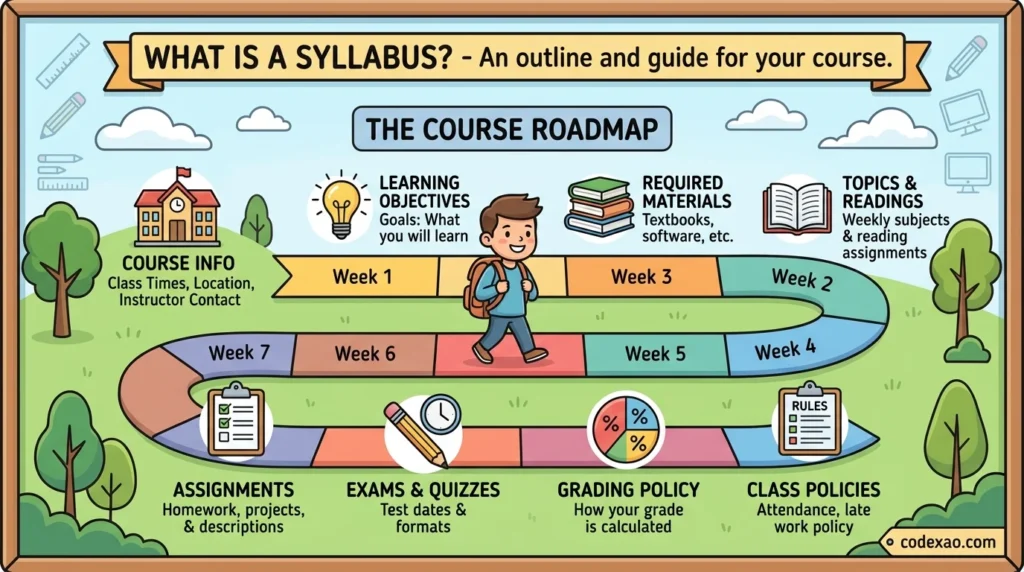
Have you ever started a new class and received a document packed with dates, assignments, rules, and course topics? That document is usually called a syllabus.
Understanding syllabus meaning is important for students, teachers, parents, and anyone involved in education.
A syllabus acts like a roadmap for a course. It tells students what they will learn, how they will be graded, and what expectations they need to meet throughout the term.
Many people hear the word often but never fully understand its purpose. Is it just a schedule? Is it the same as a curriculum? Why do schools and universities treat it as such an important document?
In this updated 2026 guide, you’ll learn the complete meaning of syllabus, its history, practical uses, real-life examples, common misconceptions, and related educational terms.
By the end, you’ll know exactly why every successful course starts with a strong syllabus.
What Does Syllabus Mean?
Definition
The term syllabus meaning refers to a document that outlines the structure and requirements of a course or subject.
A syllabus typically includes:
- Course objectives
- Topics to be covered
- Weekly schedule
- Assignments and projects
- Examination dates
- Grading criteria
- Classroom policies
- Required books and materials
Quick Answer
A syllabus is a detailed guide that explains what students will learn in a course and how their performance will be assessed.
Origin of the Word Syllabus
The word “syllabus” has roots in Latin and Greek language traditions. It entered English academic usage centuries ago and became widely associated with educational planning and course outlines.
Originally, the term referred to a summary or list of topics. Over time, educational institutions expanded its purpose, transforming it into a comprehensive course guide that students rely on throughout the semester.
How the Meaning Has Evolved
In the past, syllabi were often simple lists of subjects.
Today, modern syllabi include:
- Learning outcomes
- Digital resources
- Attendance policies
- Academic integrity rules
- Accessibility information
- Technology requirements
As education becomes more digital and student-focused, the syllabus has evolved into an essential communication tool.
Pronunciation Guide
Syllabus is pronounced as:
SIL-uh-bus
How to Use Syllabus Correctly in Education
The word syllabus is commonly used in schools, colleges, universities, training programs, and online learning platforms.
Correct Usage Examples
- Please review the syllabus before the first class.
- The professor updated the course syllabus yesterday.
- All exam dates are listed in the syllabus.
- The syllabus explains grading requirements.
When to Use It
Use the term syllabus when discussing:
- Academic courses
- Training programs
- Educational planning
- Course requirements
When Not to Use It
Avoid using syllabus to refer to:
- Entire school programs
- Educational systems
- School curriculums
Those concepts are broader than a single course syllabus.
Digital Learning Platforms
Today, students frequently access syllabi through:
- Learning management systems
- Online classrooms
- University portals
- Educational apps
The digital syllabus has become just as important as traditional printed versions.
Real Examples Using Syllabus
Example 1 Between Students
Student A: Did you know we have a quiz next week?
Student B: Yeah, I checked the syllabus yesterday.
Meaning: Student B used the syllabus to verify important course dates.
Example 2 University Setting
Professor: All assignment deadlines are available in the syllabus.
Student: Great, I’ll review it tonight.
Meaning: The syllabus serves as a planning tool.
Example 3 Parent and Child
Parent: How do you know what’s being taught this semester?
Child: Everything is listed in the syllabus.
Meaning: The syllabus provides a complete course overview.
Example 4 Online Course
Instructor: Before starting, download the syllabus.
Learner: I’ll read it before beginning the lessons.
Meaning: The syllabus helps students prepare for course expectations.
Example 5 Training Program
Manager: The training syllabus outlines all modules.
Employee: That will help me track my progress.
Meaning: A syllabus can also be used in professional development.
Common Mistakes and Misunderstandings
Mistake 1 Confusing Syllabus With Curriculum
Many people think these terms mean the same thing.
A syllabus covers one course.
A curriculum covers an entire educational program that may include many courses.
Mistake 2 Ignoring the Syllabus
Students often skim the syllabus and miss:
- Deadlines
- Attendance requirements
- Grading policies
This can lead to unnecessary academic problems.
Mistake 3 Treating It as Optional
Some students view the syllabus as a formality.
In reality, it often serves as an agreement between instructor and students regarding expectations and responsibilities.
Generational Differences
Older generations may remember brief paper syllabi.
Modern students often receive detailed digital documents containing far more information and resources.
How to Clarify the Meaning
If someone is unfamiliar with the term, simply explain:
“A syllabus is the guidebook for a course.”
Most people immediately understand its purpose after hearing that description.
Syllabus Across Different Educational Levels
Elementary School
Syllabi at this level are often simplified and shared with parents.
They focus on:
- Learning goals
- Classroom expectations
- Important dates
High School
High school syllabi become more structured and detailed.
They often include:
- Grading systems
- Project schedules
- Assessment methods
College and University
University syllabi are highly detailed.
They commonly contain:
- Reading schedules
- Research assignments
- Academic policies
- Attendance requirements
Online Learning
Digital education relies heavily on syllabi.
They help learners stay organized without face-to-face guidance.
Professional Training
Corporate training programs frequently use syllabi to outline:
- Learning modules
- Certification requirements
- Training timelines
Related Educational Terms and Alternatives
| Term | Meaning |
|---|---|
| Curriculum | Complete educational program |
| Course Outline | Brief summary of course content |
| Lesson Plan | Daily teaching guide |
| Academic Calendar | Schedule of academic events |
| Learning Objectives | Expected learning outcomes |
| Coursework | Assigned academic work |
| Semester Plan | Term-wide instructional schedule |
| Training Manual | Instructional guide for training |
| Study Guide | Learning support resource |
| Educational Framework | Structure for learning delivery |
Similar Terms
- Course outline
- Study plan
- Academic guide
- Learning roadmap
Opposite Concepts
While there is no direct antonym, the opposite idea would be:
- Unstructured learning
- Informal education
- Unplanned instruction
FAQs:
What is the meaning of syllabus in simple words?
A syllabus is a document that explains what a course will teach, what assignments students must complete, and how grades will be determined.
Why do teachers provide a syllabus?
Teachers use a syllabus to communicate expectations, schedules, policies, and learning goals before instruction begins.
Is a syllabus legally important?
In many educational institutions, a syllabus serves as an official reference document that outlines course requirements and policies.
What should students do after receiving a syllabus?
Students should read it carefully, note important deadlines, understand grading policies, and keep it accessible throughout the course.
Can a syllabus change during a course?
Yes. Instructors may revise schedules or requirements when necessary, though significant changes are usually communicated to students.
What is included in a typical syllabus?
Most syllabi include course descriptions, objectives, assignments, grading criteria, schedules, required materials, and classroom expectations.
Is syllabus singular or plural?
Syllabus is singular. The plural form is syllabi, although syllabuses is also accepted in modern English.
Conclusion:
The syllabus meaning goes far beyond a simple list of topics. It is the blueprint that guides students through a course from start to finish.
A well-designed syllabus provides clarity, organization, and direction. It helps students understand expectations, manage their time, and stay on track academically.
Whether you’re a student, parent, educator, or lifelong learner, understanding the meaning of syllabus can make navigating educational experiences much easier.
What’s the most useful information you’ve ever found in a syllabus? Share your thoughts and explore more educational terminology guides to expand your knowledge.

Hi, I’m Isabella Brown, the voice behind Codexao.com, where meanings aren’t just explained, they’re made easy to understand.
I’ve always been fascinated by how words shape the way we think, speak, and connect. But let’s be honest—most definitions out there feel confusing, outdated, or just plain boring.
That’s exactly why I created Codexao. Here, I break down words, slang, and modern expressions into simple, clear meanings you can actually use in real life.