Have you ever looked at a medical bill and noticed a strange five-digit number next to a treatment or procedure? You’re not alone.
Many patients see these codes every day without knowing what they mean. Understanding CPT meaning medical can make healthcare bills easier to read and help you better understand the services you receive.
CPT codes play a major role behind the scenes of modern healthcare. Doctors use them to document procedures, insurance companies use them to process claims, and hospitals rely on them for accurate records.
Whether you’re a patient trying to understand a bill, a healthcare student learning medical terminology, or someone curious about medical coding, this guide breaks everything down in plain English.
This article explains what CPT means, where it came from, how it works, and why it matters.
What Does CPT Mean in Medical Terms?
CPT stands for Current Procedural Terminology.
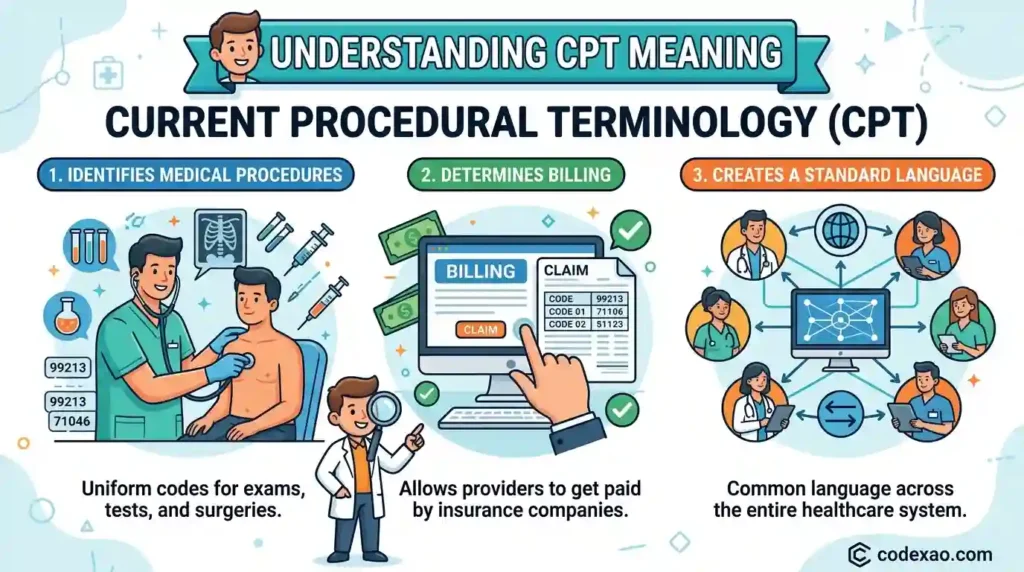
It is a standardized coding system used to describe medical, surgical, and diagnostic services performed by healthcare professionals.
Healthcare providers assign a specific CPT code to each service they perform. This allows insurance companies, hospitals, and medical offices to communicate using a common language.
Quick Answer
CPT meaning medical refers to Current Procedural Terminology, a healthcare coding system used to identify medical procedures and services for documentation, billing, and insurance purposes.
Origin of CPT
The CPT coding system was developed by the American Medical Association to create consistency across healthcare services.
Before CPT, medical procedures were often described differently by different providers, making billing and record-keeping complicated.
Over time, CPT became the standard language for reporting medical procedures throughout the United States.
Pronunciation
Most healthcare professionals simply say:
“C-P-T”
Each letter is pronounced individually rather than as a word.
How CPT Codes Work in Healthcare
Every time a patient receives a medical service, a CPT code may be assigned.
Examples include:
- Office visits
- Physical examinations
- Surgical procedures
- Laboratory tests
- Diagnostic imaging
- Vaccinations
Each code represents a specific service.
For example:
| CPT Code | Medical Service |
|---|---|
| 99213 | Established patient office visit |
| 93000 | Electrocardiogram ECG |
| 71046 | Chest X-ray |
| 90471 | Vaccine administration |
These codes help ensure healthcare providers are paid accurately and insurance claims are processed correctly.
Why CPT Codes Matter
CPT codes help:
- Standardize healthcare reporting
- Reduce billing confusion
- Improve insurance claim accuracy
- Track healthcare services
- Support medical research and analytics
Without CPT codes, healthcare billing would be far less organized.
How to Use CPT Correctly in Medical Communication
Unlike internet slang, CPT is primarily used in professional healthcare environments.
Common Contexts
Healthcare professionals may say:
- “Please verify the CPT code.”
- “The insurance claim requires the correct CPT.”
- “This procedure has a new CPT code.”
Medical Documentation
Doctors and coders often reference CPT codes when:
- Submitting insurance claims
- Creating patient records
- Auditing healthcare services
- Reporting treatments
When Not to Use CPT
Outside healthcare settings, many people may not understand the abbreviation.
Avoid assuming patients know what CPT means without explanation.
For example:
Instead of saying:
“Your CPT was submitted.”
Say:
“We submitted the billing code for your procedure.”
This improves communication and reduces confusion.
Real Examples of CPT Codes in Action
Example 1: Family Doctor Visit
Patient: I had a routine checkup today.
Receptionist: Your visit was recorded under CPT code 99213.
Meaning: The code identifies a specific type of office visit for billing purposes.
Example 2: Insurance Claim
Patient: Why was my claim delayed?
Insurance Representative: We needed verification of the CPT code submitted by your provider.
Meaning: The insurer is confirming the procedure performed.
Example 3: Laboratory Testing
Doctor: We ordered blood work today.
Medical Coder: I’ll assign the correct CPT codes for each test.
Meaning: Each lab service receives a corresponding billing code.
Example 4: Hospital Procedure
Surgeon: The procedure documentation is complete.
Billing Specialist: I’ll enter the CPT code for claim submission.
Meaning: The procedure is translated into a standardized billing language.
Example 5: Healthcare Training
Student: Why do we learn CPT codes?
Instructor: They’re essential for medical billing and documentation.
Meaning: CPT knowledge is a core skill in healthcare administration.
Common Mistakes and Misunderstandings
Many people misunderstand CPT because healthcare coding can seem complicated.
Mistake 1: Thinking CPT Is a Diagnosis
A CPT code describes what was done.
A diagnosis code explains why it was done.
These are two different coding systems.
Mistake 2: Assuming All Providers Use Different Codes
Healthcare providers generally use the same CPT system, which creates consistency nationwide.
Mistake 3: Believing CPT Codes Never Change
New medical procedures emerge regularly.
As healthcare evolves, CPT codes are updated to reflect current practices
Patient Confusion
Many patients see CPT numbers on bills and assume they are random.
In reality, every code corresponds to a specific healthcare service.
CPT Across Different Healthcare Settings
The use of CPT codes varies slightly depending on the healthcare environment.
Hospitals
Hospitals use CPT codes to report procedures, surgeries, and diagnostic services.
Physician Offices
Doctors use CPT codes for patient visits, consultations, and treatments.
Laboratories
Lab facilities assign CPT codes to blood tests and diagnostic studies.
Insurance Companies
Insurers review CPT codes to determine coverage and reimbursement.
Medical Coding Careers
Medical coders spend much of their day working with CPT codes to ensure accurate documentation.
Is CPT Formal or Informal
CPT is highly formal.
It is an official healthcare abbreviation used throughout the medical industry.
Unlike internet slang, it should be used professionally and accurately.
Related Medical Coding Terms and Alternatives
Understanding related terminology helps put CPT into context.
| Term | Meaning |
| ICD | Diagnosis coding system |
| HCPCS | Healthcare Common Procedure Coding System |
| Medical Coding | Converting services into standardized codes |
| Medical Billing | Processing healthcare claims |
| EHR | Electronic Health Record |
| Claim Submission | Sending billing information to insurers |
| Revenue Cycle | Financial process in healthcare |
| Procedure Code | Code describing a medical service |
| Diagnosis Code | Code describing a condition |
| Insurance Reimbursement | Payment for healthcare services |
These terms often appear alongside CPT in healthcare documentation.
FAQs:
What does CPT stand for in healthcare?
CPT stands for Current Procedural Terminology. It is a coding system used to identify medical procedures and services performed by healthcare professionals.
What are CPT codes used for?
CPT codes are used for healthcare documentation, insurance billing, reimbursement processing, and maintaining consistent medical records across providers.
Who created the CPT coding system?
The American Medical Association developed CPT to standardize the reporting of medical procedures and services.
Are CPT codes used worldwide?
CPT codes are primarily used in the United States. Other countries may use different medical coding systems depending on their healthcare regulations.
Can patients look up CPT codes?
Yes. Patients can review CPT codes on medical bills and discuss them with healthcare providers or insurance representatives to better understand charges.
How often are CPT codes updated?
CPT codes are updated regularly to reflect new technologies, treatments, and healthcare procedures introduced into medical practice.
Conclusion:
Understanding CPT meaning medical gives you a clearer picture of how healthcare documentation and billing work behind the scenes.
CPT codes serve as a universal language for medical procedures, helping providers, hospitals, and insurers communicate accurately and efficiently.
The next time you see a CPT code on a bill or insurance statement, you’ll know it represents a specific healthcare service rather than a random number.
Want to learn more healthcare abbreviations and medical terminology? Explore related guides and expand your medical vocabulary today.

Hi, I’m Isabella Brown, the voice behind Codexao.com, where meanings aren’t just explained, they’re made easy to understand.
I’ve always been fascinated by how words shape the way we think, speak, and connect. But let’s be honest—most definitions out there feel confusing, outdated, or just plain boring.
That’s exactly why I created Codexao. Here, I break down words, slang, and modern expressions into simple, clear meanings you can actually use in real life.