If you’ve searched “what does floxed mean” because you saw it in a comment, a news story, or a worried post from a friend, here’s the short version: it’s not a joke, and it’s not new slang for being embarrassed or clowned on.
Floxed describes something that happened to someone’s body after taking a common antibiotic.
The term picked up steam again after singer Bobby Caldwell’s family said he’d been “floxed” for years before his death, and millions of people googled the word the same week.
This guide breaks down exactly what floxed means, where the word came from, how people actually use it in real conversations, and why it matters if you or someone you know is ever prescribed this class of drug.
No medical jargon walls here. Just a clear, honest explanation of a word that a lot of people are confused about.
What Does “Floxed” Mean?
Quick Answer: To be “floxed” means to suffer serious, often long-lasting side effects from a fluoroquinolone antibiotic. The word is patient slang, not a clinical diagnosis.
The name comes straight from the drug class itself. Fluoroquinolone antibiotics ciprofloxacin, levofloxacin, moxifloxacin all share that “flox” root buried in the middle of their names. Patients who got hurt by these drugs started calling it getting “floxed,” and it stuck.
The word didn’t come from a marketing team or a dictionary committee. It came from patient forums in the early 2000s, where people swapping stories about sudden tendon pain, nerve damage, and anxiety after a routine antibiotic prescription needed a quick way to describe what was happening to them. “I got floxed” said more in two words than any medical explanation could.
Since then, the term has only grown. The FDA has issued repeated boxed warnings the strongest warning label a drug can carry about fluoroquinolones and their link to tendon rupture, nerve damage, and aortic injury. Doctors call the broader condition fluoroquinolone-associated disability, or FQAD, but almost nobody outside a clinic actually says that out loud. They say floxed.
Pronunciation: Rhymes with “boxed.” FLOKST.
How People Actually Use “Floxed” in Conversation
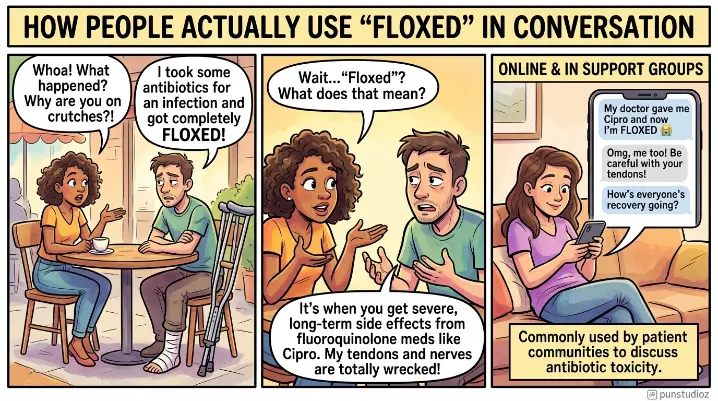
This isn’t a word you’d casually drop into a group chat as a joke, and using it that way can genuinely confuse or upset someone who’s dealt with the real thing. It shows up almost exclusively in a few specific contexts.
Health and patient communities. This is home base for the term. Reddit threads, Facebook support groups, and drug-injury forums use “floxed” constantly, alongside the related term “floxie” for someone who’s been through it.
News and health journalism. Reporters use it because it’s the term readers actually search for, then explain the clinical side underneath it.
Casual conversation about a specific person’s experience. Someone might tell a friend, “My uncle got floxed after taking Cipro for a UTI, he’s still dealing with tendon pain two years later.” It’s descriptive, not dramatic slang.
What to avoid: Don’t use “floxed” as a punchline or a stand-in for “embarrassed” or “roasted.” It has a specific, serious meaning, and misusing it in front of someone affected can land badly.
Real Examples of “Floxed” Used in Conversation
Between friends, checking in on a health scare “How’s your dad doing after his hospital stay?” “Not great honestly. Turns out he got floxed from that antibiotic they gave him for pneumonia. His tendons have been killing him ever since.” This shows how the word gets used to explain a confusing medical situation in one quick phrase, without needing to unpack the full pharmacology.
On a patient support forum “Three weeks post-Levaquin and I think I’m floxed. Sudden tendon pain in both ankles, can’t sleep, feels like my nervous system is misfiring. Anyone else start here?” Here the word functions almost like a diagnosis-in-progress, a way to find community before getting clear answers from a doctor.
At a pharmacy counter “Can I ask you something before I fill this? I’ve heard people say they got floxed from Cipro. Should I be worried?” This is the word doing real protective work, prompting someone to ask questions before taking a drug they might otherwise take without a second thought.
In a family text thread “Mom’s doctor wants to give her Avelox for her sinus infection. Didn’t Aunt Carol get floxed by that exact drug?” Shows how the term travels through families as a kind of informal warning system, often more effective than a pamphlet.
In a news comment section “This is exactly what happened to my sister. She was floxed at 24 and it took her five years to feel normal again. More people need to know this isn’t rare enough to ignore.” Demonstrates the word’s role in raising public awareness, usually from people who feel like their experience was dismissed elsewhere.
Common Mistakes and Misunderstandings
Mixing it up with “flexed.” The two words sound nearly identical out loud, and autocorrect loves to swap them. “He got floxed” and “he got flexed on” mean completely different things.
Assuming it’s rare, so it doesn’t matter. Serious reactions are uncommon relative to the millions of prescriptions written every year, but “uncommon” isn’t the same as “impossible.” That gap is exactly why the floxie community pushes so hard for awareness.
Doctors and patients using different vocabularies. A patient says “I got floxed.” A doctor might not recognize the term at all and instead ask about specific symptoms. This disconnect has caused real frustration, with some patients reporting their symptoms were dismissed simply because nobody on the clinical side spoke “floxie.”
Generational unfamiliarity. Older patients who were prescribed these drugs decades ago may have never encountered the term, even if they experienced the exact side effects it describes. Younger people researching a parent’s or grandparent’s symptoms are often the ones who introduce the word into the conversation.
“Floxed” Across Platforms and Communities
Reddit hosts some of the most active floxie communities, where people track symptoms, compare timelines, and share what’s helped them recover.
Facebook groups, often run by patients themselves, function as long-running support networks, some with tens of thousands of members swapping doctor recommendations and coping strategies.
TikTok and Instagram see periodic spikes in the term whenever a public figure’s story goes viral, like the coverage after Bobby Caldwell’s death, which briefly pushed “floxed” into mainstream search trends.
News outlets use it as a hook term in health reporting because it captures attention in a way that “fluoroquinolone-associated disability” simply doesn’t.
It’s not considered slang in any formal sense, and it’s completely appropriate to use in serious conversations, including with a doctor, even though it started as informal patient shorthand.
Related Terms and Alternatives
| Term | What It Means |
|---|---|
| Floxie | A person who has been floxed; a member of the patient community |
| Floxing | The ongoing process or experience of being harmed by these drugs |
| FQAD | Fluoroquinolone-Associated Disability, the clinical umbrella term |
| Fluoroquinolone toxicity | The broader medical description of the reaction |
| Black box warning | The FDA’s strongest safety label, applied to this drug class |
| Cipro / Levaquin / Avelox | Common brand names of fluoroquinolone antibiotics |
| Tendinopathy | Tendon damage, one of the most reported symptoms |
| Peripheral neuropathy | Nerve pain or numbness linked to floxing |
| Adverse drug reaction | The general medical term for any harmful response to medication |
| Post-floxing syndrome | Informal term for lingering symptoms after the acute reaction |
FAQs:
Is “floxed” a real medical term?
No. It’s patient-coined shorthand rather than an official diagnosis. Clinicians use terms like fluoroquinolone-associated disability, but “floxed” is the word people actually type into search bars and use with each other.
What drugs can get you floxed?
Fluoroquinolone antibiotics, primarily ciprofloxacin, levofloxacin, and moxifloxacin, marketed as Cipro, Levaquin, and Avelox. They’re often prescribed for urinary tract infections and respiratory infections.
What are the symptoms of being floxed?
Reported symptoms include tendon pain or rupture, joint and muscle pain, nerve tingling, anxiety, insomnia, and cognitive fog. Rarer, more severe cases have involved aortic damage.
Is floxed the same as being flexed?
No. “Flexed” means showing off or bragging. “Floxed” describes drug-related injury. The words sound alike, which causes frequent mix-ups online.
Can you recover from being floxed?
Recovery timelines vary widely. Some people feel better within months, others manage symptoms for years. This unpredictability is a big reason the floxie community relies so heavily on shared experience.
Conclusion:
“Floxed” isn’t internet slang for a joke gone wrong or a bad text you sent. It’s a word born out of real pain, coined by patients who needed a fast way to describe what a fluoroquinolone antibiotic had done to their bodies.
Knowing the difference between floxed and flexed isn’t just trivia, it’s the kind of small clarity that can change how seriously someone takes a symptom or a prescription.
If this guide helped clear things up, share it with anyone who’s ever been confused by the term, or anyone about to be prescribed Cipro, Levaquin, or Avelox. A little awareness goes a long way here.

Hi, I’m Isabella Brown, the voice behind Codexao.com, where meanings aren’t just explained, they’re made easy to understand.
I’ve always been fascinated by how words shape the way we think, speak, and connect. But let’s be honest—most definitions out there feel confusing, outdated, or just plain boring.
That’s exactly why I created Codexao. Here, I break down words, slang, and modern expressions into simple, clear meanings you can actually use in real life.