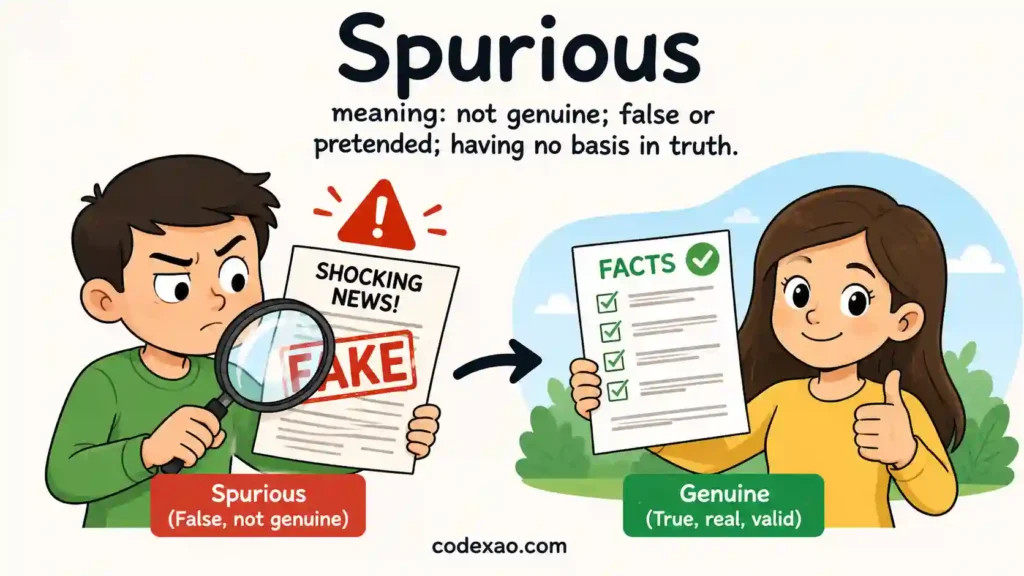
Ever heard someone say a claim was “spurious” and instantly nod along even though you were secretly confused? You are definitely not alone.
The phrase spurious meaning has become more common online because people constantly debate fake news, misleading statistics, sketchy social media posts, and questionable internet “facts.”
One minute you are scrolling through TikTok or Reddit, and the next you see someone calling an argument “spurious” in the comments.
So what does it actually mean?
In simple terms, spurious describes something that looks real, logical, or true but is actually false, fake, or misleading.
The word pops up in everything from casual conversations to science articles and academic debates.
This updated 2026 guide breaks down the meaning of spurious in plain English.
You will learn where the word came from, how to use it naturally in texts and conversations, common mistakes people make, and real examples that finally make the word stick in your memory.
What Does “Spurious” Mean?
Quick Answer
Spurious means false, fake, misleading, or not genuine even though it may appear real or believable at first.
The word is often used when talking about:
- Fake claims
- Weak arguments
- Misleading statistics
- False relationships
- Counterfeit items
- Unreliable information
Simple Definition
If something is spurious, it looks convincing on the surface but falls apart once you examine it closely.
Think of it like internet clickbait. A headline may sound dramatic and believable, but once you read the article, the “facts” are shaky or completely invented. That is a spurious claim.
Origin of the Word
The word “spurious” comes from the Latin word spurius, which originally referred to something illegitimate or false.
Over time, English speakers started using it to describe anything fake, deceptive, or lacking authenticity. Today, the word is especially common in:
- Journalism
- Science
- Politics
- Academic writing
- Online debates
Pronunciation Guide
Spurious is pronounced like this:
SPYUR-ee-uhs
A quick memory trick:
It sounds a little like “serious,” but with a suspicious twist.
How the Meaning Has Evolved
Years ago, “spurious” mostly appeared in formal writing or academic discussions. Now the internet has pushed it into everyday language.
People use it online when calling out:
- Fake screenshots
- Misleading statistics
- Bad arguments
- AI-generated misinformation
- Viral rumors
Basically, if something feels sketchy but tries hard to look legit, someone will probably call it spurious.
How to Use “Spurious” Correctly in Texts & Chat
The word “spurious” works best when describing something misleading or unreliable.
Common Contexts
You can use spurious when talking about:
- News articles
- Rumors
- Excuses
- Scientific claims
- Correlations
- Online drama
- Fraudulent products
Casual Usage Examples
- “That statistic sounds spurious.”
- “He made a spurious excuse for missing class.”
- “The website spreads spurious information.”
- “Those screenshots look fake and spurious.”
Tone and Vibe
The word usually sounds:
- Intelligent
- Critical
- Slightly formal
- Analytical
It is not exactly Gen Z slang, but it does show up in smart online conversations.
Platform-Specific Usage
SMS and WhatsApp
Used casually during debates or arguments.
Example:
“Bro that rumor is totally spurious.”
Instagram and TikTok
Often appears in comment sections when people question viral claims.
Example:
“Spurious science strikes again.”
Very common in debates, especially in tech, politics, and science communities.
Discord and Gaming Chats
Sometimes used jokingly to sound dramatic or intellectual.
Example:
“That was a spurious accusation against my gameplay.”
When NOT to Use It
Avoid using “spurious”:
- In super casual chats with people unfamiliar with the word
- In emotional conversations where clarity matters
- When “fake” or “false” works better
Sometimes simpler language wins.
Formatting Tips
- Usually lowercase
- No special punctuation needed
- Often paired with skeptical emojis like:
🤨 😭 💀 🚩
Example:
“That article is spurious 💀”
Real Conversation Examples Using “Spurious”
Between Friends
Alex: “Did you see that celebrity breakup rumor?”
Maya: “Yeah but the source looked spurious.”
This suggests Maya thinks the rumor is unreliable or fake.
In a Group Chat
Jake: “Apparently drinking pickle juice cures migraines.”
Nina: “That sounds scientifically spurious.”
Nina is questioning the validity of the claim.
In Dating Conversations
Chris: “He said his phone died for three days.”
Lena: “That excuse feels spurious.”
The word hints that the excuse seems dishonest.
At Work
Manager: “We need evidence before sharing these numbers.”
Employee: “Agreed. Some of the data looks spurious.”
This usage sounds professional and analytical.
Gaming Chat
Player 1: “You reported me for hacking?”
Player 2: “The accusation was completely spurious.”
Here, the speaker means the accusation was false.
Common Mistakes & Misunderstandings
Confusing Spurious With Suspicious
People often mix these up.
- Suspicious means questionable or doubtful.
- Spurious means actually false or fake.
Something suspicious might later prove real. Something spurious is already considered misleading.
Using It for Physical Objects Only
Spurious is not just about counterfeit items.
You can describe:
- Spurious arguments
- Spurious relationships
- Spurious logic
- Spurious statistics
Overusing It to Sound Smart
Some people throw the word into every debate online. That usually backfires.
If the audience will not understand the term, simpler words may communicate better.
Generational Misunderstandings
Older generations may know the word from formal education or journalism.
Gen Z users often encounter it online during:
- Fact-checking discussions
- Political debates
- Meme culture
- TikTok commentary
So the tone can feel either academic or sarcastically dramatic depending on context.
“Spurious” Across Different Platforms & Demographics
Gen Z Usage
Gen Z tends to use “spurious” ironically or humorously online.
Example:
“Spurious vibes detected.”
It is part intellectual joke, part genuine criticism.
Millennials
Millennials usually use the word more literally, especially in:
- Work discussions
- Online articles
- News analysis
Older Generations
Older speakers often associate the word with formal writing, education, or legal language.
TikTok and Instagram
The word appears frequently under:
- Fake life hacks
- Misleading fitness advice
- Viral conspiracy videos
Discord and Reddit
Reddit especially loves this word. Debate-heavy communities use it constantly when discussing:
- Data
- Science
- Politics
- AI
- Economics
Is It Formal or Informal
Spurious sits in an interesting middle ground.
It sounds educated enough for professional writing but still works casually online.
Safe for Work
Yes. The word is completely safe for work and professional environments.
Related Slang, Abbreviations & Alternatives
| Word | Meaning |
|---|---|
| Fake | Not real or genuine |
| Bogus | False or fraudulent |
| Misleading | Gives the wrong impression |
| Fabricated | Completely invented |
| Deceptive | Intended to trick people |
| Counterfeit | Fake version of something real |
| Dubious | Questionable or suspicious |
| Fraudulent | Involving deception |
| Sketchy | Informally suspicious |
| False narrative | An incorrect or manipulated story |
You could also explore related terms like:
- “fake news”
- “gaslighting”
- “copium”
- “delulu”
- “catfish”
These internet expressions often overlap with the idea of misleading or false information.
Synonyms
- Fake
- False
- Bogus
- Fraudulent
- Deceptive
- Untrue
Antonyms
- Genuine
- Real
- Authentic
- Legitimate
- Valid
FAQs:
What does spurious mean in simple English
Spurious means something is false, fake, or misleading even if it appears believable at first. The word is commonly used for fake claims, weak arguments, or unreliable information.
Is spurious a formal word
Yes, but not overly formal. You can use it in professional writing, academic discussions, or even online conversations when discussing misleading information.
What is a spurious correlation
A spurious correlation happens when two things seem connected but actually are not. The relationship is usually caused by coincidence or another hidden factor.
Can spurious describe a person
Not directly. People usually describe a person’s claims, arguments, excuses, or behavior as spurious rather than the person themselves.
What is the difference between fake and spurious
“Fake” is broader and more casual. “Spurious” specifically suggests something appears valid or convincing but is actually false or misleading.
Conclusion:
The next time you hear someone mention spurious meaning, you will know exactly what they are talking about.
At its core, the word describes something misleading, false, or fake despite looking believable at first glance. That is probably why it shows up everywhere online now.
The internet practically runs on people arguing over what is real and what is not.
It is a smart, versatile word that works in casual chats, professional discussions, academic writing, and social media debates.
Once you start noticing it, you will see it everywhere.
Got a favorite internet word or slang term you want decoded next? Drop it in the comments and keep exploring modern digital language.

Hi, I’m John Mark, the voice behind codexao.com, where meanings aren’t just explained, they’re simplified for the way people actually talk today.
I’ve always been curious about words, how they change, how they trend, and how a simple phrase can carry completely different meanings depending on context. That curiosity turned into codexao, a space where I break down slang, text abbreviations, and everyday words into clear, easy-to-understand explanations.